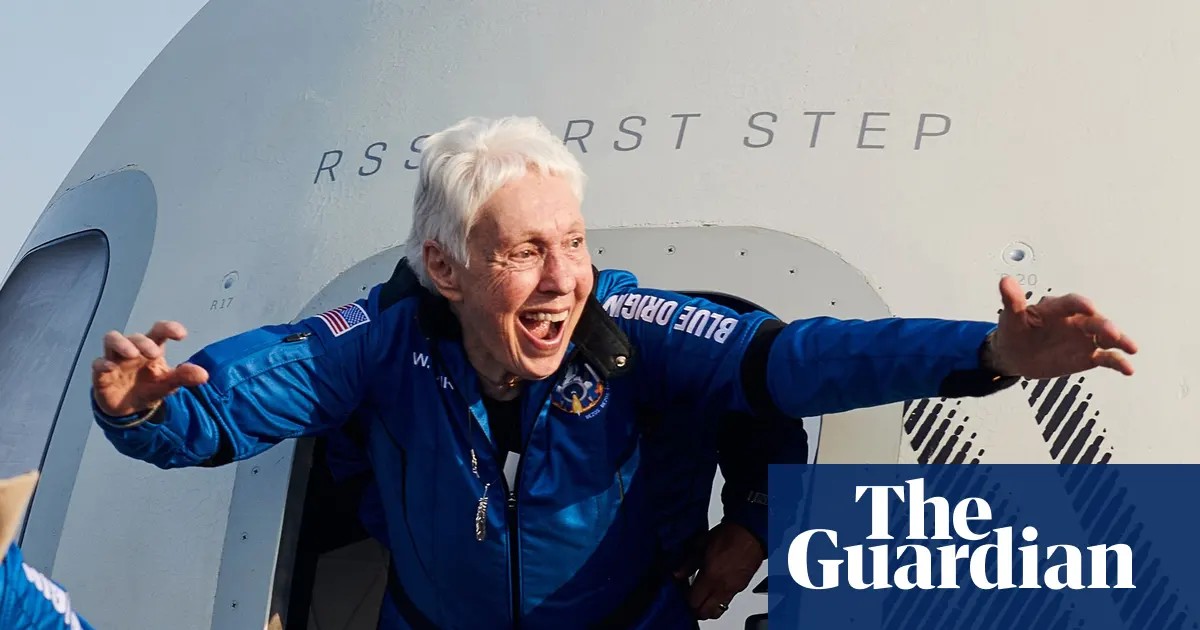
Aviation was the air she breathed. She didn’t just like planes, she lived them. As Wally Funk put it, eating and sleeping and dreaming flight for eight decades until her death at 87.
“Aviation has been my whole life”
She was fast. She was sharp. She was first in almost everything that mattered to a pilot of her generation.
By twenty she was the military’s first female flight instructor. In 1971 the FAA made her its first female flight inspector. Three years later she was instructing at the NTSB. Impressive? Yes. Satisfying? No.
The shadow hanging over every badge and license was the same empty seat. The one in the rocket. She wanted to go to space. Nasa didn’t want women up there.
So she went to Russia instead. Well. She waited there. In 1960, learning that Jerrie Cobb had been screened for spaceflight, Funk joined the group known as Mercury 13. They put women through the same gauntlet as the men. Isolation tanks for over ten hours. Rubber tubes down their throats.
Funk tested higher than the group average. Higher than the selected Mercury astronauts too. She asked four times to fly. The answer was always no. Nasa only hired USAF pilots. USAF didn’t have female pilots. End of story.
Did they care that the Soviets sent Valentina Tereshkova into orbit in 1963? Nope. Tereshkova flew alone. Circled Earth 48 times. Three days in the capsule. The American response? Silence. John Glenn, future senator, told Congress the exclusion of women was just “a fact of our social order.” Convenient. Lazy.
Funk kept flying. She trained at the Yuri Gagarin Center near Moscow. In 2000 she rode in the zero-g parabolic flights of an Ilyushin 76, weightless for seconds at a time, mocking gravity while on the ground.
Nasa finally cracked on women. But not for Wally. Sally Ride went in 1983. Eileen Collins commanded Columbia in 1999. Too late.
Then Jeff Bezos called.
It was 2021. She was eighty-two. Blue Origin invited her on their New Shepard. Sub-orbital. Quick. Expensive. Historic. They flew a pair of goggles belonging to Amelia Earhart along for the ride.
For a minute she held the record. Oldest person in space. Then William Shatner broke it. Then Ed Dwight broke Shatner’s. It doesn’t matter. She remains the oldest woman to make the jump.
“I’ve been waiting a long time,” she said. And then, naturally: When do I go back?
She was born Mary Wallace Funk in New Mexico. Las Vegas specifically, which is nowhere near the Vegas we know. She grew up in Taos. Parents ran a five-and-dime shop for tourists. She jumped off barns with Superman capes as a kid. Played among Pueblo neighbors. Loved the outdoors before she loved the cockpit, but never stopped loving the view.
School hated her ambition. Or she hated school’s limits.
Dropped out at sixteen. Why? Because they wouldn’t let her take mechanical drawing instead of home ec.
She enrolled in Stephens College, a women’s college that actually taught aviation. Then Oklahoma State, competing in collegiate sky races as a Flying Aggie. Earned a bachelor’s. Became an instructor at Fort Sill. Airlines refused to hire female commercial pilots, so she taught and charted from a tiny airport in California.
Back home she built a flight school. Trained over eight hundred pilots. Flew for Sierra Pacific. Navigated and piloted in competitions like the Powder Puff Derby across the country.
She became a speaker. Not the polite kind. The kind that annoyed people who liked things the way they were.
“Nothing has ever gotten in my way”
They told her she was a girl. She said so what? You want to do it? Do it.
Hall of Fames piled up. Women in Aviation in 1995. Wall of Honor at the Space Museum in 2017 Astronaut wings in 2021 after the flight. A book for kids based on her memoir coming out in 2025, after she is gone.
Blue Origin said they were humbled. They probably should be. She broke the ceiling by hitting it until it shattered, waited forty years, and kept her seat warm for someone who never got up.