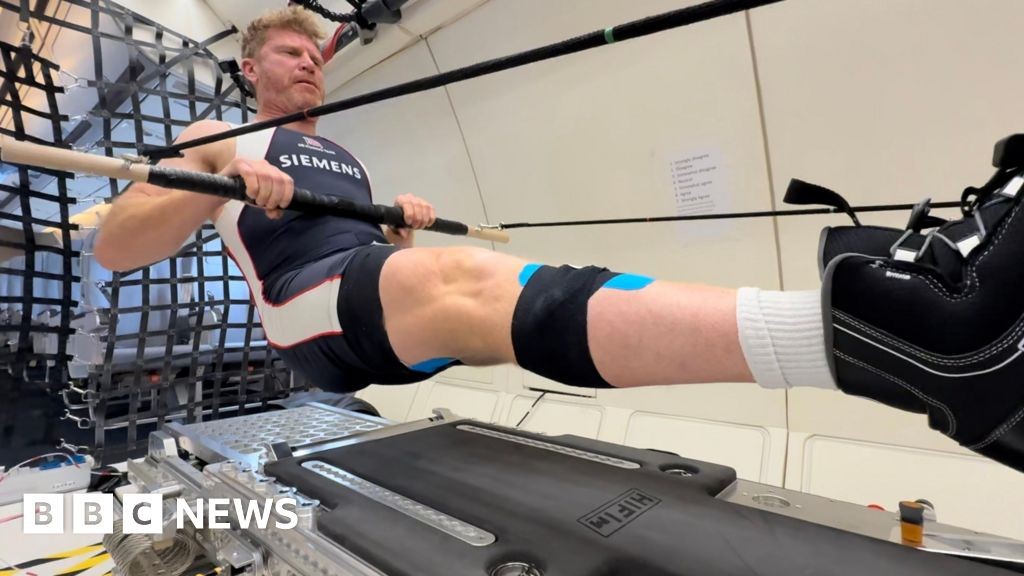
Gravity is heavy. Up here at 8,500 meters, Matthew Wells feels the opposite. The Olympic medalist pulls with everything he has, his body floating free for a precise 22 seconds. No boat. No water. Just the parabolic arc of a plane maneuvering into artificial weightlessness.
This isn’t about gold medals.
It’s about survival. Specifically, how to keep astronauts from crumbling during future missions. Wells is trialing a British invention, part of a global scramble to build fitness gear for moon bases and space stations that hasn’t even been fully decided upon yet.
The Problem with Zero G
Humans are built for gravity. When that force disappears, bones and muscles forget why they exist. Dr Dan Cleather from St Mary’s University calls it “unloaded” decay.
“In space we don’t experience any forces. Our muscles, our bones immediately start to diminished because we’re not being loaded.”
Current solutions are… bulky. On the ISS, astronauts burn roughly two hours a day on the treadmill and cycle. Two hours. That is two hours not spent on science. Not spent fixing leaks. Not sleeping.
Meganne Christian, an ESA reserve astronaut and senior exploration manager, puts it plainly: reduce the sweat time, free up the research time. If you cut that workout block in half, you buy more discovery.
The team behind HIFIm (High-FrequencyImpulse for Microgravity) promises exactly that. They claim 30 minutes a day is enough. Half the current cost.
Not Just One Machine
HIFIm is flashy. It’s clever. It isolates vibration so it doesn’t rattle delicate experiments. It runs without electricity. John Kennett, a former plane engineer who owns a pilates studio, invented it. His inspiration? A client recovering from cancer with low bone density. Not an astronaut, initially. Just a human breaking down.
“Off the chart,” Kennett says. “The most outrageous so far.”
But HIFIm isn’t alone. The race is international.
The Danish Aerospace Company is developing E4D, a beast commissioned by the European Space Agency. It features resistive training, cycling, rowning, rope pulling, and motion capture to track every grimace of exertion. Meanwhile, NASA’s Artemis II moon-flyby already tested a specialized flywheel device. Even the toilet broke. Humans are messy in space, regardless of how much you stretch.
Why Bother?
The Gateway lunar station, the original target for these gadgets, has effectively been sidelined. But that doesn’t matter. Artemis is coming. The plan is to return to the moon and stay.
“We are at a really exciting moment,” Christian notes.
New stations are planned. Lunar surface missions are drafted. All of them require fit humans. If astronauts lose coordination, they can’t perform functional tasks. They become liabilities.
Wells finds it “out of this world” that his Olympic training might end up on Mars, or at least the Moon.
“Isn’t it every kid’s dream?” he asks.
For the scientists, the engineering, the athletes—yes. The challenge remains, though. Current equipment is heavy. It limits exercise variety. It eats daylight. The solution has to be robust. Small. Quiet. Effective.
Kennett’s device fits that brief. So does the Danish model. So maybe the future gym looks nothing like today’s. It just needs to work before we get there.