Most spiders spray a net. Wait. Watch the chaos.
The Propostira spider does not do that.
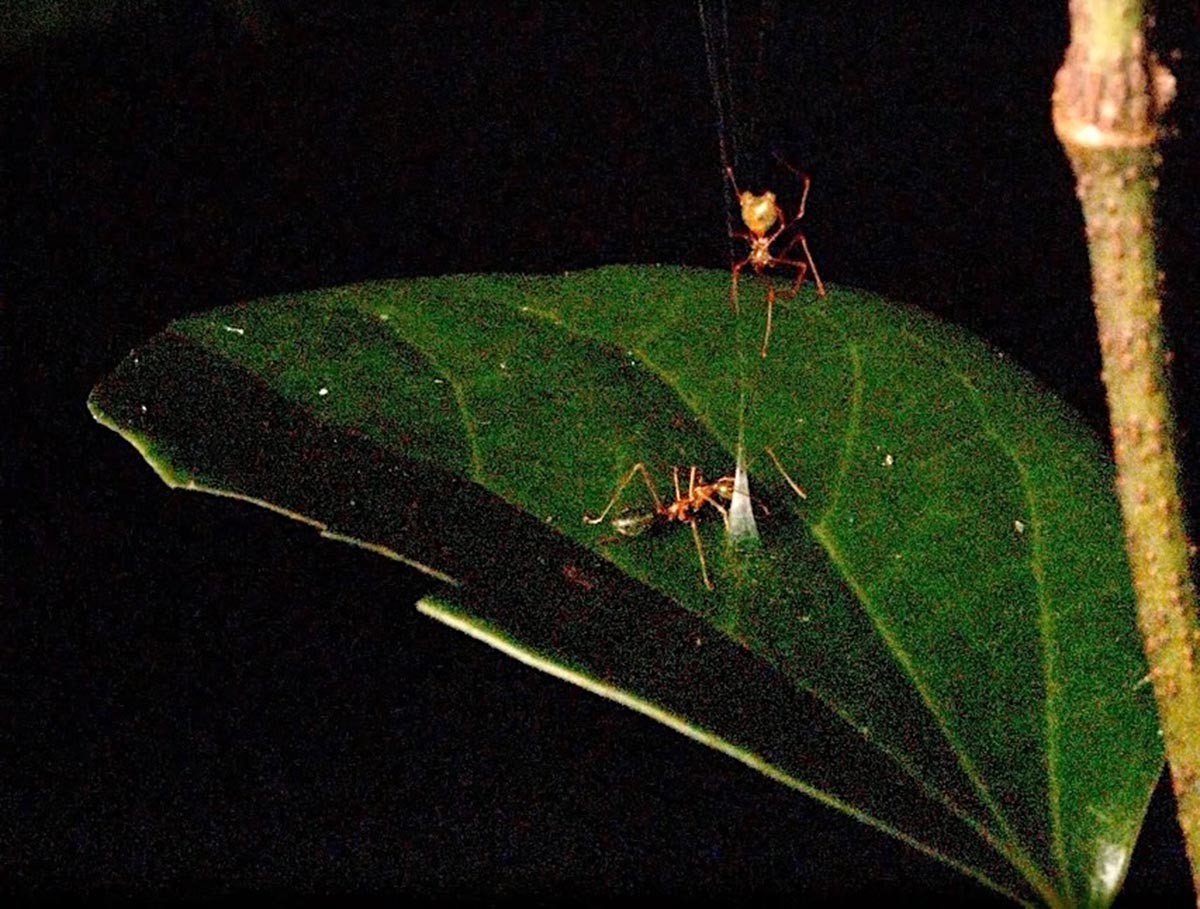
It builds a catapult.
Literally.
Hidden in the Queensland rainforest near Cooktown lies a nocturnal hunter with a single target: the aggressive green tree ant (Oecophylla smaragdina ).
No variety. No buffet. Just this one enemy.
Scientists call it “the ultimate specialization.”
Baited by instinct
Here is the setup.
It is day. The spider hides under a leaf. Above ant trails.
Night falls.
The spider drops 50 centimeters or more to the forest floor. It anchors itself.
Then the construction begins.
For four hours? Maybe longer. It builds a vertical bundle. 15 to 60 tension lines. Shaped like a cone.
Finally it wraps the thing in thinner silk.
The spider climbs back up.
Out of sight. Out of mind.
Or so the ant thinks.
A worker ant comes foraging. It bites the silk cone.
It triggers the anchor to come loose.
Snap.
Physics meets predation
That bite releases stored tension.
The ant isn’t caught in a net. It is launched.
Flung upward over 30 centimeters.
Into the spider’s waiting web.
The acceleration hits above 1,300 meters per second.
Think about that force.
Green tree ants aren’t weak. They have adhesive pads. They stick.
They also bite. They sting. They call for backup.
Professor Ajay Narendra of Macquaria University spent 10 nights watching this happen with high-speed cameras.
Why risk it?
Because ant hunting is dangerous business.
“Ants use alarm signals to rapidly recruit hundreds… to overcome potential predators.” — Prof. Narendra
If a spider eats one ant the others attack in a wave. Chemical warfare. Overwhelming numbers.
The ballista spider solves this by taking prey out of the equation. One at a time. At high velocity. Away from the nest.
Does the spider use bait?
Researchers suspect pheromones on the final silk layer lure the workers. The ant attacks. The trap fires. The prey becomes a projectile.
Elastic engineering
Dr. Jonas Wolff went to see the wild specimens. He took silk back to Germany. Scanning electron microscopes revealed the structure.
The core mechanic is stored elastic energy.
Like a stretched rubber band.
But denser. Faster.
The power density of this snap exceeds any other biological catapult.
The tension lines have to overcome the ant’s body weight plus the sticky grip of its feet.
It takes extreme force.
Not a formal name yet
The spider has a nickname now: the ballista spider. After the Roman stone launcher.
It has no official Latin name.
Prof. Greg Anderson found it. Narendra and Joshi documented the mechanics.
The paper dropped in Current Biology.
The conclusion is simple. The evolution of extreme force solves a simple problem: how to kill things that want to kill you in droves.
So the ant gets launched into the air. Trapped in silk far from its nest.
The spider approaches slowly.
It doesn’t rush.
It knows it has already won the distance.