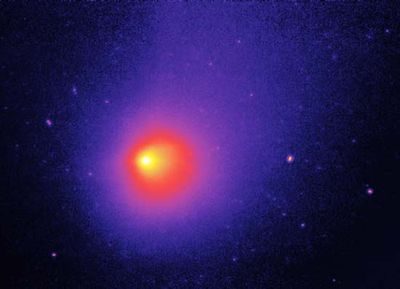
Comet Schwassmann-Wachmann 1 is not a typical ice wanderer. Discovered by German astronomers Friedrich Karl Arnold Schwassmann and Arno Arthur Wachmann on November 15, 1927, this object has been quietly orbiting the Sun for nearly a century. It does not fall from the depths of the solar system like Halley’s Comet. Instead, it stays put. Always.
It remains trapped in a narrow belt between the orbits of Jupiter and Saturn. Its orbit is remarkably circular, with an eccentricity of only 0.044. This is one of the most circular comets known. It orbits the sun every 14.7 years. A predictable body is expected to behave predictably. Not this one.
The core of Schwassmann-Wachmann 1 is estimated to be about 30 kilometers (20 mi) wide. So on paper it’s a big chunk of rock and ice. But its behavior is anything but remarkable in the traditional sense. The comet is known for its sudden, violent eruptions. Its brightness can increase by several orders of magnitude in a few hours. No warning. No incremental build. Just a flash.
The Mystery of Random Outbursts
Why does it flare up? Standard comet theory assumes that as a comet approaches the Sun, its brightness increases. The sun’s heat heats the core and causes the ice to sublimate into gas and dust, creating a coma – a faint, glowing atmosphere. More heat means more gas. More gas means more brightness. Simple physics.
But Schwassmann-Wachmann 1 ignores the rules. Its bursts occur at random points in its orbit. It can flare up if it is far from the sun, where the sun’s heat is weak. It can get darker when it is closest to the sun. Solar heat is not a trigger. So what is it?
Scientists have two leading theories for these erratic bursts.
The first involves a subtle change in the ice itself. Water ice in the core of a comet can be amorphous – disordered, glass-like. Under certain conditions, this amorphous ice turns into crystalline ice. This process is exothermic. It gives off heat. This internal heat could expel gas from the nucleus, creating a coma and increasing the comet’s brightness. No solar energy required.
The second theory points to more volatile ices. Water ice freezes at 0°C. Carbon dioxide and carbon monoxide freeze at much lower temperatures. If there are pockets of this super-volatile ices in the core, it can sublimate regardless of solar heat. A crack in the surface. A release of pressure. A sudden burst of gas.
Why this is important
Understanding why comet Schwassmann-Wachmann 1 behaves this way will help us understand the early solar system. Comets are time capsules. They retain material from the cloud from which the planets formed. If we can find out how their ice behaves at low temperature, we can get clues about the temperature and chemistry of this primordial cloud.
It will also change the way we look for comets. We cannot rely on proximity to the sun to predict activity. We must constantly watch for them, even when they are far away, even when they appear