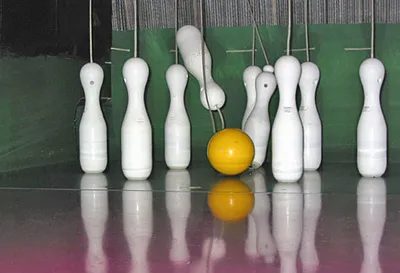
Skittles isn’t the candy you buy at the checkout aisle. It’s an old-school bowling game with roots running deep into British history. People played it for centuries. You’d find it in public houses and clubs. The action concentrated in western England, the Midlands, southern Wales, and southeastern Scotland.
Rules changed by town. Scoring methods shifted too. But the core mechanic stayed the same. Players threw a heavy ball at nine oval-headed pins. The pins stood in a diamond formation. That setup sat about 21 feet away from the bowler. The ball itself? Usually wood or rubber. It weighed around 10 pounds (4.5 kilograms).
Winning meant knocking down all the pins. You needed to do it in the fewest throws. Those successful hits were called “chalks.” Simple enough.
Control of this older form of the game was assumed by the Amateur Skittle Association, which specified the dimensions of the alley and the distance between each of the nine pins in the diamond frame.
There was a catch in London. The game evolved there. Bowlers didn’t use the round ball. They used something called a “cheese.” It was flat, round, and loaf-shaped. Made of lignum vitae wood. Heavy stuff. Weighed between 12 and 14 pounds (5.4 to 6.4 kg).
Why the difference? Tradition likely. The London version felt older, more grounded in specific local habits. The Amateur Skittle Association eventually stepped in to regulate the sport. They fixed the alley dimensions. They locked in the pin spacing. Standardization arrived, but the regional flavor remained.
The game didn’t just vanish. It lingered in the background of pub culture. Still played today, though fewer know the rules. The challenge is real. A 10-pound ball is heavy. Accuracy matters more than brute strength. Hitting the right pin at 21 feet requires precision.
Is it dying out? Hardly. In places where it sticks, it’s a community event. Not just a quick game. A ritual. The smell of stale beer mixes with the thud of wood on wood. The “cheese” from London adds a layer of difficulty. Or just variety.
You won’t find it in every pub. But look for the signs. Look for the lanes. The game persists. It waits for someone to pick up the ball. To aim at the diamond. To try for all nine. The chalk mark is waiting.