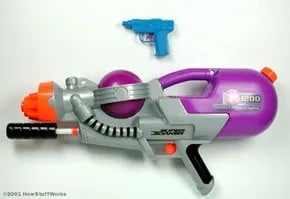
There is a specific kind of joy found in soaking a sibling. It’s primal. It’s cooling. It is the definitive summer experience. Since their debut, water guns have cemented their spot as icons of childhood. They aren’t just plastic toys; they are engineering puzzles disguised as playthings. And if you think your arsenal is impressive, you’re likely unaware of the mechanical journey that got you from a simple squirt pistol to a motorized battlefield.
Thirty years ago, your options were bleak. You held a small pistol with a pathetic range and a reservoir that emptied after two seconds. Today? You can walk into any big-box store and find water bazookas, grenade launchers, and machine guns that fire like actual firearms. But before we get to the high-tech pumps and pressurized tanks, we need to understand the basic mechanics of the classic water gun. It’s simpler than you think, yet brilliant in its design.
How a Classic Squirt Pistol Works
Before the 1980s, water guns were rudimentary. They shot a weak, narrow stream. You had to sprint back to a spigot after every few shots. But they worked on basic plumbing principles that still apply today.
A classic squirt gun relies on just a few key components:
- A trigger lever that activates the pump.
- A plastic tube drawing water from the reservoir (which is usually the hollow body of the gun itself).
- A narrow barrel that channels the water.
- A nozzle at the muzzle to focus the stream.
The magic happens inside. The real work is done by a simple pump containing a piston inside a cylinder, held by a small spring.
When you pull the trigger, you push the piston into the cylinder. This compresses the spring. Release the trigger, and the spring kicks the piston back out. That’s the entire cycle.
- The downstroke (pushing in) shrinks the cylinder volume, forcing water or air out.
- The upstroke (pulling out) expands the volume, sucking water in.
But here’s the catch: water needs to move in one direction only. It can’t suck back into the reservoir. That’s where the one-way valve comes in. In a basic pistol, this is just a tiny rubber ball sitting in a seal. You actually have two of them—one between the reservoir and pump, another between the pump and nozzle. They ensure water flows forward, never back.
It’s elegant. It’s simple. It’s also flawed.
The Limits of Simple Mechanics
This design has two major limitations that every kid has felt:
- Range: The amount of water per blast is limited by the cylinder size. To shoot further, you need a bigger cylinder. But that means a longer trigger pull. If the trigger mechanism is too long, it’s awkward to hold. You’re stuck with a short range because of the physical constraints of the pump.
- Duration: Each trigger pull is a single burst. To keep shooting, you have to squeeze and release repeatedly. It’s exhausting.
Designers have been wrestling with these problems for decades. They wanted longer range. Higher pressure. Sustained fire. The next evolution in water gun technology isn’t just about making the plastic look cooler. It’s about solving the physics of the pump. We’ll look at the designs that increased pressure and range before we hit the game-changer that changed everything.
The Bazooka Trade-Off
Classic water bazookas are essentially giant syringes. You hold the cylinder in one hand and the piston in the other. Pull them apart to load. Push them together to shoot. This manual leverage allows for serious force. You can shoot far if you slam the piston. You can spray longer if you push slow. Some models even lack a tank, requiring you to suck water directly through the barrel before firing.
It works. It’s powerful. It’s also exhausting.
Enter the Motorized Pump
The 1980s changed the game by automating the heavy lifting. Instead of human muscle, a small battery-powered motor does the pumping. The trigger becomes nothing more than a switch. Flip it, and electricity flows to the gears.
Here is the mechanical chain reaction:
- The motor turns a series of gears.
- Those gears rotate a cam.
- The cam’s extended lever catches the piston.
- It pulls the piston back, then releases it.
- A spring snaps the piston forward.
This cycle repeats automatically. The motor moves the piston in and out of the cylinder. Water is drawn in on the upstroke. It is blasted down the barrel on the downstroke.
The trigger isn’t a pump anymore. It’s a continuous fire switch. Hold it down, and the gun acts like a machine gun. The stream doesn’t stop. You don’t have to move your hand. This design allowed for a larger cylinder without making the trigger harder to squeeze. The range improved slightly. The convenience was the real win.
Limitations of Early Automation
These guns were a massive step up from standard squirt pistols. But they weren’t perfect.
The bazooka still demanded physical strength. If you wanted distance, you needed biceps. The motorized version was easier to use, but the water stream remained relatively weak. It sprayed. It didn’t hit with the force needed to dominate a backyard skirmish.
The industry needed a design that could bridge the gap between manual effort and motorized convenience. A design that could push water 50 feet (15 m) or more. That revolution is coming next.
The Super Soaker
The Nuclear Scientist Who Invented the Super Soaker
Standard water guns are weak. That’s the honest truth. They rely on the shooter to manually generate pressure for every single squirt. It’s physically impossible for a human to apply enough force quickly to create a high-velocity stream. You just can’t muscle your way to a sniper-level water blast with a plastic pump handle.
Then came 1982.
Lonnie Johnson, a nuclear scientist by day, was tinkering with a heat-pump system in his spare time. The goal was simple: use moving water to regulate temperature. He hooked a prototype of the pumping mechanism to his bathroom sink. Late one night, he pulled the lever.
The result wasn’t a trickle. It was a powerful jet of water that shot across the room.
Johnson realized he had stumbled onto something else entirely. Instead of using mechanical force for each shot, why not use compressed air to power a water blast? The idea was simple. The execution was legendary.
He didn’t go it alone. Johnson brought in Bruce D’Andrade, an accomplished inventor. Between them, they sketched the blueprint for what would become the Super Soaker.
How Super Soaker Technology Actually Works
The design was a radical departure from traditional squirt guns. In the earliest models, the pump didn’t push water out. It pushed air into a single reservoir. As you pumped, the air compressed, building up pressure against the water inside. More pumps meant more pressure. More pressure meant a farther, harder hit.
Later iterations switched tactics, pumping water instead of air to build that necessary force.
The mechanics are precise. Take the two-reservoir model as a prime example.
The gun features two distinct tanks labeled A and B, linked by a network of tubes. You start by filling the larger reservoir (A) with water. This is your fuel.
To prime the blast, you work the pump handle (C). This handle drives a long, narrow piston (D) back and forth inside a cylinder (E). It’s a one-way valve system, similar to what you might find in a basic squirt-gun pistol, but optimized for high-volume transfer.
Valve F sits between the main water reservoir and the pump mechanism. Valve G is positioned between the pump and the smaller secondary reservoir, which feeds directly into the barrel (H).
When you pull the handle, the piston creates a vacuum that draws water from reservoir A. When you push, the pressure forces that water through valve G and into the smaller tank B. You aren’t firing yet. You are charging the battery so to speak. Once the pressure is built, you pull the trigger. The compressed air in tank B forces the water out at high speed.
It’s not magic. It’s physics. And it changed summer play forever.
Why did it take until 1982 for someone to think of it? Probably because most engineers were focused on making pumps that moved water directly. Johnson looked at the problem differently. He didn’t want to move water with every shot. He wanted to store energy and release it all at once.
The result was a toy that felt like a weapon. It wasn’t just a toy anymore. It was a pressure vessel.
And once the world saw what compressed air could do with a little bit of water, there was no going back. The plastic gun industry had to adapt or die.
The design evolved. The reservoirs got bigger. The barrels got longer. The pressure ratings climbed. But the core principle remained the same. Build the pressure. Wait for the moment. Then let it fly.
It’s funny how a night job in a bathroom sink can rewrite the rules of summer. Johnson didn’t set out to invent a pop-culture icon. He just wanted to test a heat pump. But sometimes, the best inventions are just accidents waiting for a person who knows how
Think of that pumping action as a mechanical heartbeat. You pull the handle up. The piston retreats, creating a vacuum. It sucks water from the big tank (A). But it doesn’t just grab everything.
Valve G stays shut. It blocks the path from the smaller chamber (B). So the water has nowhere to go but into the cylinder with the piston. You’re filling the chamber.
Push the handle down. The piston plunges. Pressure spikes. Now valve F slams shut. It prevents that pressurized water from backflowing into the main tank. Instead, it forces open valve G. Water rushes into the small reservoir.
You’re not just moving water. You’re compressing it. Stacking it up in a tighter space.
Why does this matter? Because potential energy is building. Each stroke adds more water to that small chamber. More pressure. More power. The system is essentially charging a battery, but the battery is liquid.
This mechanism is the heart of the Super Soaker’s reputation. It’s not magic. It’s physics. Specifically, how you trap and compress a fluid to create a sudden, violent release.
The Mechanics of High Pressure
The two one-way valves are the unsung heroes here. Without valve F, pushing down would just push water back into the main tank. Useless. No pressure build-up. Without valve G, the water would bypass the small reservoir entirely. Again, useless.
You need both. One to fill. One to trap.
This is how a child’s toy became a legend. By mastering the basics of fluid dynamics. The next step? Letting that stored energy out all at once. A high-velocity stream. That’s where the fun begins.
But how exactly does that stored pressure translate into range? And why do some models shoot farther than others? We’ll need to look at the nozzle next.
How Super Soaker Pressure Works
The secret isn’t just water. It’s about squeezing air. When you pump that handle, you are forcing water from the big tank into a smaller, tighter chamber. Water doesn’t squish. Air does. So as more water pushes in, it crowds the air trapped inside, compressing it into a smaller space. You create a high-pressure zone. The water wants out. It presses against the walls, desperate for balance with the lower pressure outside.
The trigger holds it all back.
It’s a simple lever. A stiff metal arm pinches a flexible plastic tube leading to the barrel. Closed tight. No escape. Pull the trigger. The metal bends. The pinches releases. The tube opens.
Suddenly, that compressed air shoves the water out. Hard. High pressure means high velocity. It’s physics in your hand.
But there’s a limit. Pump too much, and the gun might burst. The plumbing can’t take the strain. That’s why the trigger isn’t just an on switch. It’s a pressure valve. The metal arm acts like a spring. If you pump hard enough, the water pressure overcomes the metal’s resistance. It pushes the trigger open slightly. Water leaks out.
This is the leak level. It depends on the metal. Stiff metal? You need more pressure to trip the release. Flexible metal? It gives way sooner. You get a leak at lower pressure. You can’t build infinite force if the gun just lets it all out.
The Constant Pressure System
By the late 1990s, manufacturers wanted more power. Bruce D’Andrade introduced the Constant Pressure System, or CPS. It changed everything.
Instead of compressing air in a rigid tank, CPS uses a water bladder. Think of a stiff balloon. You pump water in. The bladder expands. It doesn’t just sit there. The material wants to snap back to its original shape. It pushes inward on the water. Constantly.
This is different from air. Air pressure drops as it expands. The bladder? It stays firm. It maintains that inward squeeze. When you pull the trigger, you don’t just get the initial burst of air. You get the full force of the stretched rubber pushing everything out.
The blasts are stronger. More consistent. The bladder keeps the pressure up longer than a shrinking air pocket ever could.
It’s a clever tweak. Simple mechanics. But the result is a wetter, more powerful toy. The air is still there, sure. But the bladder does the heavy lifting. You pump. It expands. It waits. Then it releases.
Does it last forever? The bladders dry out. They crack. But while they hold, the physics works perfectly. You add water. You gain pressure. You pull the trigger.
Water flies.
The market has exploded. What started with Lonnie Johnson and Bruce D’Andrade’s original pump-powered Super Soaker and the later innovation of the internal water bladder is now a sprawling arsenal. You aren’t just buying a squirt gun anymore. You’re looking at tactical gear.
Some models hook up to massive reservoirs worn like backpacks. Others are configured to fire forward, backward, and sideways simultaneously. This shift in mechanics has changed everything.
In the past, buying a water gun was predictable. You went to the toy store. You bought a basic pump-action toy. You knew exactly what you were getting. Now? The shelves are stocked with a bewildering variety of new designs every summer. Unless you’ve been browsing the aisles recently, you have no idea what your neighbors are packing for the next water fight.
The diversity of these toys is staggering. We aren’t talking about just two types of pump-based water guns. We are talking about an entire line of water weapons. The evolution from simple plastic tubes to complex, multi-directional sprayers has drastically altered the landscape.
If you want to dive deeper into the mechanics of these devices, there are plenty of resources. You can check out the Digital Watergun Museum to see the history. Or look into The Ultimate Water Gun for competitive insights. For broader context on fluid dynamics, articles on how spray bottles pump fluid and how hydraulic ram pumps work offer a technical breakdown.
And if you’re looking for actual gameplay, Water Games provides rules and strategies. The Super Soaker official site also offers a deep dive into their latest innovations.
It’s a weird world out there. One day you’re playing with a simple sponge gun. The next, you’re dodging a 360-degree blast from a kid with a backpack tank.
Have you seen the new multi-directional models yet? They’re getting aggressive. The line between toy and tactical equipment is blurring fast. And honestly? It’s kind of awesome.