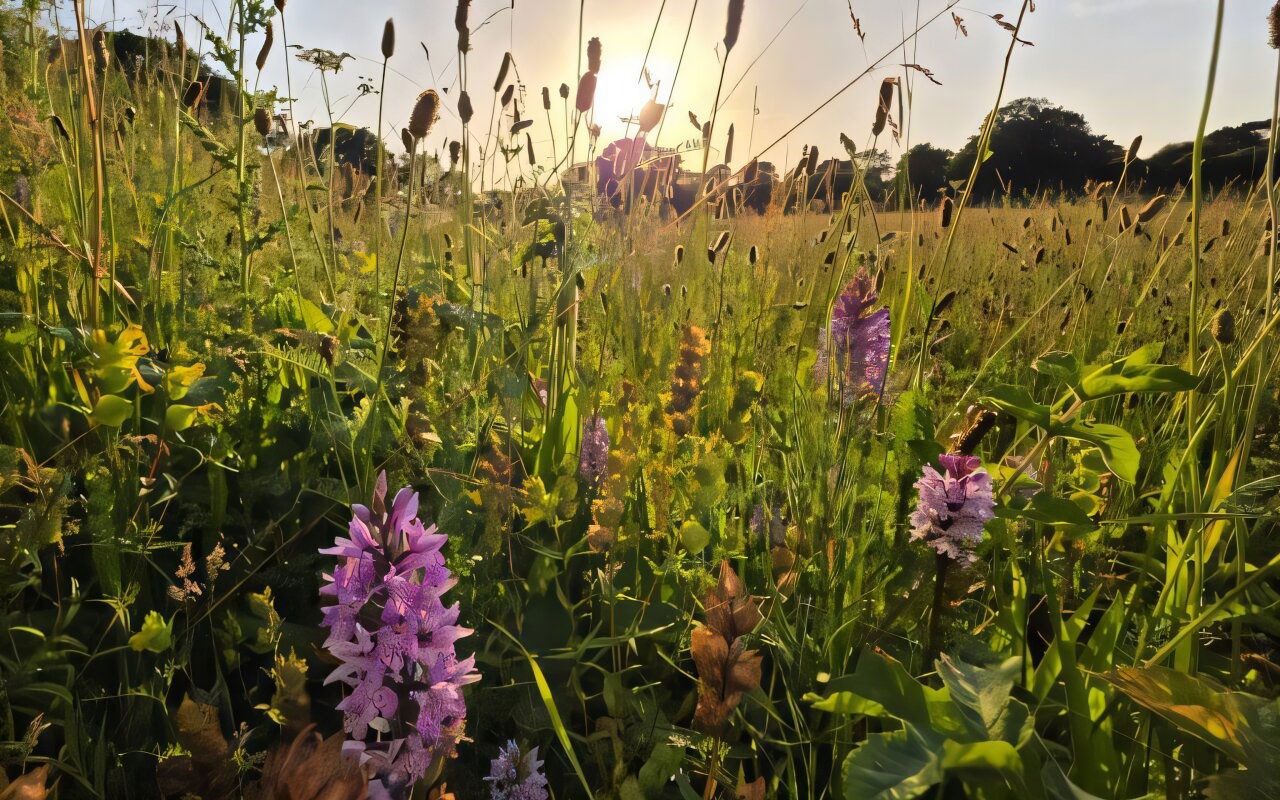
Natural recovery works. That’s the headline from a decade-long experiment in Norfolk that challenges everything we think we know about restoring degraded farmland.
The premise is simple, yet radical: leave a former crop field alone. No commercial seed mixes. No expensive soil removal. No deep plowing. Just let the land do what it wants.
For ten years, researchers watched a two-hectare plot in Bodham, North Norfolk, transform from barren oilseed rape stubble into a vibrant wildflower meadow. The only human intervention? Cutting the grass once a year for hay and removing the clippings.
The result? A species-rich ecosystem that rivals, and in some metrics exceeds, those created through intensive, funded restoration projects.
Why traditional seeding might be holding us back
The UK has lost more than 90% of its wildflower meadows since World War II. In response, government-funded conservation programs often reach for the fastest fix: sowing commercially produced seed mixes. It’s standard practice. It’s also expensive.
But this approach assumes that seeds can just appear. It ignores the genetic richness of the local landscape.
“Our study shows that resisting seeding… may be worth trying a lot more… Natural plant recovery better safeguards genetic diversity.”
Professor Carl Sayer, lead author and UCL Geography professor, puts it bluntly: we need patience over seed packets.
When you sow commercial seeds, you often get generic, widely available varieties. You miss the specific, locally adapted genetics that have persisted in the surrounding countryside. By letting nature lead, the meadow attracts and establishes species that were actually present in the local gene pool. The result is a habitat that is less generic and more resilient.
The Bodham experiment: 2011 to 2022
The study focused on land that had been abandoned for agricultural use in 2005, following an oilseed rape crop. The field, owned by Sayer’s father, Derek, presented a drainage challenge that made farming unviable. Instead of forcing productivity, the family opted for abandonment.
Monitoring began in 2011.
Researchers, including Sayer and local ecologist Pete Robinson, walked the meadow systematically every two to three years. They didn’t just glance around; they recorded every species encountered. To get hard data, they established two transects with 24 plots, each exactly one square meter in size. These fixed plots allowed them to track changes over time rather than relying on fuzzy impressions of “how green it looked.”
They also used GPS to map every single orchid and yellow rattle plant found. These are indicator species. Their presence signals improving soil and ecological conditions.
How fast does nature recover?
The data didn’t lie.
In 2011, a typical one-square-meter plot contained about 10 plant species. By 2022, that number had nearly doubled to almost 20.
But it wasn’t just about numbers. It was about rarity. Within a decade, the meadow hosted locally rare plants such as the southern marsh orchid, greater tussocksedge, and common centaury. These are species that had largely vanished from the surrounding agricultural landscape.
The growth was so rapid and prolific that researchers eventually stopped mapping individual orchids because there were simply too many to count.
How did they get there? The nearest known populations of some of these rare plants were miles away. Seeds don’t travel easily. The team suspects deer acted as unwitting couriers, carrying seeds in their fur or on their hooves. The meadow didn’t just recover; it imported diversity from the broader landscape.
Is natural regeneration worth the wait?
Intensive restoration requires capital. It requires labor. It requires a supply chain for seeds and equipment. Natural recovery requires only the discipline to cut and remove hay once a year.
For large-scale restoration goals, this distinction is critical.
“The UK needs nature recovery fast, at big styles.”
If the goal is to restore thousands of hectares of abandoned agricultural land across the UK and Europe, we cannot afford the time and money to seed every inch of it. Natural regeneration offers a scalable solution. It turns waste land into a carbon sink, a pollution buffer, and a sanctuary for pollinators without breaking the bank.
Does it work everywhere? Probably not. The Bodham field had a seed bank waiting in the soil, dormant but present. It had nearby sources for new arrivals. But for suitable sites, the barrier to entry is low.
The human element
Derek Sayer, who owns the land, resisted all advice to seed the field. He trusted the land’s ability to heal itself.
“A visit to the meadow is like stepping back in time.”
Now, thousands of local residents come to see the orchids in spring. It’s a community asset born from non-interference.
The study, published in Restoration Ecology, offers a counter-narrative to the industrialization of conservation. It suggests that sometimes, the best way to fix nature is to get out of the way.
We are obsessed with control. With accelerating timelines. With immediate results. But nature operates on its own schedule. If we want resilient, diverse, and authentic ecosystems, maybe we need to learn how to wait.