They’re close. Too close.
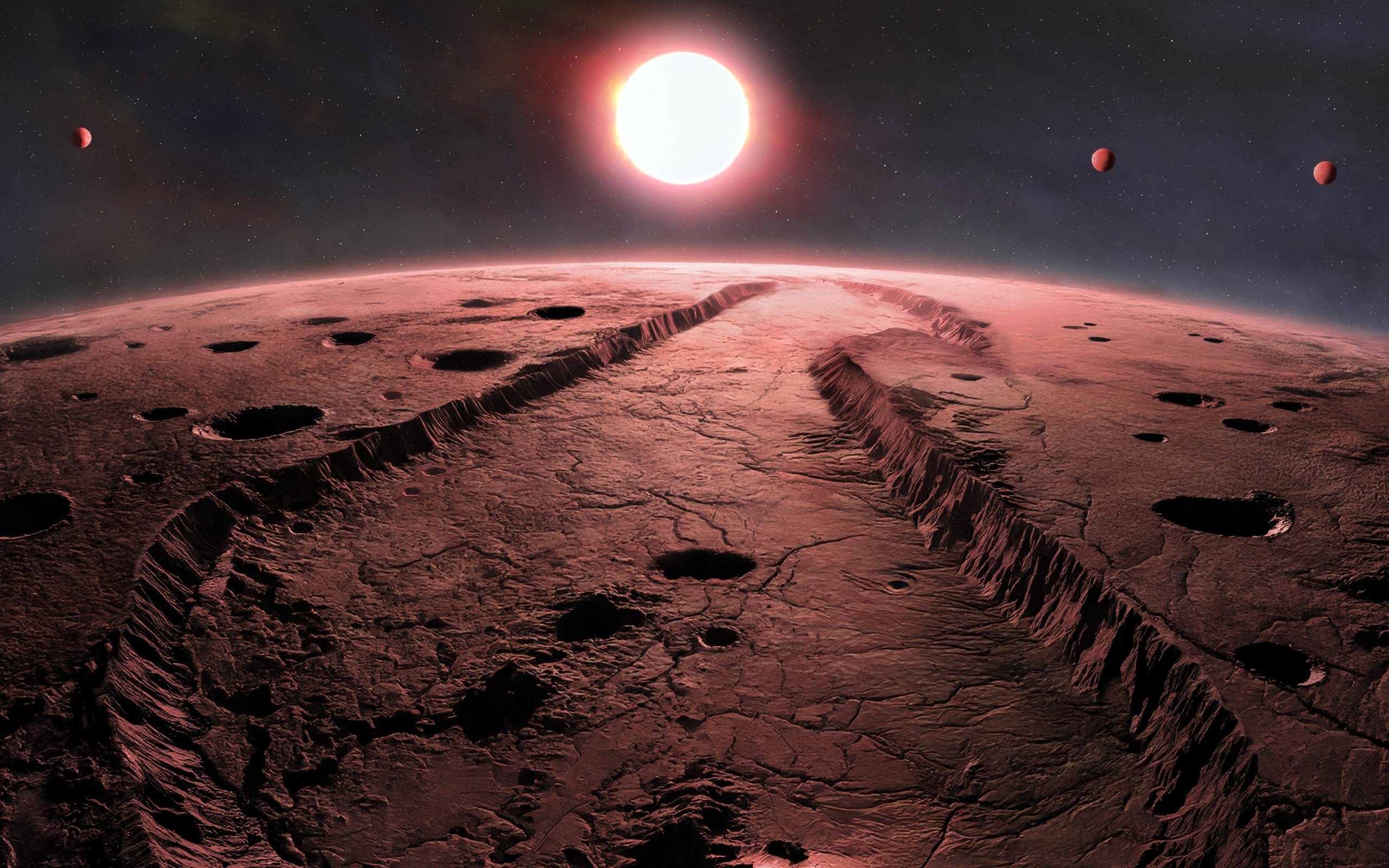
Just under six light-years away, Barnard’s Star hides four small worlds that don’t play by the rules of our own solar system. These aren’t Earth’s cousins. They’re something stranger.
Discovered in 2025, these planets are smaller than Earth but larger than Mars—a size range our solar system completely lacks. And according to new research, they’re likely the most hostile places in our galactic neighborhood.
If you’re looking for sub-Earth exoplanets capable of supporting life, Barnard’s Star is a dead end. Here’s why.
A Mineral Mismatch That Kills Water Retention
The hostility starts with the chemistry. Researchers at the University of Cambridge analyzed Barnard’s Star and found it’s incredibly rich in magnesium. On Earth, magnesium forms olivine. Olivine is a sponge; it stores water deep inside the crust.
But Barnard’s Star is too magnesium-heavy for that.
Instead, the excess magnesium forces the formation of periclase. Periclase is rare on Earth (hundreds of kilometers underground, at that) and terrible at holding onto water. The planets aren’t just dry. They’re chemically predisposed to stay that way.
“On Earth, that magnesium goes into making Minerals called olivines… Around Barnard’s Star, however… periclase… is less effective at storing water.”
Close Orbits Blow Away Atmospheres
Size isn’t the only problem. Orbit is.
These planets huddle around their star with a desperation that strips them bare. The outermost planet orbits ten times closer to Barnard’s Star than Mercury does to the Sun.
The heat? Intense.
The gravity? Weak.
Combined, they create an atmospheric purgatory. Even if these planets formed with thick skies, they wouldn’t have kept them for long. Researchers estimate any original atmospheres lasted no more than two billion years. The system itself is about ten billion years old.
Basically, the wind of the star swept everything clean billions of years ago.
The Day-Night Nightmare
Because they’re so close, the planets are tidally locked. One side faces the star forever. The other stares into eternal blackness.
This isn’t a subtle twilight. It’s a permanent scorching day on one hemisphere and a freezing void on the other. No rotation. No respite. Just two extreme environments separated by a thin, likely nonexistent, terminator line.
Why Haven’t They Crashed Yet?
In crowded neighborhoods, gravity is chaotic. Planets usually tug on each other until orbits destabilize. Collisions happen. Ejections occur.
Barnard’s Star avoids this mess through orbital resonance. The inner three planets lock into a mathematical rhythm with a period ratio of 9:12:16. Think of it like musical harmonics. It’s stable. It’s delicate. But it works.
This resonance keeps them from plunging into the star or being ejected into interstellar space. For now, at least.
The Search Continues
Why does this matter? Because we’re bad at finding small planets.
“We know about very few sub-Earth planets… because larger planets are much easier to detect,” says lead author Xander Byrne.
Barnard’s Star is an anomaly because it’s nearby. Future missions, like the European Space Agency’s PLATO, have the sensitivity to find more of these tiny, rocky worlds. The goal? To find ones that aren’t baked dry and stripped of air.
The chemistry of the parent star is a clue. If Barnard’s Star tells us its planets are mineral-rich and air-poor, maybe we can look at other stars and predict their planetary fate before we even see them.
Barnard’s Star planets are inhospitable. They are strange. They are close.
But they’re also just the beginning.