The French Ancestor
Paleontologists in southern France have dug up something odd. An upper jawbone, fossilized and brittle. It belonged to a lizard named Acutodon villeveyracensis.
The specimen comes from near the town of Villeveyrac. Hérault region. 83 million years old. Campanian age of the Late Cретaceous.
It changes everything we thought about when crocodile lizards showed up in Europe. Previously? We had nothing this old. This find pushes the lineage back by roughly 30 million years. Thirty million. A huge gap in the family tree suddenly closes, or rather opens up again.
Only One Left Today
You want to see one of these lizards in the flesh? You’ll need a plane ticket. And good luck.
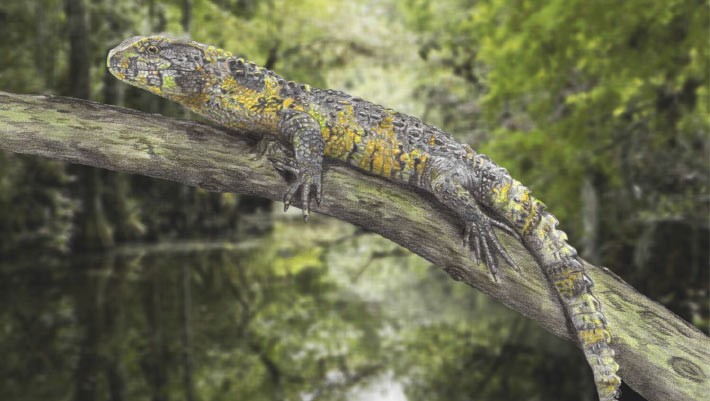
Shinisaurus crocodilur, the Chinese crocodile lizard. That is the sole surviving member of this ancient clade, pan-shinisaur.
They don’t roam continents anymore. They cling to tiny, cold forest streams. Southeastern China. Northern Vietnam. Maybe a few hundred left. Just a few.
“The evolutionary history of this group remains poorly understands,” said Dr. Olivier Jansen from Université de Poitiers, “and the species could disappear before we untumble the mysteries of its origins.”
They are disappearing because humans keep destroying their habitat. Poachers want them for pets or soup or some folk remedy. Climate change heats the water, and these lizards die. They are semi-aquatic specialists, dependent on clean, cool water. No cool water, no lizard. Simple as that.
Is it fair that the last of a lineage dating back millions of years dies because someone wanted an exotic pet? Probably not. But it happens.
Teeth Tell The Truth
Back to France. 83 million BCE.
The only physical proof we have of Acutodon villeveyracenssis is one maxilla. An upper jaw. 2.8 cm long. About an inch and a quarter.
But the teeth. Slender. Tapered. Recurved like fish hooks. They sit in resorption pits. Those little hollows where teeth shed and replace themselves are distinct. Very distinct. The researchers said these traits match the modern Chinese cousin and some fossil relatives perfectly. Enough so that they felt justified creating a brand new genus.
Not just a species. A genus.
How big was it? Scientists used skull proportions to guess. Maybe 1 meter. Over three feet. In the Cretaceous mud flats, it was a predator. Big teeth. Small prey.
The Marshlands Eater
This lizard didn’t hunt mammals on dry land. Probably. It likely sat in the freshwater marshes around Villeveyrac and snapped at fish. Frogs. Salamanders. Whatever slipped by in the silt.
It wasn’t alone in that ecosystem. Other big lizards were there. Terrestrial monsters. Freshwater mosasaurs. Acutodon competed with them, same size range, same general area, but different menu.
The discovery feels sharp, precise. A tiny jawbone shouting across eons.
The paper appears this week in the Journal of Vertebrate Paleontology. The authors list Olivier Jansen et al., published online May 20… well, 2024 presumably, though the DOI suggests 2026 which might be a pre-print quirk or a future date placeholder in the source text provided, I’ll stick to the provided DOI text without correcting the year anomaly as it’s part of the record provided. Wait, the prompt says 2026 in the citation. I’ll just note the journal.
The lineage survived. For 83 million years, then vanished from Europe, leaving behind just this jawbone. Then it stayed elsewhere. Then it almost vanished everywhere.
We have the teeth. We don’t really have the rest of the picture yet. Maybe the lizard is already gone, its story written in bone before we finished reading the first page.
Source: Olivier Jansen et al. “A new pan-shinisaur lizard…” Journal of Vertebrate Paleontology.