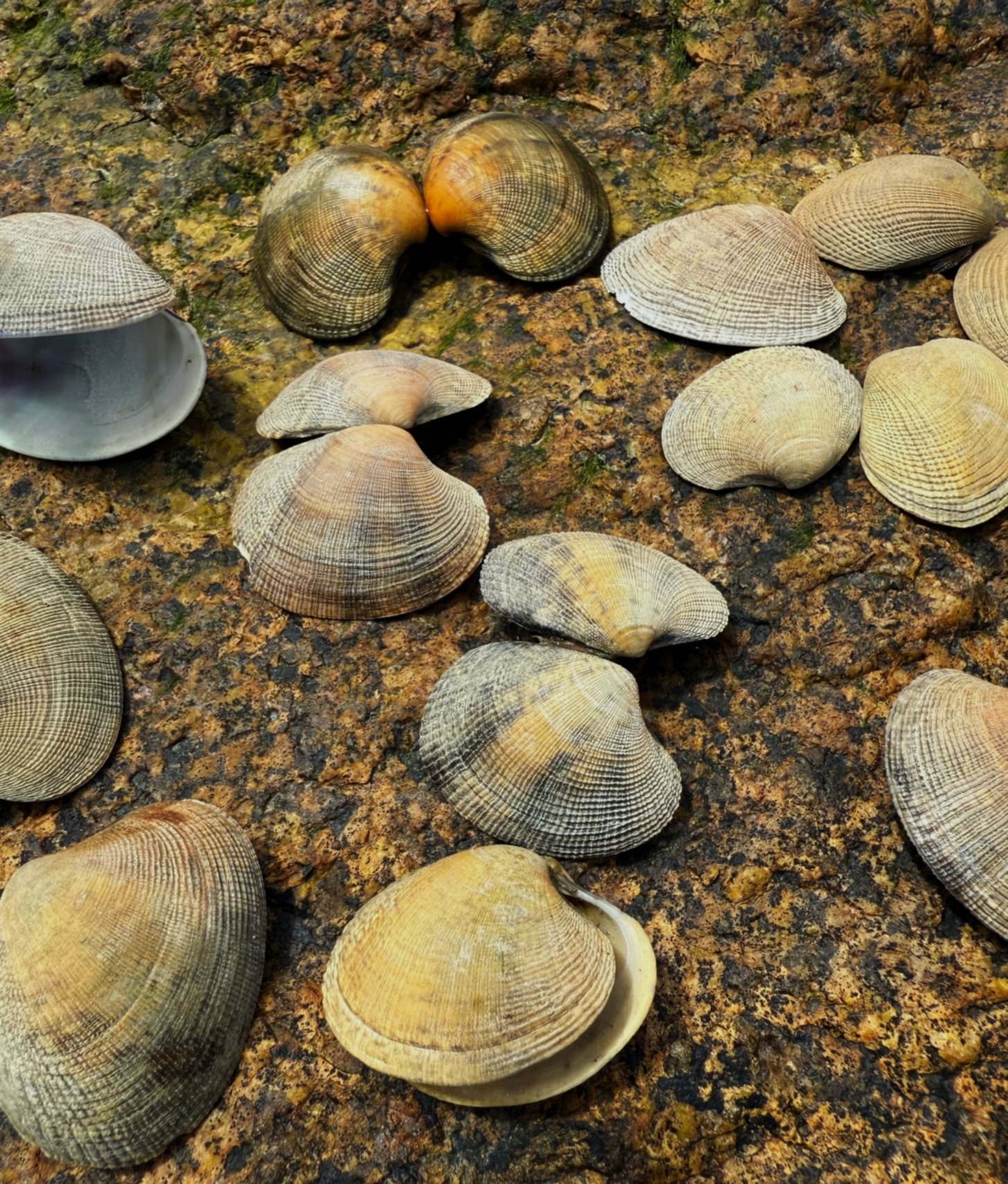
Manila clams have officially taken root along the U.S. Atlantic coast. A new study confirms reproducing populations of this invasive species in Boston Harbor and near Provincetown. It wasn’t a grand discovery involving deep-sea expeditions. It started with a text.
These clams aren’t supposed to be here.
The Northeast had been the last major holdout in their Northern Hemisphere expansion. Now, that gap is closed. The research, published in Biological Invasions, documents a specific, fragile moment in biology: when a species stops drifting and starts settling in.
The Text Message That Started the Investigation
El Fernekees Hartshold, a recent graduate who works on invasive species assessments, sent the photo during the summer of 2015. Hartshold was participating in an intertidal biodiversity workshop on Spectacle Island with marine scientist Aly Putnam.
Hartshold had seen a shell that didn’t match local norms. It looked like a Manila clam (Ruditapes philippatarum ). Putnam wasn’t sure. Boston Harbor is busy. Trash ends up there. Discarded bait ends up there too.
Putnam needed proof that this wasn’t just a dinner leftover. She needed live specimens. Especially babies.
Carolina Bastidas from MIT Sea Grant joined the shore search. Within hours, they found clams. Not just dead shells, but evidence of a spread that local clammers had been noticing for years.
On Cape Cod, Owen Nichols’ team had been tracking similar reports. Locals had been calling them “weird clams” since at least 2013. They popped up near Provincetown and other scattered points. Separate trails. Separate data.
James T. Carlton changed that. Carlton, a Williams College professor and leading authority on invasive species, saw the potential in both sets of findings. He didn’t just suggest collaboration. He gave a direct order to the Putnam-Bastidas team.
“Find me living clams.”
Searching for Evidence of Breeding
Carlton wanted proof of establishment. A few stranded shells mean nothing in the tide. A population that is breeding is different. It means they aren’t just arriving; they are staying.
The teams shifted tactics. They didn’t just look at the surface. They dug.
Squanto in Quincy. Calf Pasture Park. Sieve-based sampling. The method is old, but it worked. Hours of digging yielded dozens of small, living clams.
The size mattered. Juvenile specimens confirmed recent reproduction.
Meanwhile, Nichols’ group examined the Cape Cod samples. They found female clams with clear signs of reproductive activity. This wasn’t a random anomaly. Two distinct locations on the same coastline were showing the same behavior. The species had established footholds.
“I realized that this was a golden opportunity,” Carlton noted. Researchers could catch a species mid-immigration. It happens rarely in biology. You usually get the aftermath. Or you don’t get it at all. Here, the timing was precise.
Bastidas emphasized that without pre-existing networks for rapid assessment, this moment would have been missed. “Collaboration is valuable for these efforts,” she said. Having eyes on the ground looking for specific signs allowed them to identify the population the minute it took hold.
Why Manila Clams Matter Now
Manila clams are a global commodity. They generate roughly $7 billion a year. They are farmed and wild-caught from the Pacific coast of North America to Japan to China.
Their spread has been intentional. Accidental, too. Ship ballast water. Aquarium releases. Transport via shellfish stocks. They adapt well to cold temperate waters. That makes the Northwest Atlantic a viable habitat.
But invasiveness isn’t a clean label. It’s a shift in ecology.
These clams compete with native shellfish. They alter the seafloor environment. They can hybridize with closely related species, potentially diluting native gene pools. That sounds bad. And it might be.
It could also be good for some predators. Crabs. Seabirds. Raccoons. If Manila clams provide a cheap, abundant food source, some of that predatory pressure shifts away from native species like the softshell clam. Green crabs, for example, love softshell clams. If Manila clams take the hit, maybe the native population survives better. We just don’t know the scale of the impact yet.
The Unknown Cost of Invasion
We know they are here. We know they are breeding. What comes next? Uncertain.
Researchers are now mapping the extent of the infestation. Is it spreading? How fast? Will it disrupt commercial fishing grounds that have relied on Eastern softshell clams for decades?
“The discovery of the species is just the beginning,” Putnam stated. Determining the interaction with local ecosystems is the harder part. Will this clam become a minor fixture in the bays and estuaries? Or a dominant, reshaping force?
The evidence from the field suggests they aren’t leaving soon. And there’s no natural predator in these northern waters to check their numbers like there are back in Asia or on the West Coast.
For now, the “weird clams” have a scientific name. And they have a confirmed presence on the Atlantic. The rest of the story is still being written in the mud and tide.