It works. Finally, something that doesn’t just slow down the decline.
The PRIMA retinal implant has secured regulatory approval in Europe. This isn’t just a minor tweak to existing treatments. It is the first device of its kind approved anywhere to restore functional central vision in patients with geographic atrophy. These people can read. They can see details they previously missed entirely.
Darius Shahida, from Science Corporation in California, doesn’t shy away from the results.
“We’ve had patients who could recognise the face of
The Queen and others who’ve drawn the Sydney Opera House through the device.”
That is the core of what this technology delivers. Functional sight. Not a blurry impression. Actual recognition.
How the PRIMA system works for severe vision loss
Geographic atrophy is a brutal condition. It is a progressive, irreversible form of dry age-related mac degeneration (AMD). The macula – the part of the retina responsible for fine detail and straight-ahead vision – deteriorates slowly as retinal cells die and don’t get replaced. There are roughly 8 million sufferers worldwide.
Current treatments offer little hope for restoration. In the US, there are two FDA-approved injections. They block proteins that damage the retina. They slow the disease. They do not bring back what was lost.
Sunir Garg at Wills Eye Hospital puts it bluntly:
“We have two [US Food and FDA]-approved medications for the treatment of geographic
atrophy that slow down the progressive disease, but unfortunately, cannot bring back lost vision.”
The PRIMA implant bypasses this limitation entirely.
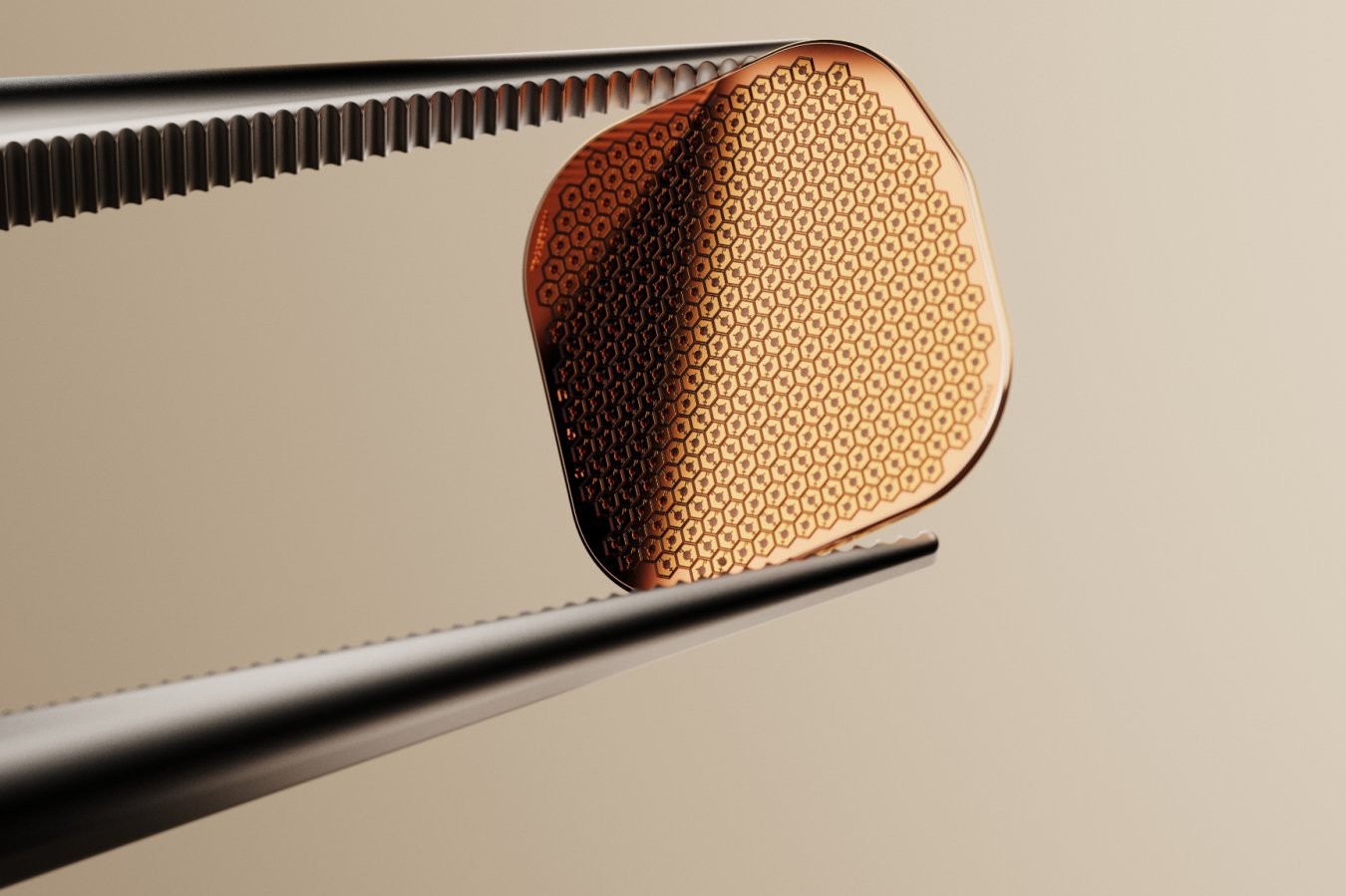
Here is the mechanics. The device is tiny. About the size of a pinhead. It is inserted beneath the retina. Patients wear glasses equipped with a frame-mounted camera. The camera captures images and processes them. Then, it projects the result onto the implant using near-infrared light. Humans can’t see this wavelength, so it doesn’t blind or dazzle the user during the process.
The chips inside the eye catch that near-infrared light. They convert it into electric pulses. These pulses stimulate bipolar cells in the retina. Normally, rod and cone cells do the heavy lifting. They convert light to electrical signals. Macular degeneration destroys these cells. But bipolar cells usually survive the damage.
PRIMA lets these healthy bipolar cells do the work. It skips the dead cells. It creates electrical signals the brain can interpret as sight.
Crucially, the glasses don’t need a battery pack or a tether. They generate electricity directly from ambient light. Think solar panels.
“This means patients don’t need a tethered power source,” Shahida notes.
Visual outcomes: From 20/200 to 20/160
A study published last October tested the device. The results were concrete. About 80 percent of participants saw restored central vision and improved visual acity.
Let’s put that in perspective.
Frank Brodie, also from Science, explains the scale. Normal vision in the US is 20
- Blindness is defined as 20/200.
“Patients using PRIMA reached about 20/160.”
They didn’t achieve perfect 20
20 sight. They went from blind to not blind. They can read. They can navigate. They are functional.
Recovery is surprisingly fast. Most side effects stem from the surgery itself and vanish within two months. Some patients feel better within a day. Post-op training involves learning how to wear the glasses properly. Head positioning. Pupil alignment. It requires adjustment, yes. But the physical toll is minimal compared to the visual gain.
Availability and future pathways
The device carries a CE certification mark under the EU Medical Device Regulation. This allows use in the European Union and the UK.
In the US, it holds Breakthrough Device and Humanitarian Device designations from the FDA. This signals a serious pathway toward full US approval, though it isn’t there yet. Shahida says PRIMA received approval for use in Europe, but US regulatory status remains a next-step milestone.
Commercial rollout begins soon.
First stops: Germany and the UK later this year. Surgeons in Germany have been trained. Sites selected. Surgeries planned. The goal is global commercialization. Help as many people as possible.
Expanding beyond geographic atrophy
Is this only for geographic atrophy? Probably not.
Brodie mentions the team is exploring the implant’s potential for other conditions affecting the macula. Stargardt disease is one target. It damages the macula too. The mechanism of action – stimulating surviving bipolar cells – might translate well.
More research is needed on a larger scale. Long-term safety data is the current gap. Garg notes that scientists must also determine if specific patient or condition characteristics predict success. Not every patient may respond equally.
But the foundation is laid. A device that turns light into readable signals. No tethers. No complex external batteries. Just a pinhead-sized chip and glasses.
We asked if it restores normal vision. No. But it restores agency. For 8 million people, that distinction matters more than pixels.
The surgery happens. The glasses go on. The world comes back into focus, one word at a time.