Diamond. Everyone knows it’s hard. It cuts glass. It withstands pressures that would crush steel. It doesn’t react to acids. It’s the king of inert materials.
So for over a hundred years, scientists agreed on one thing: diamond doesn’t care about piezoelectricity. You can’t bend it and make it spark. It doesn’t generate electricity when stressed. Not naturally. Not in bulk.
But that belief just evaporated.
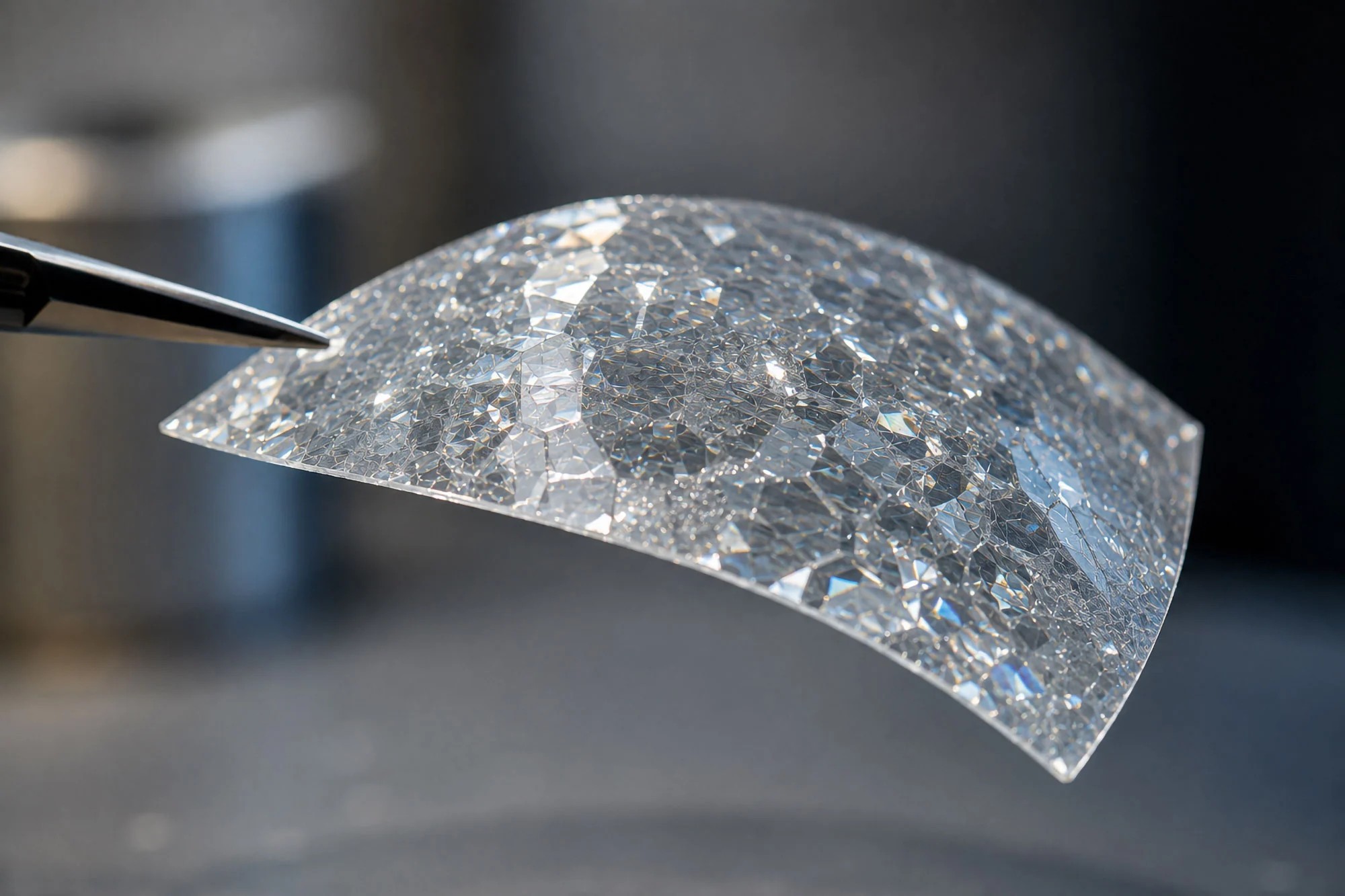
A team at the University of Hong Kong has shown that if you slice diamond down thin enough—specifically into polycrystalline membranes—it generates voltage. Just by bending. The century-old rule is broken.
How ultrathin diamond creates piezoelectric voltage
The researchers, led by Professors Zhiqin Chu and Yuan Lin, didn’t just thin a piece of diamond. They used an edge-exfoliation method to create flexible polycrystalline structures. The difference between bulk diamond and this ultrathin membrane is structural freedom. Bulk diamond is locked in place. Too rigid. Too symmetrical. The forces cancel out. No charge.
Thin diamond? It bends. Substantially. And when it bends, it pushes back with electricity.
They didn’t stop there. They had to prove it wasn’t some freak accident. Or static friction. Or environmental noise. So they bent the membrane repeatedly under controlled conditions. Triboelectric effects? Ruled out. Ambient interference? Eliminated. The signals were stable. Reproducible. Real.
The result: a measurable, stable voltage output directly tied to mechanical strain. Diamond is finally piezoelectric. At least, in this specific, ultrathin form.
Why grain boundaries make the difference
So, where does the charge come from? Diamond’s crystal structure is normally too perfect. Too symmetrical to allow a net polarization. But polycrystalline diamond is different. It’s made of many tiny crystals joined together.
Those joining points are grain boundaries.
First-principles calculations show that the effect happens mainly at these asymmetrical boundaries. When the membrane bends, the stress doesn’t distribute evenly. It piles up. Electrical charge accumulates along these boundaries.
This accumulation creates a voltage difference. Positive on one surface. Negative on the other.
It’s not the diamond lattice itself acting in isolation. It’s the interface. The crack in the symmetry. The bend reveals the asymmetry that bulk crystals hide.
“Uncovering piezoelectric effect is not just about a new material property, but a new way to use an ancient one.”
Where this changes the game for sensors
Diamond is biocompatible. It’s chemically stable. It’s non-toxic. Usually, we use it as a hard coating. Or a heat spreader. Rarely as a sensor core.
This changes the list.
If diamond can generate power from movement, it can power itself. No battery needed. Consider an implantable medical device. The human body moves. Constantly. Muscles flex. Bones shift. A piezoelectric diamond membrane could harvest that kinetic energy. It could also serve as a pressure sensor simultaneously.
No external wiring. No fragile batteries to replace. Just diamond, bending, producing power.
The implications for miniature energy systems are significant. Think about devices that operate without an external power grid. Relays. Monitors. Sensors buried in infrastructure. Diamond doesn’t degrade. It doesn’t rot. It lasts.
Is piezoelectric diamond ready for your phone?
Probably not tomorrow. We’re talking about ultrathin membranes. Lab-scale fabrication. Edge-exfoliation is precise but difficult to scale for consumer electronics.
But the proof of concept is solid.
We used to think diamond was too hard to be useful beyond abrasion and thermal management. We were wrong. It’s also a generator. A sensor. A durable power source.
The question isn’t whether it works. The question is how thin is too thin? How much strain can we push before the structure fails?
We have the science. The voltage is real. The grain boundaries are the key. Now we just have to figure out how to put this in the hands of engineers who need small, tough, self-powered devices.
Diamond isn’t just forever. It’s active.
And that’s a shift we didn’t see coming.