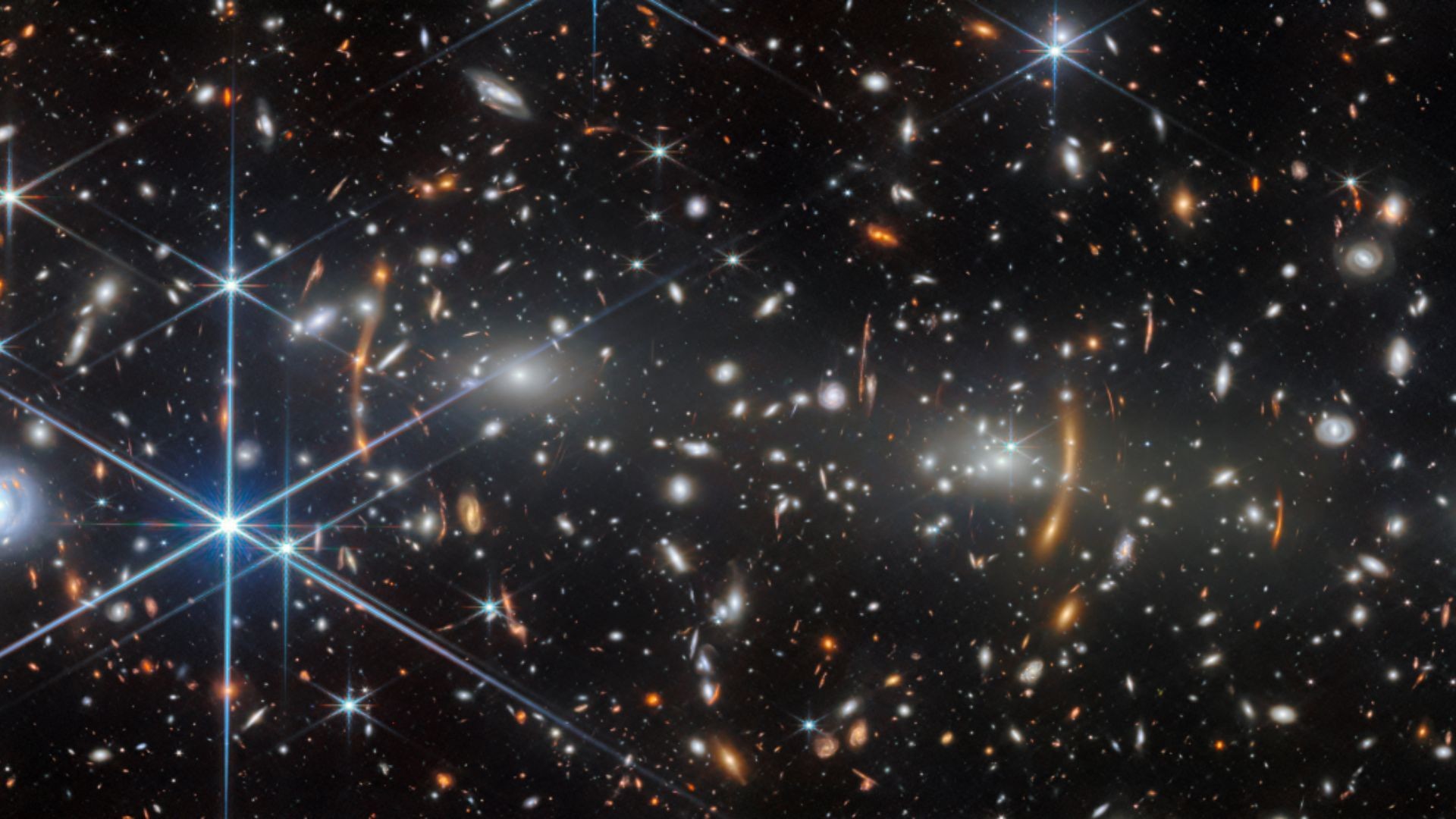
It happened on July 3. The James Webb Space Telescope (JWST) didn’t just take a picture; it tore a hole in the fabric of time.
The result is MACS J0553.34-3342.
A young cluster of galaxies. Glittering. Alive with a cosmic glow that is exactly 4.4 billion years old.
This isn’t a static postcard of a mature, dead universe. It is a construction site. The stars are still being hammered out. The gravity is still pulling things together. We are seeing the galaxy cluster while it is forming.
The Gravity of the Situation
What exactly are we looking at here?
A galaxy cluster is the universe’s way of grouping its most massive structures. Hundreds, maybe thousands of galaxies. Held together by gravity’s relentless pull.
Most of these clusters are old. Weary from billions of years of expansion and drift. MACS J0553 is different. It’s a baby. Or, relative to cosmic standards, a teenager. It exists in a phase of rapid assembly, captured at the moment it was 4.4 billion years in the making.
The telescope used its near-infrared camera (NIRCamera) to see this. Not because visible light failed, but because infrared is the only way to pierce through the cosmic fog and the redshift of such ancient distances.
Why We Need a Time Machine
You might ask: why not just look there now?
Because light travels at a finite speed. When you look at the Sun, you see it as it was 8 minutes ago. When you look at distant galaxies, you are looking into deep history.
The JWST acts as a time machine. Not by magic. By physics.
Hubble did this too. Hubble saw back. But Hubble’s eyes were tired. It couldn’t catch the faintest whispers from the earliest epochs.
JWST is different. Its instruments, specifically the NIRCam, are sensitive to incredibly faint light. It can detect galaxies that Hubble simply couldn’t see. It stretches the horizon further back.
Seeing the Unseeable
This power doesn’t belong solely to Webb. But its specialized tools make the difference between a blurry smudge and a resolved stellar spectacle.
We are pushing the limit of visibility.
The JWST’s specialized instruments allow the telescope to pick up incredibly faint-light from galaxies remarkably far away.
This matters.
If we can see how clusters formed 4.4 billion years ago, we understand how they evolved. We see the mechanics of gravity at work on the largest scales.