Velcro came from burrs. The Schmitt Trigger circuit was inspired by squid nerves. The Shinkansen bullet train’s high-speed nose mimics the kingfisher’s beak. Engineers are constantly mining the natural world for blueprints.
Echolocation is another case where nature arrived at the solution long before humans did. The process involves hitting an object with high-frequency sound waves and listening for the bounce-back. Humans have used sonar for over a century. But toothed whales and bats perfected it first.
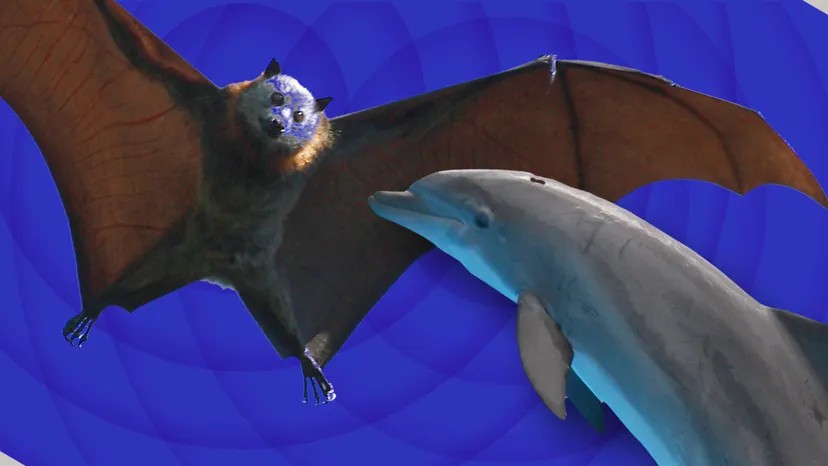
Dolphins, porpoises, and sperm whales use this biological sonar. So do roughly 1,000 bat species. As engineering evolves, future inventors will likely look to these animals for inspiration. But which group offers more value to tomorrow’s pioneers?
Scientists have ribbed each other over this question. Laura Kloepper, an assistant professor of biology at St. Mary’s College in Indiana, presented new research at the November 2018 Acoustical Society of America meeting. She highlighted key differences between bat and dolphin echolocation. Her conclusion is unambiguous. She believes bats use the technique in a far more impressive manner.
Not everyone agrees. There may not be a definitive winner in this aural battle. Before picking a side, consider the data.
The Range and Volume Advantage
Sound travels roughly four times faster in water than in air. This allows toothed whales to echolocate across massive distances. A submerged bottlenose dolphin can identify potential prey from 361 feet away. That is 110 meters.
Bats have much narrower sonar ranges. Most insect-hunting species detect prey only within 9.8 to 16.4 feet. That is 3 to 5 meters. In terms of range, the whales win by a landslide.
Volume is another metric where toothed whales dominate. Dolphins and their kin use nasal passages to generate clicks. These sounds move through the “melon,” a fatty organ above the jaws. The melon acts like a built-in megaphone. It focuses and directs the outgoing sound.
Some of these whales produce clicks as loud as 230 decibels. That is nearly 130 decibels louder than the roar of trains in a New York City subway station. It also dwarfs bat-made noises. Sonar-wielding flyers emit sounds around 100 to 100 decibels.
In bats, the tongue or larynx usually generates the sound waves. Scientists recently discovered a more primitive technique. A 2014 study reported that Old World fruit bats navigate darkness by clicking their wings. They then listen for the echo. Researchers are still figuring out how that works.
Processing the Noise
Making the noise is only half the challenge. You must process returning echoes when they arrive. Dolphins use their jaws and teeth to intercept echoes. These signals pass to the middle ears. Bats use overgrown external ears to collect return signals.
Even with those large ears, it is remarkable that bats hear so well. Many species live, travel, and hunt in massive colonies. The largest groups contain around 15 million animals. When hundreds or millions of bats echolocate simultaneously, the result is chaotic background noise.
A given bat must distinguish its own cries from those of others. To achieve this, winged mammals alter the pitch, frequency, and timing of their individual voices. Some take it further. The Mexican free-tailed bat deliberately releases sounds to jam other bats’ sonar signals. All is fair in love, war, and bug-hunting.
Bat signals are intricate. They are flexible and easy to manipulate. Toothed whale sonar clicks are more homogeneous. Cetaceans have less control over the pitch or duration of their relatively simple sounds.
This flexibility is one reason Kloepper considers bats more sophisticated. Anti-jamming strategies support this view. In a recent experiment, Kloepper and her colleagues exposed two dolphins to recordings of artificial cetacean clicks. The aquatic beasts did not get disoriented. They slightly altered the timing and frequencies of their outgoing signals.
The performance was decent. Kloepper stresses, however, that bats retain greater vocal flexibility. The engineering possibilities hidden in a bat’s throat might just be more complex than those in a whale’s melon.
On November 16, 2018, a friendly Science Friday debate highlighted a surprising divergence in the sonar capabilities of bats and dolphins. Kloepper represented Team Bat against Brian Branstetter, a biologist at the National Marine Mammal Foundation. Halfway through the discussion, Branstetter pointed out a distinct advantage toothed whales hold over their flying counterparts.
Bats use sound to map the exterior of solid objects. The reflected signals tell them what an object looks like on the outside. Dolphins operate differently. Because sound travels through water, their echolocation signals pass through targets. This allows them to see inside an object as well as out. A 1992 study proved that bottlenose dolphins could determine the thickness of hollow cylinders using only their natural echolocation.
The two species might seem worlds apart. They live in different environments. They evolved on different continents. Yet, genetic analysis from 2010 reveals a shared path. Both lineages independently developed sonar after undergoing similar hearing-related mutations. Evolution repeated itself. History echoes.
Beyond Bats and Whales
Bats and toothed whales are not the only animals relying on sonar. Oilbirds, which live in caves, use echolocation to navigate in total darkness. Shrews might also use this trick to sense their surroundings. The ability to “see” with sound is more widespread than we thought.
“Dolphins can determine the thickness of hollow cylinders using only their echolocation talents.”
This biological convergence raises questions about how animals perceive their world. For bats, the outside matters most. For dolphins, the inside holds secrets. Both strategies work. Both evolved through similar genetic changes. The mechanism is different. The outcome is the same.
Why do so many animals need this sense? Darkness hides predators. Turbid water obscures prey. The solution is simple. Send out a sound. Listen for the return. The brain builds a picture from the echo. It is a universal language of space.
The oilbird flies in the dark. The shrew digs in the dirt. The dolphin swims in the blue. The bat flies in the night. They all listen. They all hear. The echo is real. It is always there. Waiting.