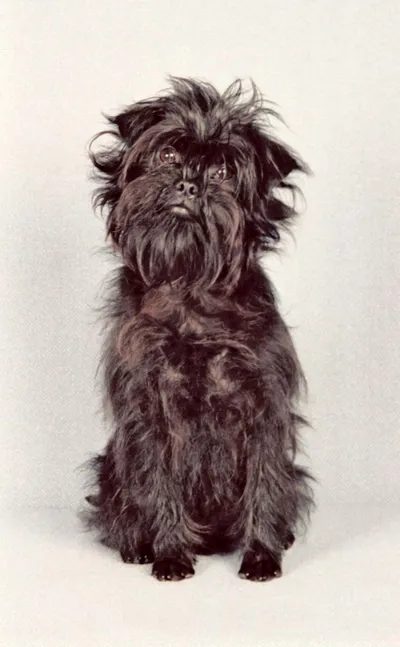
It looks like a living caricature. A scruffy bundle of wiry hair with a beard that hangs just so and eyes that seem to be judging your life choices. This is the Affenpinscher, a toy dog with a history that stretches back to the 17th century. While it might look like a plush toy that gained sentience, this breed was not originally bred for lap time. It was bred for work. Specifically, it was designed to hunt rats in German stables and barns.
The Original Job: Vermin Control with Attitude
Despite its small stature, the Affenpinscher retains the tenacious spirit of its terrier ancestors. It is lively. It is playful. It is stubborn. These traits were essential for a dog tasked with killing mice and other vermin in cramped, dirty spaces. You don’t want a dog that gives up when a rat scurries under a heavy crate. You want something with grit. That grit is still visible today.
Physical Specs and the “Monkey” Connection
The breed’s name comes from the German word affen, meaning monkeys. The comparison isn’t superficial. The wiry coat is short on the body but grows longer on the legs and, most notably, around the face. This facial hair creates a distinctive expression. Round black eyes. Small erect ears (often cropped, though that practice is fading). A short, docked tail. The result is a face that resembles a primate. It’s an unusual look for a dog, one that has kept the breed recognizable for centuries.
Size-wise, they are compact. They stand between 9.5 and 11.5 inches (24 to 29 cm) tall. Weight ranges from 7 to 8 pounds (3 to 3.5 kg). They are sturdy. Not fragile. The coat color usually leans toward black, as that is the preferred standard, but you will find them in gray, silver, red, black and tan, or beige. The texture is wiry. It protects the skin while allowing the dog to navigate tight spaces without getting tangled.
Why This Breed Matters Today
We often categorize dogs by utility. Herding. Hunting. Guarding. The Affenpinscher falls into the “toy” category now, but its DNA is that of a worker. Understanding this helps explain its personality. It isn’t just a decoration. It has a drive. It has a history of solving problems—specifically, the problem of unwanted rodents.
When you look at an Affenpinscher, you aren’t just seeing a small dog with a funny face. You are seeing a lineage of ratters. A lineage of dogs that refused to leave a job undone. The monkey-like expression is a byproduct of function and form meeting in 17th-century Germany. It’s a reminder that even the smallest members of the canine world have a purpose. One that doesn’t disappear just because the rats are gone.