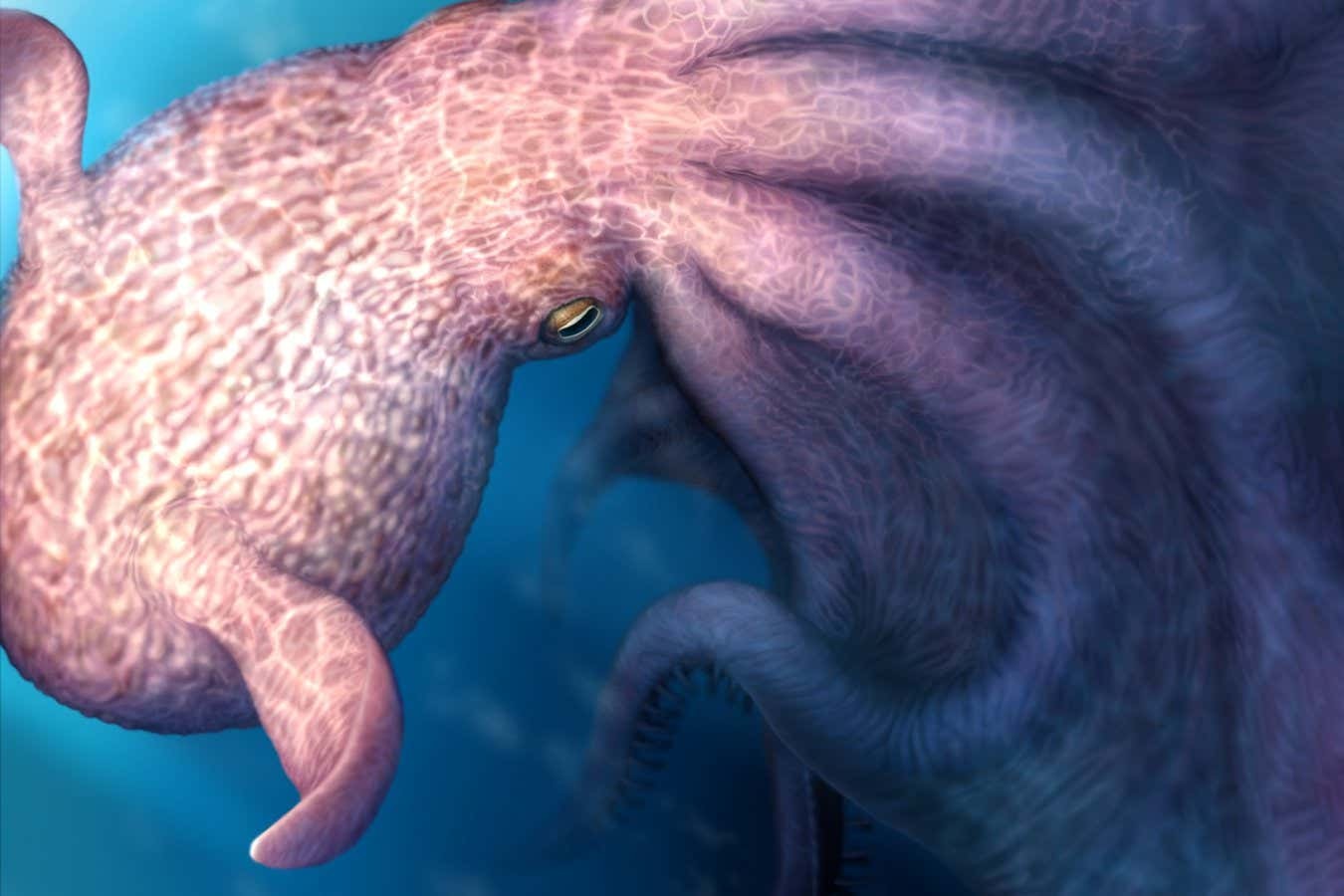
While dinosaurs dominated the terrestrial landscapes of the Cretaceous period, a different kind of titan ruled the oceans. New research suggests that the prehistoric seas were home to massive, highly intelligent octopuses that functioned much like modern-day great white sharks or orcas.
The Discovery of a Prehistoric Giant
A research team led by Yasuhiro Iba of Hokkaido University has analyzed 27 fossilized octopus jaws (beaks) dating back between 72 and 100 million years. These specimens, recovered from Japan and Vancouver Island, Canada, have provided a window into a world of “gigantism” that defined the Cretaceous era.
Using advanced “digital fossil mining” —a combination of high-tech scanning and artificial intelligence—the researchers were able to extract fossils that were previously hidden deep within rock matrices.
The study revealed that many of these specimens were previously unknown to science. Most notably, the team identified the species Nanaimoteuthis haggarti , an animal that may have been one of the largest invertebrates to ever exist.
Scaling the Monster
Because octopuses are soft-bodied, they rarely leave complete fossils; their durable, chitinous beaks are often the only surviving evidence of their existence. To estimate the size of these creatures, researchers applied a mathematical model based on the relationship between beak size and mantle length found in modern long-bodied finned octopuses.
The results are staggering:
– Estimated Length: N. haggarti may have reached total lengths between 6.6 and 18.6 meters.
– Comparison: This puts them in the same size class as the largest marine reptiles and sharks of the era, such as mosasaurs and plesiosaurs.
While they superficially resemble the modern giant squid, these ancient octopuses were likely different hunters. Unlike squids, which use two long tentacles to snatch prey, these octopuses likely used eight long, flexible arms to seize and manipulate their food.
Intelligence and Hunting Patterns
The fossils offer more than just a sense of scale; they provide clues about the behavior and cognitive abilities of these ancient predators.
1. Specialized Diet
Analysis of the wear and scarring on the jaws suggests these animals were capable of crushing hard structures. They likely fed on a variety of prey, including:
– Large bivalves
– Ammonites
– Crustaceans
– Fish and other cephalopods
2. Evidence of Complex Behavior
Perhaps most intriguing is the discovery of asymmetric jaw wear. This suggests “lateralization”—the tendency to favor one side of the body over the other during feeding. In modern cephalopods, lateralization is a key indicator of increased brain complexity and efficient information processing. This implies that these giant octopuses were not just brute force predators, but highly intelligent animals with potentially individual behavioral tendencies.
Why This Matters
This discovery highlights a period of intense biological competition. During the Cretaceous, the abundance of food in the oceans fueled a trend of gigantism across many species. The presence of such massive, intelligent invertebrates suggests a highly complex marine food web where even “invertebrates” could occupy the role of apex predators.
“These were animals over 10 metres long, with long arms, powerful jaws capable of crushing hard structures and probably advanced behaviour.” — Yasuhiro Iba, Hokkaido University
Conclusion: The discovery of N. haggarti reveals that the Cretaceous oceans were dominated by massive, intelligent, and highly effective octopus predators that rivaled the era’s most famous marine reptiles.