Remember last week? The ScienceAlert team shared their pick of facts. For July 4th. Conversation starters. We liked them. We did.
So we asked you. Our readers. You know who you are. What your favorite facts were. The ones you drop on family dinners to shut everyone up. To inspire. Or just to confuse.
We expected maybe fifty responses. Maybe a hundred if we got lucky.
We got more than 500.
You guys are intense. Here are the best ones. The ones that stayed with us.
Breath and history
Joseph Johnson starts it off.
Every breath you take contains air molecules breathed by almost everyone in history.
Think about that. The same oxygen. Passing through lungs. Across centuries. You are breathing the same air as people you’ve never met. Most of them are dead. It’s weirdly intimate.
Scale makes sense
Then again, maybe not. Scale ruins perspective.
Huw F. Rees has the math for it. Shrink our solar system to a red blood cell? The Milky Way is as big as the USA. We are tiny. Incredibly so.
Louis Macallistar-Menzes agrees. Earth’s atmosphere is just skin on an apple. Thin. Fragile. Peel it and you’re dead.
Michael O’Brien notes the solar coincidence. The sun is 400x wider than the moon. And 400x further away. That is why they look the same size. No other planet gets this trick. It’s a visual hack. Built-in.
When you look at the night sky you are looking back in time. Some stars no longer exist.
Rebecca Congreve says this. George Zoric Jr adds specifics. Polaris light left 450 years back. The Andromeda Galaxy light left two million years ago. You aren’t seeing the universe as it is. You are seeing ghosts. Is it lonely? Maybe. Or just peaceful.
Animals doing impossible things
Nature doesn’t care about physics sometimes.
Sean Newell reminds us: Birds are dinosaurs. Living theropods. The bird in your feeder? That is a T. rex relative. Dressed up. With feathers.
Cuttlefish change colors. They look like stained glass windows moving underwater. Jess Cockerill points out the kicker. They are colorblind. Their eyes see polarized light instead. They navigate a world of angles not hues. Alien vision. In our ocean.
Joshua Riley talks coyotes. They won’t go extinct. Easily. A pregnant female howls. If no one answers she nearly doubles her litter. Biology responding to silence. Survival mode.
Peter Dockrill likes spiders. Spider silk is thin. Pound of it goes around the earth. And keeps going. Wrap the planet in thread. Tie it off.
Renee Michele says flamingos freeze to ice overnight. Then walk away. In the morning. Just shake it off. Literal freeze frames.
Deep time hits hard
Eric Dunlap has the timeline stat that hurts. We are closer to T. rex than T. rex was to Stegosaurus. Sixty-six million years versus seventy-six million. Dinosaurs are old. But deeply old. The gaps between them are larger than all human history combined.
Ben Bailey explains coal. It’s rotten trees. For sixty million years trees had wood but fungi hadn’t evolved to eat it yet. Dead wood just stacked up. Rot-free. Buried. Pressured. Coal is an accident of evolutionary lag.
John Rider describes stellar death. Stars make iron. Iron can’t fuse. Gravity wins. Collapse. Iron is the stop sign in the nuclear highway. The star ends because it got stuck.
Math that breaks the brain
@gurubob12 throws the chess problem. Possible chess games? More than particles in the universe. Count the stars? Fine. Count chess games. Impossible.
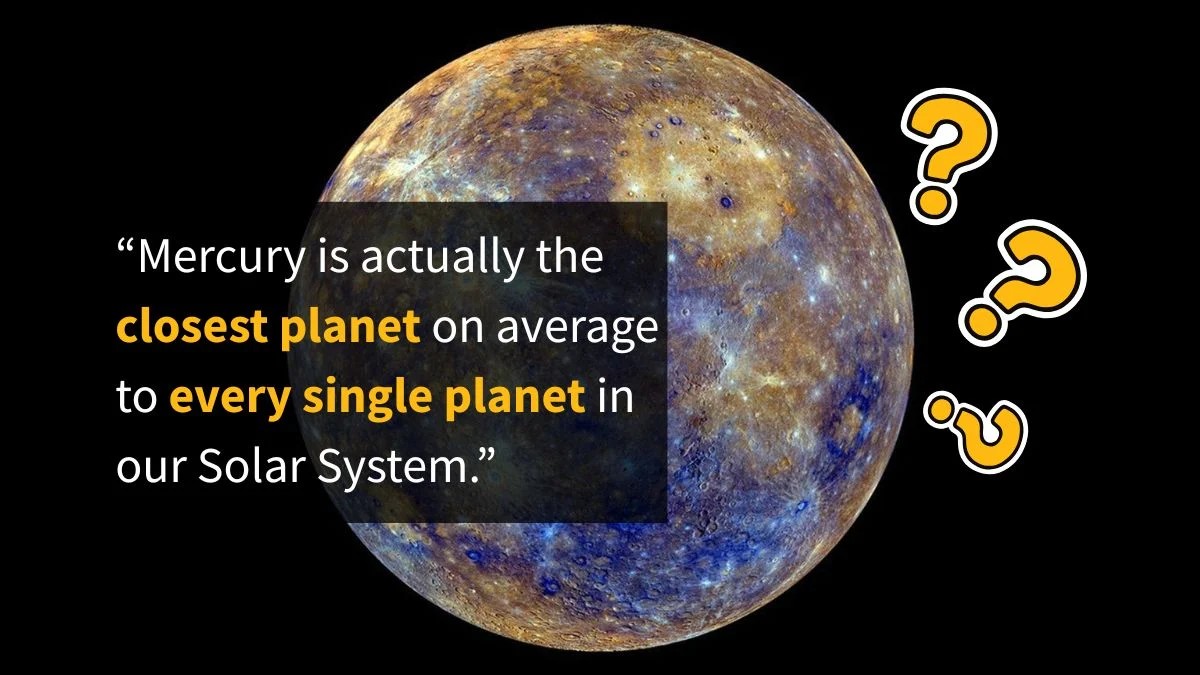
@remuslup19 fixes our orbital views. Mercury is the closest planet to every planet in the solar system on average. It hovers near the sun. The hub of the wheel. Closest to everything else because it refuses to leave home.
Daniel Lockwood loves 1980s computing. Computers switched in the time light travels one foot. Fast then. We were working at light scale decades ago. Progress is slow but steady.
The weird details
William E. Davenport finds the convergence point. Negative forty. Celsius meets Fahrenheit. They touch once. And only then. A brief handshake in the cold.
Carl Cassella worries about our brains. They are 60% fat. The fattiest organ we have. We think with blubber. Sort of. And if peripheral vision was as sharp as central vision? We’d need a brain the size of a classroom. Good thing we blur the edges. Otherwise we’d be overwhelmed. Noise everywhere.
Fiona MacDonald puts space travel in perspective. Voyager 1 left in 1977. Hasn’t traveled one light-year. We have moved fast in terms of money but space is just… empty. Mostly.
Ian Graham drops a bomb. Your mother’s egg? Made when she was a fetus. Three months before birth. You started older than your mother was alive. Biological time loops back on itself.
Just more truth
Flowers signal distress when cut. Fresh grass smells like screaming plants warning their neighbors. Wezze Van Ongevalles calls it what it is. Distress. We call it perfume.
In a double rainbow colors invert on the outer band. Alex Mayberry notes the geometry. Light does what light wants.
There are more trees than stars. Ben Fincher checks the math. Trees win. Every time.
Sharks predate trees. Jacob Anthony proves it again. The ocean beats the land every time in a longevity contest.
All planets fit between Earth and moon. Melina O’Brien confirms it. Plenty of room in that dark gap.
The Sun took 45,001 years for a photon to leave the core. Then eight minutes to hit your eye. Michael Koa contrasts the journey. Slow inside. Fast outside.
Venus spins slower than it orbits. A day there is longer than a year. @sad.foto highlights the lag.
And Kenneth Shawn leaves us with Chorioactis geaster. A mushroom found only in Texas and Japan. Twenty million years separated. Seven thousand miles apart. No humans involved. DNA doesn’t lie but it doesn’t explain this.
What does it mean?
Nothing maybe. Everything.
Coal exists because trees evolved before fungi did.