Astronomers have captured a high-energy spectacle 7,000 light-years away, observing a stellar-mass black hole “cannibalizing” a neighboring star and blasting out jets of energy with the power of 10,000 suns.
Using data from the Square Kilometre Array Observatory (SKA), researchers have gained a rare, measurable look at the mechanics of black hole outbursts—a discovery that could serve as a vital “anchor” for understanding how even the largest black holes in the universe influence their host galaxies.
The Anatomy of Cygnus X-1
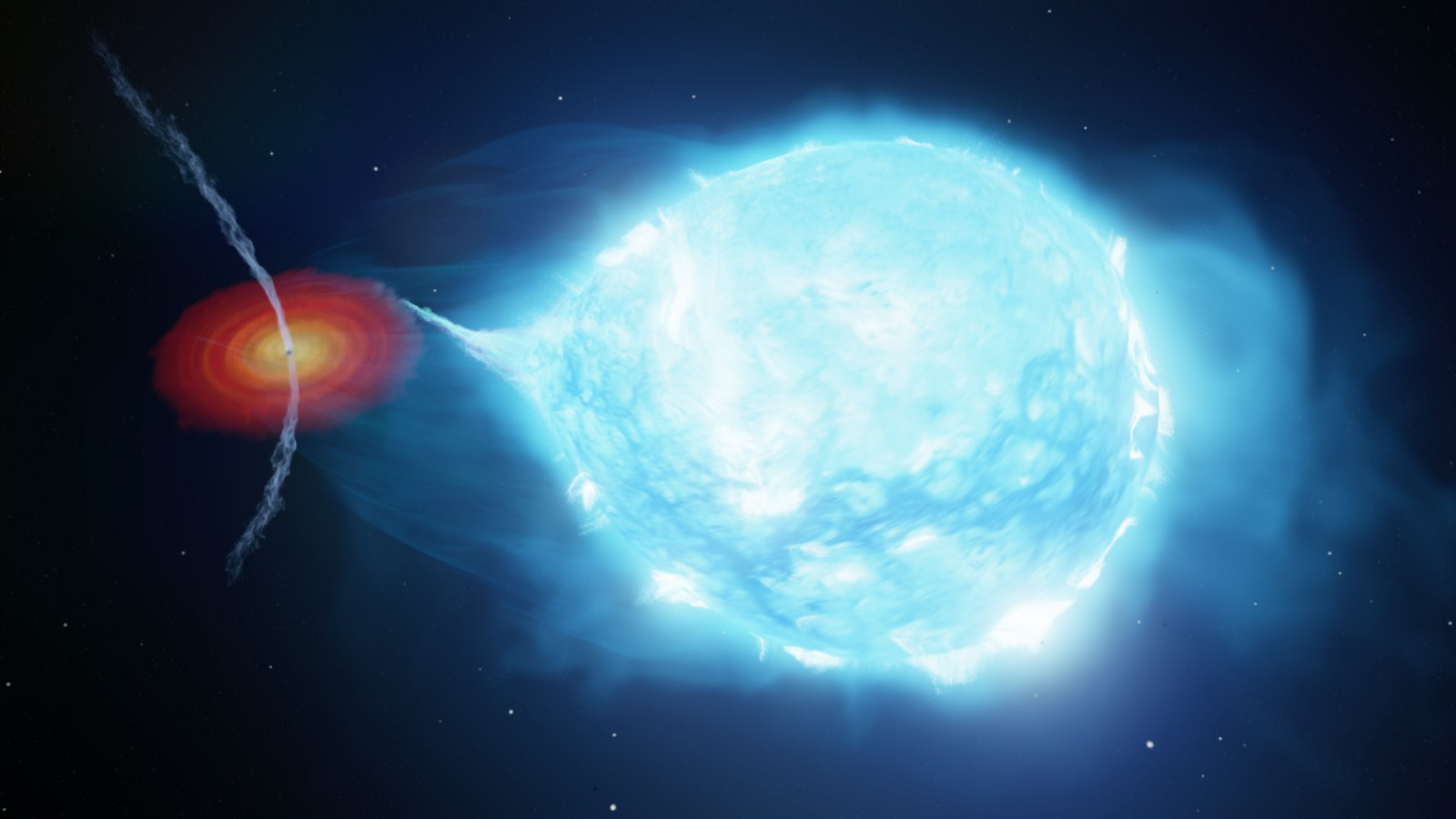
The subject of this study is Cygnus X-1 (Cyg X-1), one of the most prominent X-ray sources in the sky. The system is a violent binary partnership consisting of:
– A Stellar-Mass Black Hole: Estimated to be roughly 21 times the mass of our Sun.
– A Blue Supergiant Star: A massive donor star located just 30 million miles (48 million km) away from the black hole.
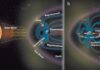
The relationship is parasitic. The blue supergiant emits powerful stellar winds, shedding material that is pulled toward the black hole. Because this matter possesses angular momentum, it cannot fall directly into the abyss; instead, it swirls into a flattened, superheated accretion disk. This process generates the intense X-ray emissions that make Cyg X-1 so visible to telescopes.
The “Dancing” Jets
Not all the matter consumed by the black hole is swallowed. Instead, a portion is channeled toward the black hole’s poles and ejected into space as massive jets.
Key characteristics of these jets include:
– Extreme Velocity: They travel at approximately 336 million miles per hour (150,000 km/s)—roughly half the speed of light.
– Erratic Movement: Lead researcher Steve Prabu of the University of Oxford described the jets as “dancing.” Rather than shooting in a straight line, the jets appear to deflect and wobble.
– The Cause of the Dance: The researchers determined that the intense stellar winds from the companion star are physically pushing against the jets, causing them to shift direction as the two objects orbit one another.
Why This Matters: Calibrating the Cosmos
This observation provides much more than just a spectacular visual; it offers a crucial piece of mathematical evidence.
For years, astrophysicists have operated on a theoretical assumption: that roughly 10% of the energy released by matter falling into a black hole is carried away by these jets. While this has been a staple of large-scale universe simulations, it has been notoriously difficult to prove through direct observation. The Cyg X-1 data has now provided that confirmation.
From Stellar-Mass to Supermassive
This discovery creates a bridge between different scales of cosmic phenomena. The physics governing a small black hole like Cyg X-1 are remarkably similar to the physics of supermassive black holes —the giants residing at the centers of galaxies that are millions or billions of times more massive than the Sun.
By “anchoring” their understanding with these precise measurements from Cyg X-1, scientists can now more accurately calibrate how much energy jets from distant, supermassive black holes are pumping into their environments. As the Square Kilometre Array Observatory continues its construction in Australia and South Africa, astronomers expect to use this new baseline to measure the power of jets in millions of distant galaxies.
This research confirms a long-held theoretical model, providing a vital calibration tool that allows scientists to scale their understanding from small stellar black holes to the supermassive giants that shape the architecture of the universe.