You’ve got the confidence. You’ve got the practice. But sitting down at a real poker table without knowing the slang is a recipe for disaster. You can’t play what you can’t pronounce, and you certainly can’t bluff if you don’t know what your opponent is saying.
Mastering the game isn’t just about reading your opponents’ faces. It’s about speaking their language fluently. Here is the definitive glossary to help you navigate the felt like a pro.
The Basics of Betting and Action
Poker is a game of money in the middle. Before cards are even dealt, forced bets called Blinds jump-start the Action, which is the collective betting within a hand. If you bet first, you start the action. Games with heavy betting are described as having “a lot of action.”
When you put money into the Pot (the sum of all bets), you are making a Bet. If you match an opponent’s bet exactly, you Call. If you refuse to bet when it’s your turn, you Check. But be careful. If you check and then raise when an opponent bets, you’ve just executed a Check-Raise. That’s a aggressive move.
You can also Limp-In, which means entering a hand by just calling the big blind before the flop. It’s passive. Loose players limp in often. Tight players don’t. If you play too many hands, you’re loose. If you play fewer than normal, you’re tight.
Position, Cards, and Community Board
Your Position matters. It’s your place in the betting order. Acting first is bad; acting last is good. The Button token marks the dealer position, which gets to act last in most rounds after the first.
Under the Gun means you are the first person to act on the first round. It’s a tough spot.
You’ll look at your own cards, known as Hole Cards. These are private. If your hole cards are a pair, you have a Wired Pair. If they are the same suit, they are Suited.
Then there are the Community Cards or the Board. In Texas Hold’em, the first three cards flipped are the Flop.
Your hand strength depends on these cards. If you match the lowest card on the board, you have Bottom Pair. The Middle Pair uses the second-highest card. An Overcard is a card in your hand higher than the community cards.
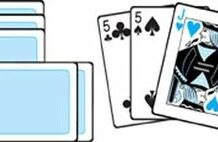
To break ties, you use your Kicker. In Hold’em, if the board has an Ace and you hold Ace-5, your 5 is the kicker. If your opponent has Ace-King, their King wins. Your kicker loses.
Hands and Hierarchy
Poker hands have specific names. A Pair is two cards of the same rank. Trips and a Set are both three of a kind, but they come from different sources. A Set is usually three of a kind using one hole card and two board cards. Trips can be formed differently depending on the game variant.
Quads is four of a kind. If you have four aces, you have quads.
Drawing cards changes things. A Back Door draw needs two specific cards to hit (like the turn and river) to complete a flush or straight. A Gutshot (or belly buster) is an inside straight draw. You need one specific card in the middle of your sequence.
Outs are the cards left in the deck that will improve your hand. If you need a spade to complete a flush, every remaining spade is an out.
Sometimes you can’t win even if you hit. This is Drawing Dead. Even if your hand improves, someone else already has a better hand that cannot be beaten.
Bluffing and Psychology
Poker is half math, half psychology. A Bluff is betting with a weak hand to make opponents fold. A Semibluff is similar. You might not have the best hand now, but you have a good chance to improve to the best hand.
If you lose a hand where you were a massive favorite before the river card, that’s a Bad Beat. It hurts.
Your behavior can give you away. A Tell is an action that reveals the strength of your hand. Watch for them. Use them sparingly.
When you lose control and start making emotional, poor decisions, you are Tilt. Don’t let it happen. It’s the fastest way to lose your Bankroll —the money you have available to play over a specific period.
Advanced Concepts and Table Dynamics
Understanding Expected Value (EV) is key. It’s the average amount you expect to win or lose when betting in the same situation repeatedly. Positive EV is good. Negative EV is bad.
Pot Odds help you calculate if a call is worth it. You compare the size of the pot to the bet you must call. Implied Odds go further. They include bets you expect to win later if you hit your hand.
At the table, one player might go All-In. If they do, and two or more others are still betting, a Side Pot is created. The all-in player can only win the main pot. The others bet against each other for the side pot.
If one player has the smallest stack of chips, they are Short Stacked.
Casinos take money. Rake is the percentage taken from each pot. Some rooms charge a Seat Charge per hour instead.
Final Tips for the Table
If you are playing against a single opponent, it’s Heads-Up.
Best of It simply means you are the favorite to win.
If you decide you’re done, you Muck your hand. You discard it face down.
You don’t need to memorize every term instantly. But knowing the difference between a Raise (betting higher than a previous bet) and a Reraise (raising after a raise) will keep you from looking like a novice.
Learn these terms. Use them. The game opens up when you understand what’s happening under the hood.
Further Reading on Poker Strategy
- How To Play Poker : Check out our main guide for comprehensive rules and advice.
- Poker Basics : Start here for a pure introduction to the game mechanics.
- How to Play Texas Hold ‘Em Poker : Most of these terms are specific to this variant. Learn the most popular game.
- How to Play Poker in a Tournament : These phrases are essential when competing against experienced players in tournament settings.