


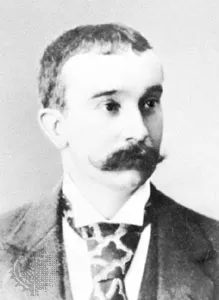

Andreas Franz Wilhelm Schimper did not only study plants. He mapped their territory.
Born in Strasbourg on May 12, 1856, the German scientist achieved something that most biologists of his time had missed. He noticed that the world’s vegetation is not random. Follow the rules. The rules are written from a climatic and physiological point of view. He died on 9 Sep 1901 in Basel, Switzerland. But before he left, he provided us with our first real framework for understanding the floral regions.
How Schimper defines the flower area
If you look at a map of Africa or South America, you will see the borders. Schimper looked at the green and saw it.
He believed that the continent could be divided into different floral regionss. It’s not about politics. Because of plant life. His big breakthrough came in 1898 when he published Pflanzen-Geographie auf physiologischer Grundlage. English title? Plant-Geography upon a Physiological Basis. It dropped in 1903.
This is not a dry list of species. This is a structural argument. The book is divided into three separate parts.
First we looked at what kills or helps plants. temperature. humidity. light.
Second, it gives his classification of the world’s vegetation.
Third, it provides a systematic description of the vegetation.
The book also tells about the spread of plants to new areas and the unexpected stability of those areas.
The stability part is important. We consider nature to be wild and chaotic. Schimperer showed it to be systematic. Predictable, even.
Discovery of chloroplasts
Although his geographical research later made headlines, his early laboratory work changed biology forever.
He received his Ph.D. He received his doctorate from the University of Strasbourg in 1878. He then spent a year as a researcher at Johns Hopkins University in Baltimore. 1880-1881. He returned to Europe and joined the faculty of the University of Bonn. He remained there until 1898, when he moved to Basel as a professor.
But he didn’t take his eyes off the cell.
In 1880, Schimperer showed something simple that no one was sure about. starch. It is more than just a storage tank for plant energy. It is a direct product of photosynthesis.
Two years later, in 1882, he elaborated. He showed that starch granules are formed in specific bodies of plant cells. He didn’t just see them. He tracked them.
In 1883, he named these objects. Chloroplasts.
His arguments still hold true. New chloroplasts don’t appear out of nowhere. They are simply the result of division of preexisting ones.
This is huge. It connects the visible world of the leaf to the invisible mechanisms of the cell. It explained how plants make their food. It also explains “where” that machinery lives.
Why is this important now?
We take photosynthesis for granted. It’s in every textbook. However, before Schimperer, the relationship between leaves and starch was unclear. There is no connection between geography and botany.
He traveled to Brazil. Java. East Africa. The Canary Islands. He didn’t just collect samples; he tested them