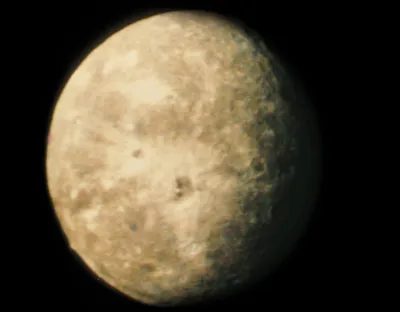
It sits out there. Far from the Sun. Far from the warmth that drives weather on Earth. Oberon is the outermost of Uranus’s five major moons, a silent, icy sentinel drifting 583,500 kilometers away from the gas giant it orbits. Discovered in 1787 by William Herschel—just six years after he found the planet itself—it remains one of the most mysterious and oldest members of the Uranian system.
Named by William’s son, John Herschel, after a character in A Midsummer Night’s Dream, this moon is not just a rock in the void. It is a geological archive. Its surface tells a story of violence, age, and hidden heat that challenges our understanding of how icy bodies evolve in the deep freeze of the outer solar system.
The Geometry of a Frozen World
Oberon is the second largest moon in the Uranian system, measuring nearly 1,523 kilometers (946 miles) across. It is dense for an icy body—1.63 grams per cubic centimeter—suggesting a mix of water ice and rocky material that mirrors its siblings Ariel, Umbriel, and Titania.
The mechanics of its orbit are rigid and predictable. Oberon takes 13.463 Earth days to complete one lap around Uranus. Crucially, it is tidally locked. This means the same hemisphere always faces the planet, and the same face points forward in its orbit. It is a synchronized dance that has likely persisted for billions of years.
Oberon is one of the most heavily cratered of Uranus’s major moons, which may indicate that it is one of the planet’s oldest satellites.
Reading the Scars on the Surface
If you were to land on Oberon, the first thing you’d notice is the lack of fresh ground. The surface is old. Aggressively so.
Among the large moons of Uranus, Oberon is the most heavily cratered. This pockmarked landscape suggests it has remained relatively unchanged for eons, preserving a record of bombardment that other, more geologically active moons have erased. The craters themselves are named after Shakespearean figures, a literary touch added by later astronomers.
The largest of these scars is the Hamlet crater, spanning 206 kilometers (128 miles). It is followed closely by Macbeth, which stretches 203 kilometers (126 miles) wide. These aren’t just dents in the ice; they are geological features that hint at complex histories.
Evidence of Internal Heat
For decades, Oberon seemed like a dead world. A frozen relic. But images from the Voyager 2 flyby in 1986 revealed something surprising.
While the surface is indeed ancient and cratered like the highlands of Earth’s Moon, it isn’t uniformly dark. Some of the bright craters appear to have been flooded by dark material that upwelled from the interior. This isn’t lava in the volcanic sense we know from Earth or Io. It’s likely cryovolcanism—ice melting and erupting due to internal heat or impacts.
This suggests that Oberon wasn’t always a passive ice ball. At some point, its interior was warm enough to mobilize material, reshaping