


The universe didn’t start small. It started hot.
That is the core premise of the big bang model. This widely accepted theory explains how everything we see emerged from a state of extreme density and temperature. The event itself happened 13.8 billion years ago. Before that, there was no “before” in any traditional sense. Just a singularity.
The idea wasn’t born in a vacuum. It came from two distinct sources in the 1920s. Russian mathematician Aleksandr Friedmann derived solutions to Einstein’s equations that suggested an expanding universe. Around the same time, Belgian astronomer Georges Lemaître proposed that the universe began from a “primeval atom.” Both were correct. Both were ignored or overlooked for a while.
It took the 1940s for the modern version to crystallize. That work falls largely to George Gamow. He was a Russian-born American physicist who saw the implications of an expanding, cooling universe. He and his colleagues predicted that if the universe started hot, remnants of that heat should still be around. They called it cosmic background radiation.
This isn’t just history. It’s physics. The big bang model isn’t a static picture. It’s a dynamic timeline. It tracks the cooling of the cosmos. It explains the formation of light elements. It sets the stage for galaxies to form. Without this framework, we have no baseline for where we are. We are floating in the aftermath of that explosion.
The model has held up. Observations of redshift. Measurements of the cosmic microwave background. The abundance of hydrogen and helium. All of it points back to that initial hot, dense state. It is the only theory that fits the data so well.
But it leaves questions. What triggered the expansion? What happened at the very first instant? The model describes the evolution. It doesn’t explain the ignition. That gap remains. For now, we look at the evidence. We trace the expansion backward. We accept the big bang as the starting point of our cosmic story. Even if the beginning remains partially obscured.

The standard model of cosmology doesn’t just appear out of thin air. It rests on two specific pillars. If one crumbles, the entire framework wobbles.
The first pillar is Albert Einstein’s general theory of relativity. This is the bedrock. It assumes that our current understanding of gravity correctly describes how all matter interacts across the cosmos. We trust this because it has held up to nearly every test we’ve thrown at it for a century. But trust is not proof.
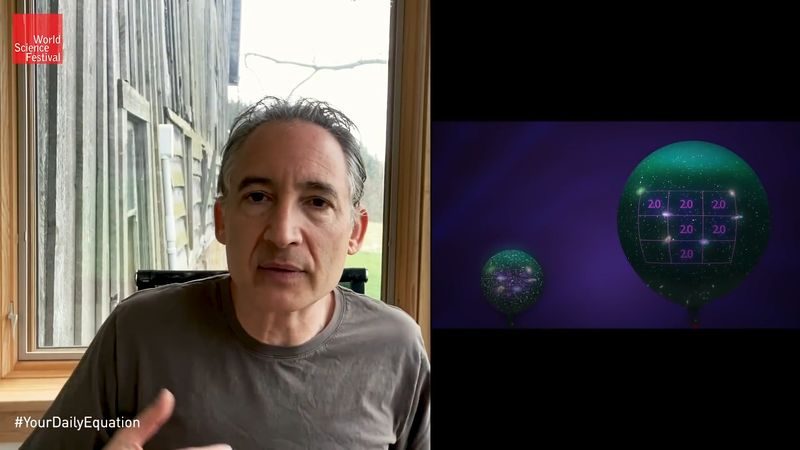
The second pillar is the cosmological principle. It sounds simple enough. It states that an observer’s view of the universe does not depend on their direction or location. Look left, look right, look up, look down. It’s all the same. You are no more special than any other point in space.
This principle applies only to the large-scale properties of the universe. Zoom in too close, and you see galaxies, stars, and voids. Structure everywhere. But smooth it out over billions of light-years, and it becomes uniform. This uniformity implies something profound. It implies the universe has no edge.
Think about that.
If there is no edge, the big-bang origin did not happen at a single point in space. It didn’t explode into a pre-existing void. The expansion happened through space at the same time. Everywhere was the big bang. Every point was the center.
The Limits of Calculation
These two assumptions—relativity and uniformity—allow physicists to calculate the history of the cosmos. They can trace the timeline back to a specific epoch. It’s called the Planck time.
Before Planck time, the math breaks down.
Scientists have yet to determine what prevailed before that tiny fraction of a second. The equations of general relativity clash with quantum mechanics at that scale. We simply do not have a working theory of quantum gravity. So, we are blind to the first moments of existence.
We can describe the aftermath. We can map the cooling gas, the formation of atoms, the first stars. But the initial trigger? The moment of creation? That remains a mystery. We are calculating the movie from the first scene onward. We do not know who wrote the script.
This is not a failure of science. It is a boundary condition. It marks the limit of our current tools. We know what we do not know. That is a distinct, uncomfortable, and necessary position.

The Cooling Universe and Its Cosmic Relics
The universe didn’t just appear. It expanded. Fast. From a state so compressed that density and temperature were almost incomprehensible, the cosmos stretched out, cooling rapidly as it went. This wasn’t just expansion for expansion’s sake. It created the conditions for matter to finally outpace antimatter.
We see that dominance today. But it wasn’t guaranteed. Theories suggest this asymmetry was locked in during those first chaotic moments. And it came with a catch. The same processes that favored matter over antimatter also predicted something else entirely: proton decay. It’s a prediction we haven’t quite seen yet, but the math holds.
During this phase, the particle zoo was full. Too hot for structure. Too hot for anything to stick. But give it a few seconds, and the temperature dropped enough for nuclei to form. Big Bang nucleosynthesis. It’s a precise process. The math predicts specific ratios. Hydrogen. Helium. Lithium.
Look at the sky today. The amounts match. Exactly. This isn’t a rough approximation. It’s a tight fit between theory and observation. It’s one of the strongest pillars of the model.
But atoms? That had to wait.
For about a million years, the universe remained a foggy plasma. Charged particles scattering light in every direction. Nothing could travel freely. Then, the temperature cooled enough for electrons to bind with nuclei. Atoms formed. The fog cleared. Light, previously trapped, was suddenly free to roam the cosmos.
This leftover radiation is what we call the cosmic microwave background. It’s the afterglow of the Big Bang. A relic from the dawn of time. It’s not warm. Not really. It’s cold.
The Microwave Background Discovery
Technically, it’s 2.728 Kelvin. Just above absolute zero. But for decades, it was known simply as the “three-degree” background. That label stuck. It’s how most people refer to it, even if the precision has improved.
It was discovered in 1965 by Arno Penzias and Robert Wilson. Two American physicists. They weren’t even looking for it. They were working with a horn antenna, trying to eliminate noise. They kept finding this persistent hiss. They cleaned the antenna. They checked for pigeon droppings. Nothing worked. The noise remained.
It turned out to be the universe itself speaking.
This discovery confirmed the prediction that the early universe left a thermal imprint. It’s the oldest light we can detect. A snapshot of the universe when it was roughly 380,000 years old. Before that, it was opaque. After that, it was transparent. The universe opened up.
Hidden Particles and Future Relics
The story doesn’t end with photons. The model predicts more ghosts in the machine. Neutrinos. Fundamental particles with no mass. No electric charge. They interact so weakly that they pass through Earth by the billions every second without us noticing.
The Big Bang model predicts that the universe should be filled with a cosmic neutrino background. Relics from the same era as the microwave background. But detecting them is incredibly difficult. They’re faint. Elusive.
There’s a possibility that other relics exist too. We don’t know what else might be hiding in the dark, waiting


