


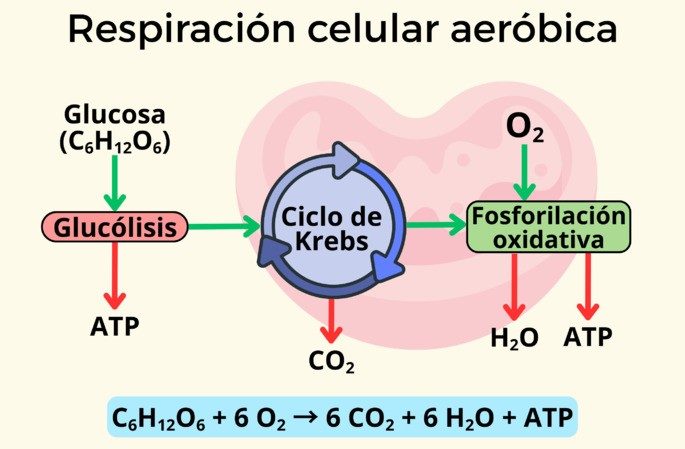
Your cells are busy. They need fuel to keep your heart beating, your brain firing, and your muscles contracting. That fuel comes from cellular respiration, the process by which a cell extracts energy from sugars and other organic molecules. It is not just a single reaction. It is a complex chain of chemical events happening constantly inside you.
The end result is straightforward: carbon dioxide, water, and ATP.
What Exactly Happens Inside Your Cells?
ATP, or adenosine triphosphate, is the energy currency of life. Your cells use it to do work. The carbon dioxide is waste. It leaves the cell. The water is a byproduct. The real magic is the conversion of chemical bonds into usable power.
This process does not happen everywhere in the cell. It takes place in two specific locations:
– The cytoplasm
– The mitochondria
Enzymes drive these reactions. They are specialized proteins that speed up the chemistry. Without them, the process would be too slow to sustain life. Each enzyme handles a specific step, ensuring the breakdown of carbon and hydrogen in the presence of oxygen or other compounds happens efficiently.
Cellular respiration is how life converts food into action.
Why does this matter? Because every movement you make, every thought you have, and every breath you take relies on this microscopic machinery. It is the engine that keeps you alive.

Why anaerobic respiration lacks a universal chemical equation
Aerobic respiration follows a predictable script. Glucose meets oxygen. Carbon dioxide, water, and ATP emerge. The balance is straightforward.
C6H12O6 + 6 O2 → 6 CO2 + 6 H2O + Energy (ATP)
That clean equation does not exist for anaerobic respiration. Why? Because different organisms use different chemicals as final electron acceptors. Some swap oxygen for sulfate. Others use nitrate. The chemistry shifts with every species and environment.
The one constant remains. Oxygen is absent. Efficiency drops significantly compared to the aerobic version. You get less ATP for the same amount of glucose.
The three stages of breaking down glucose
Cellular respiration is not a single reaction. It is a pipeline. Three distinct phases handle the job.
1. Glycolysis: The cytoplasm starter
This happens first. In most cells, the action moves through the cytoplasm.
One glucose molecule (six carbons) splits into two pyruvate molecules (three carbons each). Ten separate reactions drive this process. Each step is catalyzed by a specific enzyme.
The energy math is modest. The cell spends two ATP molecules to start the line. It harvests four ATP by the end. Net gain: two ATP.
It also produces two NADH molecules. These carriers hold hydrogen atoms ready for the final stage. They are the fuel for what comes next.
2. The citric acid cycle: The mitochondrial engine
In eukaryotes, the scene shifts to the mitochondria. This is the second stage. Scientists also call it the Krebs cycle or the tricarboxylic acid cycle.
Here, the goal changes from direct ATP production to electron harvesting.
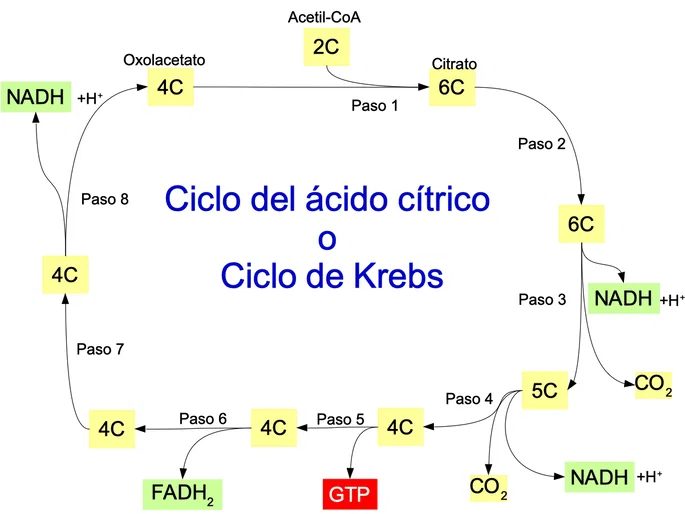
The cycle has eight steps. It starts when oxalacetate (four carbons) meets acetyl-CoA (two carbons). Together, they form citrate (six carbons).
From there, the molecule sheds carbon. Carbon dioxide leaves the system. The remaining carbon skeleton shrinks, releasing high-energy electron carriers along the way.
You get NADH. You get FADH2. These are not ATP yet. They are tickets to the next stage.
The carbon atoms released as CO2 are eventually expelled from the cell. The cycle finishes by regenerating oxalacetate. It is ready to start again.
The cycle does not make much ATP directly. It prepares the fuel for the main energy release.
Comparing aerobic and anaerobic pathways
The difference is not just the presence or absence of oxygen. It is the yield.
Aerobic respiration extracts maximum energy from glucose. Anaerobic respiration is a workaround. It allows life to continue without oxygen, but it is inefficient.
The universal formula for aerobic respiration works because the inputs and outputs are consistent. The formula for anaerobic respiration varies because the inputs change. Sulfate reducers, nitrate reducers, and other microbes all run different chemical scripts.
Both processes serve the same biological need. Converting chemical energy into usable ATP. The method determines how much you get.

How oxidative phosphorylation turns electrons into cellular energy
The final act of cellular respiration happens in the inner mitochondrial membrane. This is where oxidative phosphorylation actually happens. It is the only stage that uses oxygen directly.
Think of it as a relay race. Electron carriers, specifically NADH and FADH2, hand off high-energy electrons to a chain of proteins. These proteins are embedded in the membrane. As the electrons move down the line, they eventually reach oxygen molecules. The oxygen grabs those electrons and teams up with hydrogen ions (H+) to form water. That is the waste product you breathe out.
But the real payoff is the ATP. As the electron transport chain runs, it pumps protons across the membrane, creating a gradient. That pressure drives a turbine-like enzyme to snap a phosphate group onto ADP, making ATP. This specific reaction is called phosphorylation. The math is impressive. One molecule of glucose can yield between 36 and 38 ATP molecules. That is a massive jump from the meager returns of glycolysis.
Where aerobic and anaerobic respiration diverge
The fork in the road comes down to one variable: oxygen. If you have it, you take the aerobica route. If you do not, you go anaerobic.
In aerobic respiration, the pyruvate produced during glycolysis in the cytosol gets shuttled into the mitochondria. There, it gets converted. It releases carbon dioxide and becomes Acetyl-CoA. That Acetyl-CoA then feeds into the Krebs cycle, keeping the engine running at full capacity.
Anaerobic respiration is the backup plan. It starts the same way. Glucose goes through glycolysis. But once you hit pyruvate, the path changes. Because there is no oxygen to accept electrons in the mitochondria, the cell relies on fermentation in the cytoplasm.
This is why sprinters gasp after a race. Your muscles switch to fermentation. The pyruvate turns into lactate. In yeast, it turns into ethanol and carbon dioxide. The result is the same either way: less energy. Anaerobic pathways are far less efficient. You get a tiny fraction of the ATP you would get if oxygen were present. It works, but it is a short-term fix.


