
May isn’t just the month the roses start popping. It is the month the sky gets busy.
You get the full moon, sure. But you also get the debris trail left behind by Halley’s Comet. That is the Eta Aquariids meteor shower. And the constellation Leo? It is strutting across the night sky like it owns the place.
The Moon is doing a lot of work, too. It is the guidepost for several other viewing opportunities.
Why the Eta Aquariids Matter for May Sky Watchers
You are not looking at a random bunch of dust. You are looking at Halley’s leftovers.
Halley’s Comet last visited in 1986. The dust it shed back then is still floating out there. When Earth’s orbit plows through that debris stream in May, we see meteors.
This is the Eta Aquariids meteor shower.
It peaks around May 5 and 6. You don’t need a telescope. You need a dark sky, some patience, and a reclining chair. The meteors are generally bright and fast. They come from the direction of Aquarius, but you will see them streaking anywhere in the sky.
The Eta Aquariids are one of the few meteor showers that are actually visible from both the Northern and Southern Hemispheres.
If you are wondering about the “best time to see meteors in May,” look just before dawn on May 6. That is when the viewing geometry aligns best.
How the Moon Changes What You Can See in May
The full moon peaks on May 23. That is a lot of light for stargazing. It washes out faint objects.
But the waxing and waning phases are where the fun happens.
In the first half of the month, the Moon is a crescent. It hangs low in the east after sunset. It is a beautiful object in its own right. You can see the terminator line, the shadow edge, sharply defined.
As the month progresses, the Moon gets closer to the planets. By late May, it sits near Saturn and Jupiter. That is a photo op. Point your camera or binoculars at that cluster.
Why Leo Is the Star of the Show in May
Leo is high in the sky all night long in May. It is not fighting the twilight. It is right there.
Regulus, the brightest star in the constellation, is easy to spot. It is a blue-white star. It marks the heart of the Lion.
The Sickle asterism is the head. Algieba is the heart. Denebola is the tail. It is a simple pattern. You can learn it in ten minutes.
Why does this matter? Because Leo is a spring constellation. It signals the change in the sky. It is a anchor point. When you know where Leo is, you know where the rest of the Milky Way is.
Where to Look for Planets in May 2024
The planets are putting on a show, too.
- Venus : Bright, high in the east before sunrise. It is the morning star right now.
- Mars : Visible in the early morning. It is getting smaller
Mai 2024: Die Weißen Nächte und die besten Sternkonstellationen
Die Sonne weigert sich fast, den Horizont zu verlassen. Ende Mai wird es nur noch zwischen Mitternacht und kurz vor 3 Uhr morgens richtig dunkel. Anfang Mai dauert diese Phase noch doppelt so lange. Je nördlicher die Beobachtungsstätte, desto heller bleibt der Himmel. Für die Beobachtung von Weißen Nächten am Himmel ist das ein Nachteil. Das Firmament wird zu hell. Trotzdem lohnt der Blick nach oben.
Pollux, Mars und der Halbmond
Am 2. Mai um Mitternacht steht die Mondsichel direkt neben Pollux. Dieser orange leuchtende Riese ist der hellste Stern im Sternbild Zwillinge. Links oberhalb positioniert sich der Mars. Das Trio bildet einen auffälligen Kontrast im dunklen Himmel.
In den folgenden Wochen verblasst der rote Planet. Er wird unauffälliger. Dennoch bleibt er ein Blickfang.
„Nun können wir beobachten, wie sich ihm der zunehmende Halbmond nähert. Schauen wir gegen 23:30 Uhr in Richtung Westen, erfreuen wir uns am wohl schönsten Himmelsanblick des Monats“, erklärt Björn Voss, Direktor des Planetariums Hamburg.
Der Mond prangt direkt neben der rost-roten Nachbarwelt. Jupiter ist gerade noch am Firmament auszumachen. Dieser Anblick in der Abenddämmerung lohnt den Griff zum Fernglas.
Der Abschied des Jupiter
Am 28. Mai gesellt sich die Mondsichel erneut zu Jupiter. Der Gasriese macht sich auf den Weg vom Himmel fort. Nach Mai wird er schwer zu entdecken sein. Die kurze Phase bis zu seinem Verschwinden bietet noch einmal einen hübschen Anblick. Wer auf Sichtungen des Jupiter hofft, sollte diese Tage nutzen.
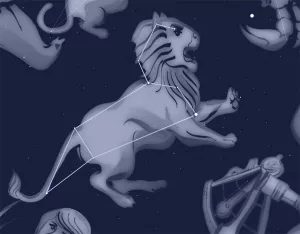

The Moon meets Regulus in the constellation Leo
May 5 marks a specific moment for stargazers. The Moon slips near Regulus, the brightest star in Leo. This isn’t just a random alignment. It’s a visual cue pointing you toward the Spring Triangle.
You need to know what you’re looking at. Regulus sits in the chest of the lion. Denebola marks the tail. Algieba sits at the mane. The names come from Arabic. They mean “tail” and “mane of the lion.” Simple. Direct.
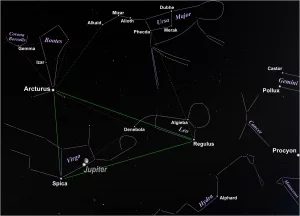
This grouping helps you find your way around the sky. Regulus, Arcturus in Bootes, and Spica in Virgo form the Spring Triangle. It’s a large, open shape. Easy to spot. If you can find one corner, you can usually trace the others.
Why does this matter? Because the naked eye sky is cluttered. You need anchors. The Moon provides a temporary anchor. When it sits next to Regulus, it draws your eye to the lion’s chest. From there, you can extend your view to the rest of the triangle.
Don’t confuse Regulus with Arcturus. Arcturus is brighter. It sits in the northern part of the sky. Regulus is lower. They are distinct points in the same asterism. The Spring Triangle spans a large area. It covers a significant portion of the spring night sky.
This alignment happens because of orbital mechanics. The Moon moves fast. It passes by Regulus on this specific date. You don’t need a telescope. Binoculars help with detail, but the naked eye catches the event. Look for the bright point of light near the star. That’s the Moon.
The spring sky is rich. It has more recognizable constellations than winter or autumn. Leo is one of them. The names Denebola and Algieba are technical, but their meanings are intuitive. Tail. Mane. You can visualize the animal if you try.
So, on May 5, look east after sunset or in the early morning, depending on your latitude. Find the bright star Regulus. See the Moon nearby. Then look out to Arcturus and Spica. You have the triangle. You have the lion. You have the spring sky mapped out in front of you.

May Sky Events: Eta Aquariids, the Flower Moon, and Venus
The Eta Aquariid meteor shower is visible every May. Named for its radiant point in the constellation Aquarius, the activity peaks around May 6, with meteors remaining visible until mid-month. Observers in Central Europe face a challenge. Aquarius rises just before dawn, making the viewing window extremely short. Conditions are significantly better in the Mediterranean and southern regions.
These spring meteors originate from Halley’s Comet. The comet visits Earth roughly every 76 years. The last close pass was in 1986. Its tail leaves a trail of dust that Earth intersects annually in May. In 1910, Earth passed directly through the comet’s tail.
Public panic followed the 1910 event. Researchers had announced the comet contained hydrogen cyanide. Experts emphasized the concentration was harmless. Gas masks and “comet pills” sold widely as protection against potential poisoning. Speculation about Earth’s destruction also circulated. Historical pattern: speculative entrepreneurs exploit public fear during celestial events.
The Flower Moon and Venus Visibility
A full moon appears on May 12. Common names for this lunar phase include “Wonnemond” (German for “pleasant moon”) and “Flower Moon.” Indigenous North American peoples named it the Flower Moon, reflecting seasonal associations with blooming plants. Naming conventions often reflect local customs and environmental observations.
Venus, the morning star, offers limited viewing time in May. At the start of the month, Venus rises around 4:30 AM. By the end of May, its rise shifts about an hour earlier. However, the sun also rises earlier. This shortens the astronomical twilight window where Venus is visible against a dark sky.
On May 24, the moon appears as a thin crescent next to Venus. In the two nights preceding this date, the moon is positioned near Saturn. These lunar pairings provide clear visual markers for observers tracking planetary positions.