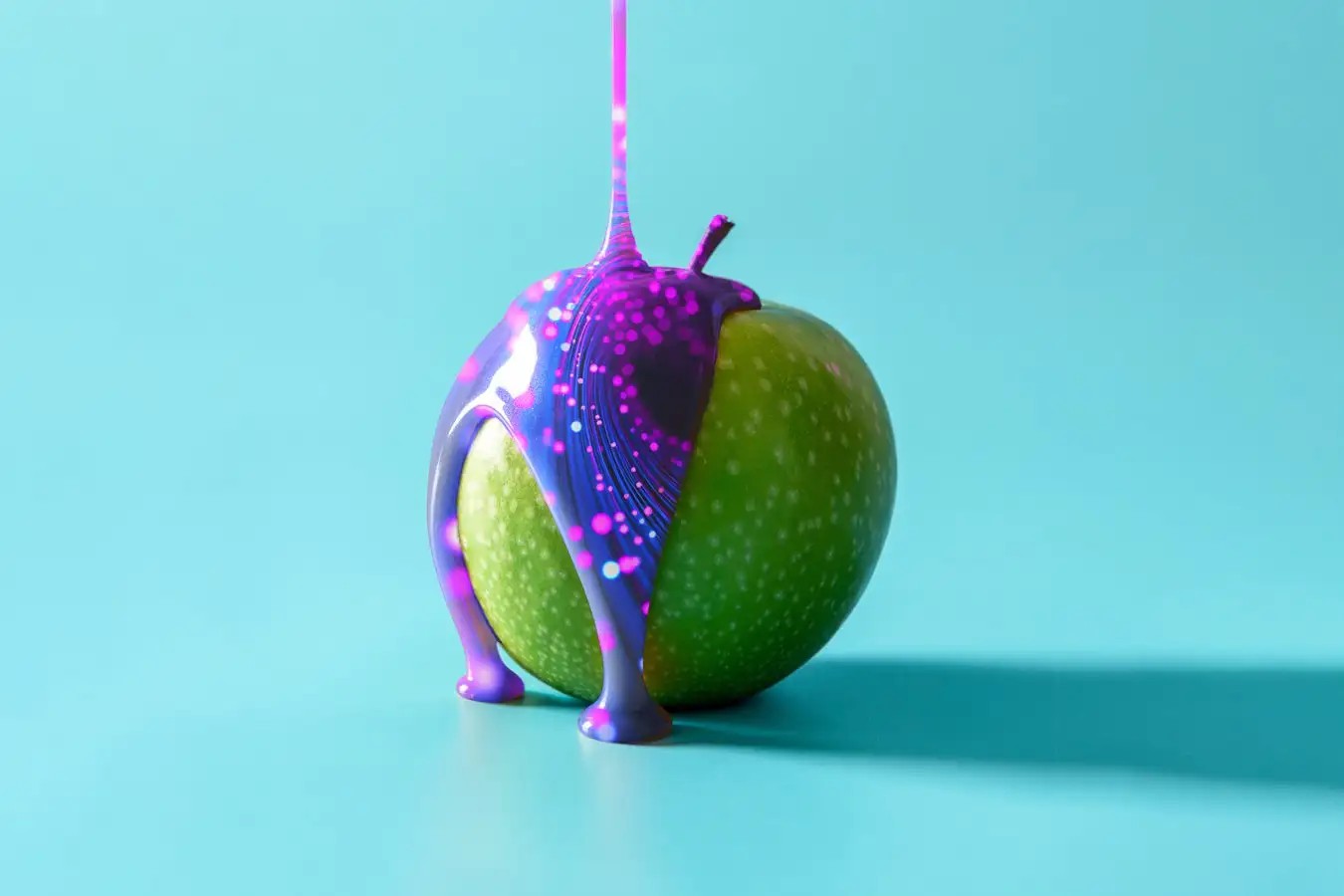
Sometimes you realize you’re walking backwards through a door. You’ve shoved. Rotated the piano. Broken the legs. Still doesn’t fit.
You don’t force the piano.
You build the room.
That is what some physicists are doing right now. For eighty years the plan was to squeeze gravity into quantum mechanics. Quantum theory rules three of the four forces. It works. It predicts. So we assumed gravity would too.
It won’t fit.
Almost a century later.
“This is like going into the ocean with no map.” — Angelo Bassi, University of Trieste
Maybe the wrong direction leads to the right answer.
The cat. The cloud. The contradiction
Your desk is solid. The clock ticks. Your cat is either alive or not. Definite.
Down at the atom scale. Nothing is definite.
Quantum mechanics deals in probabilities. A particle isn’t here or there. It’s a blur of possibilities. A wave function. You predict the odds. Not the outcome. Until you look. Then it picks. One spot.
Two headaches.
First: When does the fuzzy cloud become a hard object? Where does quantum end and reality begin?
Second: This probability business hates Einstein. His gravity is precise. Classical. Every point in space has a value. Merging them creates monsters. String theory is heavy. Untestable. Clunky.
The old assumption was that everything is quantum deep down. Bassi says we’ve hit a wall. “We have to understand what else is going on.”
We have to break the rules to fix them.
Superposition’s weight problem
Take superposition. Put a particle in two places at once. Easy enough. Scientists do this with photons. Atoms.
Measure it. It collapses. Left or right.
Why?
Some say many worlds. Every outcome happens in a branch. Fine. Boring.
Others want physics. Real causes.
In the 80s. Giancarlo Ghirardi and colleagues suggested invisible forces tamp down the quantum waves. Later Lajos Diósi and Roger Penrose added a twist.
Gravity does the collapsing.
Imagine a big object. Split it into two locations. Superposition. Space-time has to curve two ways. At once. It can’t. The geometry refuses. The tension breaks the superposition. Quantum cracks. Gravity stays intact.
Bigger mass. Faster collapse.
That explains why you never see a chair in two rooms. The gravitational pull drags it down into reality. Instantly. Any measuring device is massive enough to trigger it.
“Quantum cracks first.” — Penrose model premise
No more measurement problems. The act of looking doesn’t matter. The weight matters.
Bigger is better. If you can catch it
Testing this is hard. You need big stuff. Really big stuff. In quantum land.
Interferometry got better. Now physicists coax massive things into superposition. Earlier this year. Sodium nanoparticles. 7,000 atoms. Larger than a virus.
Then Penrose’s team posted a new idea in December 2022. Not peer reviewed yet.
Ron Folman’s group in Israel trapped rubidium. One state levitated. The other fell. Gravity acted on both. The interference pattern told them how the quantum state changed.
It matched old predictions.
Quantum and gravity? Compatible. At this size.
But Folman says scale up. Make it heavy enough for its own gravity to pull on its other self. The atom here tugs on the atom there. Penrose says the interference dies. The superposition collapses from internal tension.
Cătălina Curceanu watches closely. She calls the tech fascinating. “Quantumness dies in front of your eyes.”
Her team tries diamonds. Two micrometers apart. If they succeed the collapse should take less than a second.
Bassi isn’t rushing. “Molecules are too small now. The day will come. Long journey.”
Make gravity noisy
What if gravity isn’t just classical?
What if it’s random?
Jonathan Oppenheim at UCL proposed this in 2023. “Post-quantum.” Gravity remains classical. But it wiggles. Noises. Objects don’t fall straight. They jitter. Intrinsic noise built into space-time itself.
No need for a ‘collapse’ mechanism. No measurement required. The randomness kills superpositions.
It builds on 2016 work by Diósi and Antoine Tilroy. They showed math allowing classical gravity. Oppenheim took it further. He claims it fits Einstein. Fully.
Not everyone likes it.
Ivette Fuentes thinks it’s lazy. Random gravity without explaining the source hides the problem. But she admits: It’s a valid test. Alternative path. Worth running.
Recent studies support the chaos. If gravity is classical. It shakes quantum waves. Bassi and Daniel Carney calculated the size of those shakes. Minimal. Measurable?
Maybe.
Three ways to look for the noise
Experiments are moving. Three angles.
One. Heat.
Random gravity shakes charged particles. Jitter. Radiation. Light. Curceanu’s team buries germanium crystals under a kilometer of rock. Wrapped in lead. No sunlight. No cosmic rays. Just the earth’s hum.
Looking for sparks.
So far? Nothing significant. Good news. Bad news.
Eliminating models leaves the real work. “Now it begins.” she says.
Two. Pendulums.
Oscillating arms. Cantilevers. Metal cubes freefalling in space aboard ESA’s LISA Pathfinder. They watch for weird swerves. Unexplained drift.
Bassi proposes colder experiments. Less noise. More sensitivity.
Three. Time.
Nicola Bortollotti’s team found a new target. Gravity doesn’t just shake space. It shakes time.
Random fluctuations put a limit on precision clocks. A fuzziness. Not the Planck scale. Closer.
“Ultimate fuzziness arises from accessible physics.” — Cătălena Curceanu
Current atomic clocks tick on electron jumps. Good. Not good enough for this.
But we’re building better ones. The window opens. The room is being constructed.
The piano hasn’t fit yet. But we stopped shoving it through the door. We are moving the walls.
Where do we put the fourth side?
That is the question.