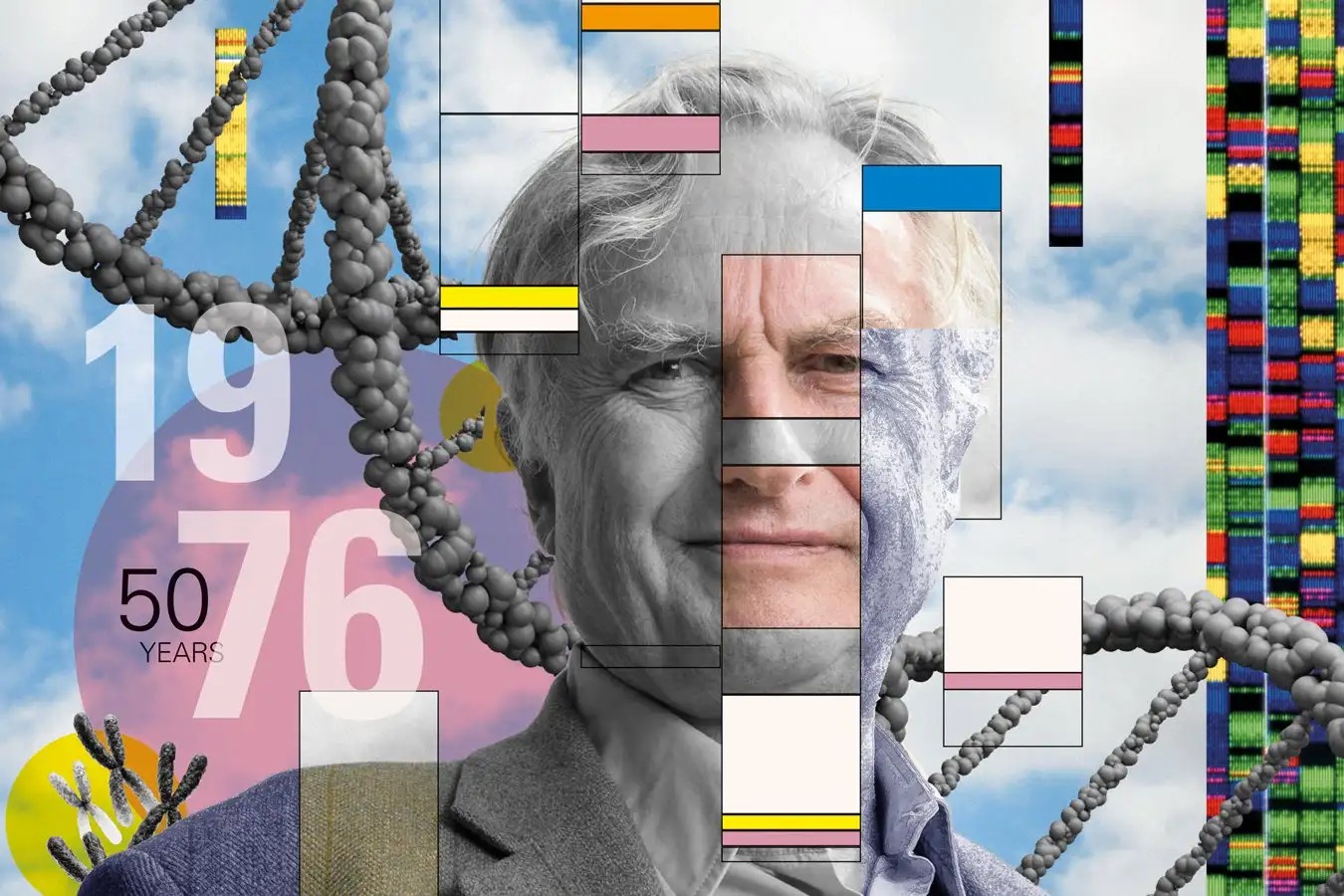
Fifty years is a long time in publishing.
Most science books rot on shelves within five. The Selfish Gene hasn’t just survived; it thrived. Richard Dawkins published it in 1976. The New York Times called it “the kind of science writing that makes you feel like a genius.” Still is. Dawkins wrote the epilogue for this 50th-anniversary edition himself, a rarity in an industry where authors usually fade into obscurity before the third reprint.
Why does it last?
It shifted the lens. Before Dawkins, biology looked at organisms. At animals. At us. After 1976? Everything snapped into a gene-centred focus. It’s the biggest rethink of Darwin since the origin of species. Or close to it.
A monkey is a machine that preserves genes. A fish is a machine for keeping genes wet.
That’s the core idea. We aren’t the players. We are the vehicles.
The Logic of the Loomer
Here’s how Dawkins saw it.
Natural selection doesn’t care about you. It cares about replicators. In our world, these replicators are DNA. Genes. They are old. Older than monkeys. Older than fish. They are effectively immortal if they keep copying themselves into new bodies. We die in decades. The gene? Millions of years.
It sounds cold. Dawkins even wrote a limerick about it.
An itinerant selfish gene
Said: ‘Bodies a-plenty I have seen.
You think that you are clever,
But I’m the master here; for ever,
I’ll live and you’ll decay.’
He considered titling the book The Immortal Gene. Maybe that would have saved it some trouble.
But Dawkins didn’t invent this view. He refined it. He took the dry, difficult mathematics of kin selection —developed by his colleague William Hamilton—and turned it into a story anyone could swallow.
Hamilton showed something counter-intuitive.
Altruism isn’t kindness. It’s a calculation. If a bird helps raise its siblings’ chicks, it isn’t being noble. It’s preserving its own genetic copy in another body. From the gene’s perspective, helping your brother survive is the same as helping yourself. Selfishness, rebranded as care.
This clicked for people. Even biologists. David Shuker, an evolutionary biologist, says Dawkins created a new conceptual space. It wasn’t just pop science. It changed how researchers think. Melissa Bateson from Newcastle University points out that Dawkins got his Royal Society fellowship for actual scientific contribution. Not for PR. Not for making it easy. He changed the framework.
The Metaphor That Bit Back
So why is the book so hated?
The title.
“The Selfish Gene.” It’s a metaphor. Metaphors are dangerous when readers miss the point.
People read the book and concluded two things that made Dawkins furious:
- Humans are inherently selfish, genetically doomed to be sociopaths.
- “Selfish genes” justifies free-market capitalism.
Neither is true. Dawkins detests these interpretations. He says the metaphor is for genes, not for human morality. But the damage is done. Matthew Cobb at Manchester University calls it “misleading.” Mary Midgley, the philosopher, snapped back that genes can no more be selfish than atoms can be jealous.
Genes are not agents. They are chemical strings.
But the stickiness of “selfish” ruins the nuance for the layperson. George Williams wrote about the same gene-eye view in 1966 with Adaptation and Natural Selection. Nobody hated him. Why? He didn’t give it a punchy, moralised title. He didn’t lean into the personality of the molecule.
Dawkins did. And people liked or hated it for the metaphors. Some found the idea of being “lumbering robots” programmed to save DNA comforting. Others found it terrifying. Genetic determinism creeped in. We stopped being free agents and became puppets.
Arvid Ågren admits this. Some people lose sleep over the implications. He didn’t. I don’t either. But the friction is real. The metaphor pulls hard.
New Challenges?
Does modern genetics break the theory?
Some try. Kevin Lala, an evolutionary biologist, argues for an “extended synthesis.” He says genes aren’t enough. We need to look at how environments shape development, too.
The main weapon here? Epigenetics.
Tags on DNA that aren’t code changes but affect how genes work. These tags can pass to offspring. So is it still just DNA? Does inheritance require DNA sequences, or just information that gets copied?
Lala says it matters. It complicates the picture.
But Shuker and Ågren shrug it off.
Epigenetic marks don’t appear out of nowhere. They are products of genes. They evolved. They evolved selfishly.
If a gene produces a tag that helps survival, the tag sticks around. The mechanism might be complex, but the logic is identical to Dawkins’. The replicator—whether a base-pair or a tag—is selected because it spreads.
What about plasticity? The ability of an animal to change its form without genetic mutation. A spadefoot toad develops a bigger jaw if shrimps are around. It adapts to food availability instantly.
Seems to break the genetic script?
Not really. The toad only has plasticity because 14 specific genes allowed that change to evolve in the first place. The plasticity is a gene trait.
And what about horizontal gene transfer? Bacteria swapping DNA like flash drives? Vertical inheritance isn’t the only path. Ågren argues this supports Dawkins even more. Genes care about replication, not ancestry. If jumping bodies works better, genes will do it.
The Genome Revolution
The 1970s view of genes was simple. DNA codes for proteins. End of story.
We know that now it’s… messy.
There is RNA. There are switches. There is regulation. Genes don’t just build stuff; they tell other genes what to do. Regulatory sequences matter just as much as protein-coding ones. They turn lights on and off. They evolve the same selfish way Dawkins described. The complexity has grown. The central engine remains the same.
Then there’s the surprise count.
Humans thought we had 100,001 genes. We don’t. We have about 20,018. Fewer than a rice plant. A rice plant has 51,125. Trichomonas vaginalis —a parasite that gives people a disease—has 60,174.
Shockingly, gene numbers are boring across life. A mouse has roughly the same number as a human.
So what makes us humans?
Not more parts. It’s the instructions on when to use the parts. Shuker puts it bluntly.
Variety comes from gene expression. Spatial and temporal regulation.
It’s the orchestra, not the number of instruments.
This kills the idea of “the gene for” things. There isn’t one gene for height or intelligence. It’s hundreds of switches. Some people blame Dawkins for the old deterministic idea. He gets it wrong, Ågren argues. That blame should land on the hype around the Human Genome Project.
But Dawkins? He doesn’t care.
The Selfish Gene rides above details.
He thinks his book could have been written a hundred years ago with the same arguments. It might still stand in 2176.
Competition and the Missing Link
Here’s what bothers me.
Dawkins loves Alfred Tennyson. Specifically the line: Nature, red in tooth and爪 (claw).
He opens his book with this. It’s visceral. Violent. He sees natural selection as a struggle. Survival of the fittest as a meat-grinder.
Darwin saw that too. Tennyson saw that before Darwin. It was the mood of the era. But 50 years of biology later, we have learned about something else.
Symbiosis.
It isn’t always war. Most life happens through cooperation. Plants and bacteria. Cells inside your gut. Mitochondria that used to be their own bacteria.
Symbiosis is everywhere.
Dawkins tried to claim his theory explains this, too. He argues that at the gene level, competition exists. But competition among genes can look like cooperation between species.
At the gene level, it is war. But war makes alliances.
He told me he couldn’t convince critics like Lynn Margulis, the champion of symbiosis, of this point. He believed that cooperation between different organisms was a “higher level” trick played by selfish genes to survive better.
And maybe he’s right.
From a gene’s viewpoint, cooperation is just a better strategy for winning. But does the framing matter? If we focus on “red tooth and claw” instead of the symbiotic weave that actually keeps life on track?
It matters. The lens distorts. We look at the world as a battle, ignoring the hug that holds the planet together.
Dawkins believes his essence survives. Maybe he’s right about the physics of it.
But I wonder if we have moved on from his aesthetic.
Is it? Or do we just need to update the story?