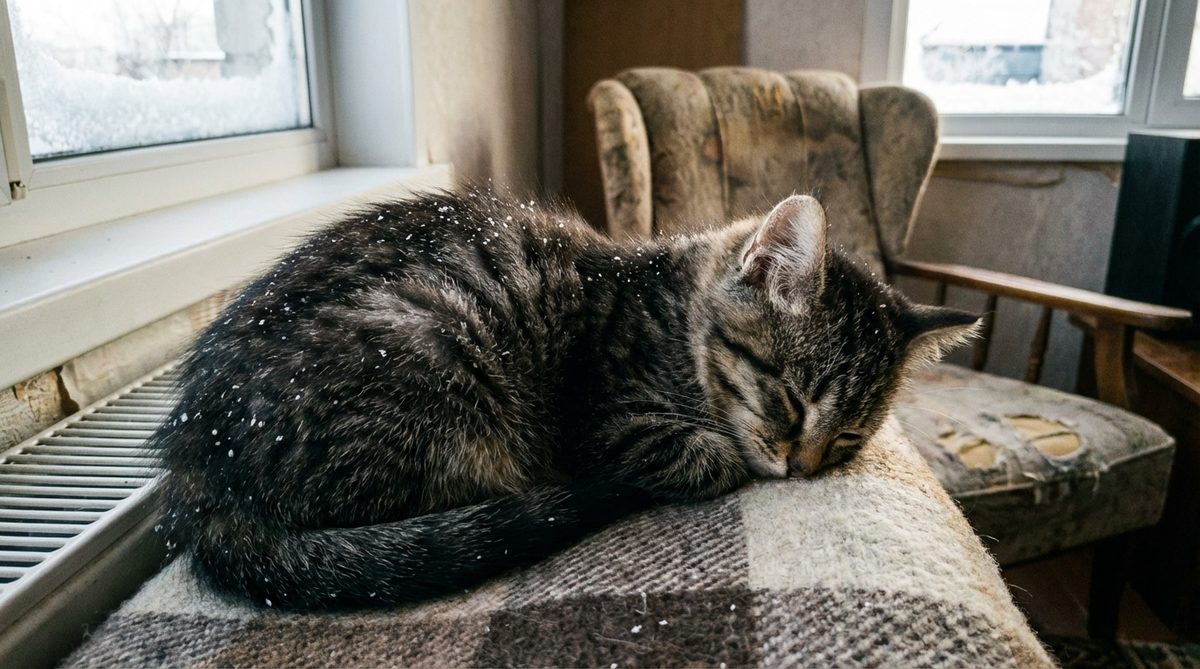
It’s already February. The wind froze the windows. You were curled up on the sofa and petting your cat. This moment is perfect. Until you pull your hand away.
Suddenly, white particles fall from the black fur onto the clothes. It’s like fresh snow. Looks disgusting.
You might think this is a hygiene issue. You may be concerned about parasites. Neither of them.
This is the skin of a cat screaming for help. The enemy is not dirt. This is your heating system.
The Hidden Drought Inside Your Home
We blame the diet. We blame stress. In winter, the real culprit is usually the wall mount.
We use heaters to keep our homes warm. We are turning our house into a drying oven. This skin disease has a name: winter scaly dermatosis.
It doesn’t happen randomly. Triggers when the heating drops the ambient humidity below 40%. For humans, this means a dry throat in the morning. In cats, the epidermal balance is even more fragile. This is a direct attack.
Dry air acts like a sponge on the animal’s body. It strips the hydrolipidic film. This natural barrier consists of sebum and sweat. When this fails, the skin loses its ability to retain moisture. The skin comes off faster. White flakes appear.
Stop doing laundry. Start feeding fat.
Human reflexes are obvious. You want to bathe the cat. I want to wash off the dandruff.
Don’t do this. This is a serious strategic mistake.
Even mild shampoos remove the small amount of protective sebum that remains on the skin. This makes the dryness worse. Repairs must be done from the inside. The cream cannot penetrate the thick coat. Food can.
The absolute weapon against this dryness is lipids. Requires essential fatty acids. Especially omega-3.
Adding these acids to your daily diet can restore your skin’s protection. These nutrients fluidify cell membranes. They bring elasticity back to the skin.
how? Add high-quality fish oil. Salmon or sardine oil works well. Veterinary capsules are also effective. Put them directly in the bowl.
Do not overfeed the animal. Use targeted supplements. A diet rich in good fats is more valuable than any shampoo. These are the bricks needed to build the defective intercellular mortar.
21 day rule
Nature has its own rhythm. Don’t rush.
Even with the best salmon oil, dandruff does not disappear overnight. Skin physiology requires minimal delay. It takes 21 days for the scales to completely disappear and the fur to be shiny again.
Why 21 days? This is the exact duration of a complete cell regeneration cycle in cats. It takes a long time for new, healthy, hydrated cells to emerge from the deep layers of the epidermis.
However, it makes no sense to only deal with internal issues without improving the environment.
A humidifier is needed. This is a necessary complementary measure. Compensates the drying effect caused by heat. If you do not correct the humidity in the room, you are asking your cat’s skin to constantly resist evaporation.
Stop the storm on the couch. Combine the re-humidified atmosphere with the right nutrients. Your cat will be nice and soft again in 3 weeks.
If symptoms persist after 21 days or if it starts to itch, contact your vet. Another pathology might be hiding under the flakes.