they don’t eat. They don’t poop. They just sit there.
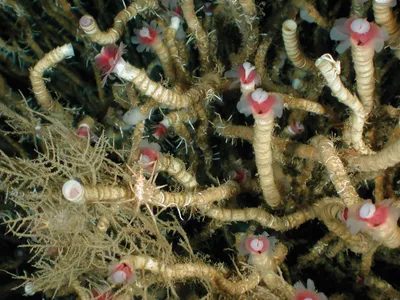
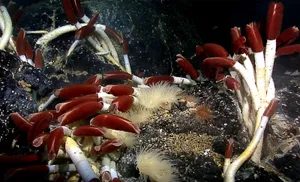
a strange group of worms nests in the dark deep sea. Scientists call them beard worms. Their family name is Siboglinidae. These are multicellular, marine worms found on the ocean floor around the world. Each one lives in a long protective tube. This is a sedentary lifestyle. No wandering. Just waiting.
The common name comes from the front. Many species have numerous feathery tentacles. These look like a beard. Hence the name. But that beard isn’t just for grooming. It’s for feeding.
This is where things get weird. Beard worms is the only multicellular animal that does not have a mouth and anus in adulthood. Think about it. Every other animal on Earth process food through open systems. You eat here. You exit there. Beard worms break this rule.
Their development tells the story. The intestine is formed in the embryo. At first glance, it looks normal. However, as the worm matures, the intestine disappears. Gone. The adult depend on symbiotic bacteria for survival. These bacteria live inside the worm and convert chemicals in the environment into energy. This allows them to thrive even in places where there is no sunlight.
Males and females look the same. You can’t tell them apart visually. They are They share the in the same tube. The only difference is reproductive.
This adaptation allows beard worms to occupy ecological niches not possible with other animals. They live near hydrothermal vents and cold seeps. These areas are rich in sulfur and hydrogen sulfide. Toxic to most life. Provides fuel for bacterial partners.
Why is this important? It challenges our understanding of animal biology. It shows that life can survive without a digestive tract. It redefines what an animal means.
Beard worms are more than just a curiosity. It’s a testament to the ingenuity of evolution. It proves that complexity does not necessarily require obvious structure. Sometimes the most effective solution is to give up everything you think you need.
“Beard worms is the only multicellular animal that does not have a mouth or anus when it is an adult.”
This discovery makes us rethink the limits of life. If animals can live without a mouth, what else is possible in the unexplored depths of the ocean? The answer are still buried in the mud.
The taxonomic history of beard worms is a case study in scientific confusion. In 1914, the French biologist Maurice Caullery described Siboglinum weberi from the Malay Archipelago. He classified it in a new family, Siboglinidae. Nineteen years later Lamellisabella zachsi was caught in the Sea of Okhotsk. In 1937 it acquired its own class, Pogonophora.
For decades they were treated as separate entities. Then in 1955, evidence appeared linking Siboglinum and Lamellisabella. They belong to the phylum Pogonophora.
DNA sequencing changed everything in the late 1990s. By 2001, genetic data indicated that Pogonophora and Vestimentifera belong to the Siboglinidae family. Currently, this family includes 34 genera and about 120 species.
They are not just curiosities. These worms diverged from other annelids during the Cambrian period, more than 500 million years ago. This makes them an ancient bloodline hidden under the sea.
Where to find deep sea beetles
Beardworms thrive in harsh environments. The majority live on continental slopes less than 1000 meters above sea level. They are clustered near diffusion centers, hydrothermal vents, and methane seeps.
However, the depth is not a hard limit. Some species live in shallow waters less than 100 meters deep. Some individuals live in deep sea areas at an altitude of 7,000 to 10,000 meters. It is near the bottom of the deepest oceans in the Pacific and Indian oceans.
Uneven distribution. Many genera are discontinuous. It’s not everywhere. But where they exist, they dominate certain ecological niches defined by chemical energy rather than sunlight.
Natural history and feeding mechanisms
The most striking feature is the tentacle crown. The number of tentacles is proportional to the body size. These are not just decorations. They nourish their organs.
Inside each tentacle are blood vessels. This structure is continuous with the body cavity. The tentacles are covered with rows of small unicellular surfaces. They interlock to form a fine filter in the tentacle cavity.
Water operating system. A bundle of cilia at the base of each tip produces an electric current. This flow attracts microorganisms and nutrients. A small ear net captures them.
Needle heart filters act as complex screens based on the action of cilia and process nutrients directly from seawater.
Gland cells at the base of the back can secrete digestive enzymes. Absorption takes place directly through the surface. Pinocytosis allows small food particles to penetrate the outer layer of the ear. Direct penetration of amino acids from seawater also occurs.
The waste water is drained through certain openings at the bottom of the tentacles. No courage. There is no anus.
Reproduction and embryo development
Reproduction is sexual. Females lay high-yolk eggs in the front of the oviduct. The male releases a packet of sperm into the water.
Sperm enter the woman’s fallopian tubes. It breaks down into individual sperm cells. Fertilization takes place inside the pipe.
Development followed a strange path. Cleavage produces a symmetrical embryo. The endoderm begins as yolk-containing cells. These form the primary intestine.
The intestines are gone. The yolk is gone.
Importantly, the mouth and anus never develop. Instead, a secondary body cavity is formed. It is separated from the coelomic sac that was originally attached to the primary intestine.
The larva emerges with two cilia and three segments. It can swim. It has grown. We never built the digestive tract that our ancestors had.
Forms and works under extreme pressure
Body length varies greatly. Some species are only a few centimeters long. Lamellibrachia barhami reaches up to 2.5 meters. The diameter varies from 0.06 mm to 4 cm.
The body is divided into three different parts.
- Carapace: Small front part. It has tentacles.
- Mediator: Middle part. Includes reins.
- Service body: Long body. Deal with structural support.
Each segment has its own body cavity. The frenulum (or frenulum) is a pair of cuticle ridges. They extend to the back and meet in the midline of the abdomen. This structure holds the worm at the end of the pipe.
The options are separated by lanes. These ridges contain platelets with small teeth. Some parts have grooves with shallow pleats at the ends.
The tube is made of chitin. Special glands secrete it. The lower part sank into the mud. Hardcore A pipe drills a hole in a bumpy tree.
The worm never leaves the pipe. They move inside.
The body wall has an epidermal layer covered with cuticles. Below are the longitudinal muscle cells. The nervous system is a continuous network within the epidermis. There are no sense organs.
The circulatory system is simple. Two long blood vessels run through the body. Push the blood forward. Another person pulls it back. Hemoglobin gives blood its color.
The blood vessels flowing forward at the base of the tentacle become the muscular heart. It pumps blood into its tentacles.
Excreted through a pair of kidneys. These coelomic tubes connect the body cavity to the outside world.
The reproductive system consists of a pair of glands located on the body. In women, the ovaries are located in the front of the body. Fallopian tubes are in the middle.
In men, the testicles are located behind. The vas deferens is located in front. Sperm are formed in capsules in these tubes.
It’s hard to imagine a creature eating its own skin and thinking it’s broken. The body plan looks incomplete. No courage. There is no anus. All you need is a pipe and a filter.
But it works. Even in the dark, under high pressure and without sunlight, this model has not failed. This is an adaptive process honed over 500 million years. The subway is not a prison. It’s an anchor. The insect stays put. The sea brings us food.
We know genetics. We know the anatomy. However, the specific chemical interactions that allow these worms to reproduce without a gastrointestinal tract are partly unclear. The tube remains closed. Tentacles fluttered in the darkness. We observe them from afar and measure what is in the picture, but we never see the whole organism in the background.