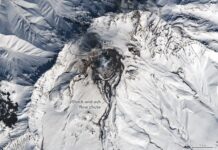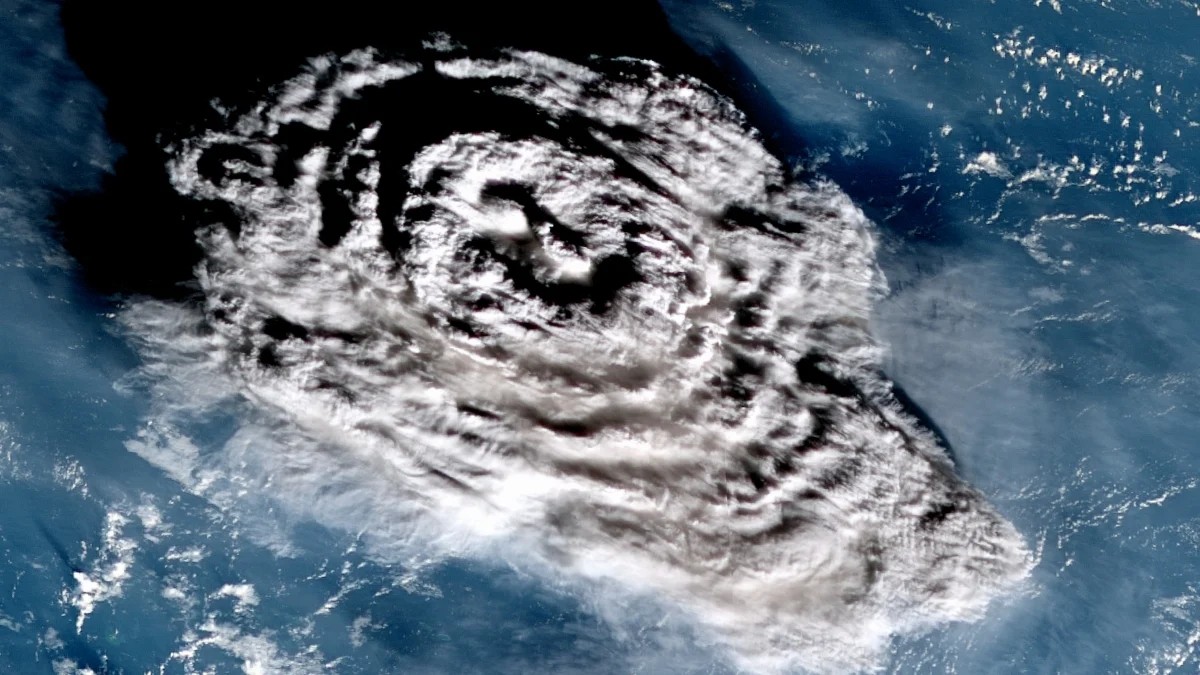
The 2022 eruption of the Hunga Tonga-Hunga Ha’apai volcano was one of the most powerful geological events of the modern era. While volcanic eruptions are typically viewed through the lens of destruction—sending ash clouds and toxic gases into the stratosphere—this specific event has yielded a surprising scientific discovery. Researchers have identified a natural chemical process within the volcanic plume that rapidly destroyed methane, a potent greenhouse gas. This finding not only reshapes our understanding of atmospheric chemistry but also offers a proof-of-concept for potential future technologies aimed at cleaning the atmosphere.
A Surprising Chemical Reaction
For decades, scientists knew that volcanoes emit methane during eruptions. However, they did not realize that the eruption itself could also act as a catalyst for breaking down that same methane. The key to this discovery lies in a compound called formaldehyde.
In a study led by atmospheric scientist Maarten van Herpen of Acacia Impact Innovation BV, researchers analyzed satellite data from the Tonga eruption. They detected unusually high concentrations of formaldehyde in the volcanic plume. Formaldehyde is a short-lived intermediate product that appears when methane is broken down by chlorine radicals. Its presence served as a “smoking gun,” indicating that a rapid chemical reaction was occurring high in the atmosphere.
“It is known that volcanoes emit methane during eruptions, but until now it was not known that volcanic ash is also capable of partially cleaning up this pollution,” explains van Herpen.
How the Process Works
The mechanism behind this phenomenon relies on the unique ingredients present in the Tonga eruption. Because the volcano erupted underwater, it blasted seawater, salt, and mineral particles high into the atmosphere, creating a plume that reached record altitudes.
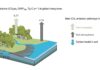
When sunlight hit this mixture of salt aerosols and volcanic gases, it triggered the formation of reactive chlorine radicals. Chlorine is highly reactive because it has an unpaired electron seeking stability. When these chlorine radicals encounter methane, they strip away a hydrogen atom, initiating a chain reaction that unravels the methane molecule. Formaldehyde is a brief byproduct of this process.
This is not the first time scientists have observed chlorine-mediated methane breakdown. In 2023, van Herpen’s team identified similar processes triggered by Saharan dust and ocean spray. However, the Tonga eruption provided a massive, concentrated example of this reaction occurring on a global scale.
Scale and Significance
While the discovery is scientifically significant, it is important to understand its scale. The volcanic plume did not eliminate all the methane produced. Researchers estimated that approximately 900 metric tons of methane were destroyed by chlorine oxidation per day. In contrast, the volcano emitted an estimated 330,000 metric tons of methane in total.
Therefore, the volcano did not “clean up” its own emissions; the majority of the methane remained in the atmosphere. However, the study proved that this atmospheric cleanup process can be observed, tracked, and quantified. By monitoring the formaldehyde cloud for ten days as it drifted toward South America, scientists confirmed that the methane destruction was continuous and measurable.
Implications for Climate Technology
The primary value of this research lies in its potential application to human-made climate solutions. With methane levels rising due to industrial activity and agriculture, scientists are actively seeking ways to reduce its concentration in the atmosphere. The Tonga eruption demonstrated that chlorine-mediated methane removal is physically possible.
Chemist Matthew Johnson of the University of Copenhagen notes that while replicating this natural phenomenon for industrial use is an obvious next step, it requires rigorous safety and efficacy testing.
“Our satellite method could offer a way to help figure out how humans might slow global warming,” Johnson says.
Conclusion
The Hunga Tonga-Hunga Ha’apai eruption provided a rare, large-scale laboratory for atmospheric science. While the event itself did not significantly reduce global methane levels, it confirmed that natural mechanisms exist to break down this greenhouse gas. This insight moves the concept of direct atmospheric methane removal from theoretical chemistry to observable reality, paving the way for future research into safe and effective climate mitigation technologies.