Jump. That might be the best way to explore Saturn’s moon.
NASA is looking at a one-legged robot to probe the icy geysers of Enceladus. We aren’t talking about rolling slowly across the dust. We mean jumping. Sampling the hidden ocean plumes that might harbor life.
The concept is called LEAP — Legged Exploration Across the Plain.
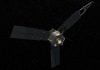
Imagine something the size of a toaster. Roughly one foot tall. Two pounds heavy. No rover tracks. It uses a spring-driven leg and spinning “reaction wheels” inside its chassis to balance and launch. It tips itself up. It leaps.
Funded by NASA’s Innovative Advanced Concepts program. It’s built on a real prototype called SALTO.
It looks like a pogo stick. Or maybe that Pixar lamp that bends and boings. The science? Inspired by squirrels. Yes, actual squirrels. Researchers watched them parkour with high-speed cameras. Published the data in Science Robotics last year. Cute? Sure. Functional? Even better.
The problem with driving there
Enceladus is the hottest spot in the hunt for extraterrestrial life. There is a global ocean under that ice crust. At the south pole, fractures called “tiger stripes” spray water into space.
This gives scientists a golden ticket.
We can sample the ocean without drilling through miles of frozen hell. We just wait for it to spray up.
But getting close is messy.
The ground around those jets is broken. Steep ridges. Powdery ice fields. Rugged junk. A traditional rover would struggle. Maybe get stuck. Maybe roll over.
What about flying?
Not really an option either. Enceladus has no atmosphere. Rockets are too messy—they risk contaminating the samples we’re trying to analyze. Justin Yim from the University of Illinois puts it plainly at a symposium: jumping is uniquely promising here.
The physics of the hop
Gravity on Enceladus is weak. Like, barely-there weak. One-eightieth of what we feel on Earth.
A small push goes a long way.
Estimates put a single LEAP hop at around 560 feet. That’s almost two football fields. It will rise 300 feet into the black sky.
And because gravity is so low? The jump feels slow.
Like a minute long.
This airtime is the point. The robot floats right through the plume. Seconds inside the icy spray while instruments scan for composition and data.
More legs?
Nah. One is ideal. Concentrates the power. Simplifies the design. Wheels handle the sitting and standing parts just fine. The leg handles the verticality. Two wheels plus one leg equals three points of contact. Stable enough to reset. Unstable enough to be weird.
The cold hard truth
LEAP probably lands from an Orbilander. A big spacecraft that orbits then touches down. The little hopper deploys and bounces between vents.
But here is the rub.
Enceladus is minus 330 degrees Fahrenheit.
Our gear breaks at temperatures like that. We don’t have lab conditions that match Enceladus’ ice exactly. The particles are different. The cold is extreme.
Most of this mission has to happen in simulation right now. Engineers have to prove the foot works on weird ice before they build the thing for real.
Whether this pogo-stick robot ever reaches the tiger stripes? Still up in the air.
Maybe we need to learn to hop first.