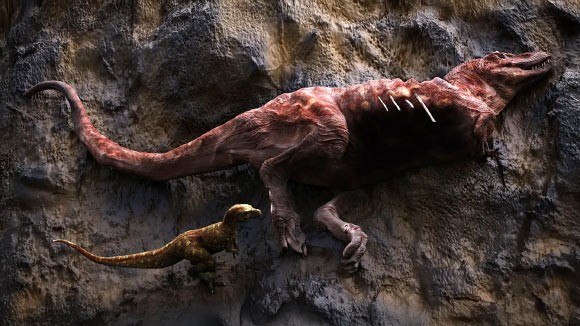
For decades, the popular image of the tyrannosaur has been that of a relentless apex predator, hunting live prey with terrifying efficiency. However, new research led by Aarhus University suggests a more complex reality: these giants were also opportunistic scavengers, even feeding on members of their own species.
By analyzing bite marks on a 75-million-year-old fossil, scientists have uncovered evidence that smaller tyrannosaurs consumed the carcasses of larger relatives, challenging the notion that these dinosaurs relied solely on active hunting.
The Evidence in the Bone
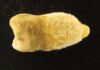
The study, published in the journal Evolving Earth, focuses on a fossilized metatarsal (a foot bone) from a massive tyrannosaurid. The original bone, measuring just 10 centimeters (about 4 inches) in length, was discovered by an amateur fossil hunter in Montana’s Judith River Formation. This geological site serves as a rich archive of the Late Cretaceous ecosystem.
First author Josephine Nielsen, a Master’s student at Aarhus University, and her colleagues did not have access to the physical fossil for this specific analysis. Instead, they utilized advanced 3D scanning technology to create a digital replica and a 3D-printed model of the bone. This digital approach allowed them to zoom in on microscopic details that might have been missed in a traditional visual inspection.
The analysis revealed 16 distinct bite marks on the bone. Nielsen examined the depth, angle, and placement of these impressions in a virtual 3D environment. The precision of the marks confirmed they were not accidental damage or geological wear, but rather deliberate bites from the teeth of another dinosaur.
Why Foot Bones Matter
The location and nature of the bite marks provide crucial clues about the feeding behavior involved. The marks were found on the foot bone, an area with very little meat attached. Furthermore, the bone shows no signs of healing, indicating that the larger tyrannosaur was already dead when the bites occurred.
“Since the marks are located on the foot, where there is very little meat, it suggests that the dinosaur was ‘cleaning up’ and eating the last remains of an old carcass,” Nielsen explained.
This points to size-asymmetric feeding, where a smaller predator or scavenger feeds on a much larger relative. The smaller tyrannosaur likely arrived at the scene late in the decomposition process, after the bulk of the meat had been consumed by other scavengers or decomposers. The tough foot bones were among the last parts to be processed, requiring significant bite force to crack.
Challenging the “Pure Predator” Myth
Tyrannosaurids, such as Daspletosaurus and Gorgosaurus, were indeed the dominant terrestrial predators of the northern hemisphere during the Late Cretaceous. They possessed heavily built skulls designed to withstand extreme stress and deliver powerful bites capable of crushing bone—evidence of which has been found in fossilized feces (coprolites) containing bone fragments.
However, this new study adds nuance to our understanding of their ecology. While their anatomy was certainly suited for hunting large prey, it was equally effective for scavenging. The findings suggest that nothing went to waste in the dinosaur food chain. Tyrannosaurs were not just hunters; they were efficient recyclers, exploiting every available calorie source, including the bodies of their own kind.
A New Technique for Old Bones
What makes this study particularly significant is not just the behavioral insight, but the methodology. By moving away from traditional visual examination to high-resolution digital modeling, paleontologists can now detect and analyze subtle trace fossils with unprecedented accuracy. This technique allows researchers to “read” the history of a fossil in greater detail, revealing interactions between species that occurred millions of years ago.
The research highlights how technology is reshaping paleontology, turning static fossils into dynamic records of ancient life. It reminds us that the dinosaurs we reconstruct in museums were part of a complex, interconnected ecosystem where death and decay were as vital to the cycle of life as birth and growth.
In conclusion, this study refines our understanding of tyrannosaur behavior, portraying them not as mindless killing machines, but as adaptable survivors who maximized their resources in a competitive prehistoric world.