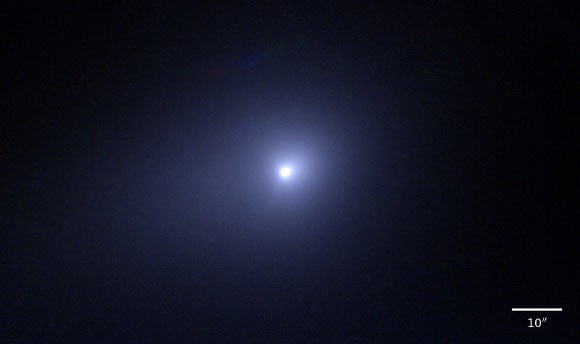
New observations from the Atacama Large Millimeter/submillimeter Array (ALMA) have uncovered evidence that the interstellar comet 3I/ATLAS originated in a planetary system far colder and chemically distinct from our own. By analyzing the “chemical fingerprint” of its water, astronomers have gained a rare glimpse into the formation processes of a distant corner of our galaxy.
The Deuterium Signature: A Cosmic Thermometer
To understand this discovery, one must look at the specific composition of the comet’s water. While standard water consists of two hydrogen atoms and one oxygen atom (H₂O), there is a heavier version known as deuterated water (HDO). In this version, one hydrogen atom is replaced by deuterium, an isotope that contains both a proton and a neutron.
The ratio of deuterium to hydrogen (the D/H ratio) acts as a powerful chemical tracer. This ratio is highly sensitive to temperature: the enrichment of deuterium in water typically occurs only in extremely cold environments—specifically those below 30 Kelvin (-243°C / -406°F).
The findings published in Nature Astronomy reveal a striking discrepancy:
– The D/H ratio in 3I/ATLAS is 30 times higher than that of comets in our Solar System.
– It is more than 40 times higher than the ratio found in Earth’s oceans.
“The cloud of gas that formed the star and other planets in the system where 3I/ATLAS came from was likely very cold and had very different conditions than the environment that created our Solar System,” says Luis E. Salazar Manzano, a researcher at the University of Michigan.
Why Water Matters in Space
Water is more than just a biological necessity; it is a fundamental driver of how planetary systems are built. Its presence serves two critical roles in the cosmos:
- Star Formation: In its gas phase, water acts as a coolant, helping molecular clouds lose heat so they can collapse under gravity to form new stars.
- Planet Building: In its frozen form, water coats cosmic dust grains. This “ice glue” allows particles to stick together more effectively, accelerating the growth of planetary cores.
By studying the water in 3I/ATLAS, scientists aren’t just looking at a frozen rock; they are examining the “fossils” of a distant star system’s birth.
Capturing a Rare Moment with ALMA
Detecting these specific molecules is a significant technical challenge. Most telescopes cannot point directly toward the Sun, which makes observing comets immediately after they pass their closest point to the Sun (perihelion ) extremely difficult.
However, ALMA, a radio telescope array, has the unique ability to observe through the solar glare. This allowed the research team to capture data on 3I/ATLAS just as it emerged from its transit behind the Sun, providing a level of chemical detail that other instruments simply could not achieve.
A Window into Galactic Diversity
This discovery highlights the vast diversity of planetary systems across the Milky Way. While our Solar System followed a specific evolutionary path, 3I/ATLAS proves that other systems can form under much harsher, colder, and more radiation-specific conditions before being ejected into interstellar space.
As researchers continue to study interstellar objects, they are moving closer to a universal map of how different chemical environments shape the planets and potentially the life-sustaining environments of the galaxy.
Conclusion: The extreme deuterium levels in comet 3I/ATLAS confirm it formed in an ultra-cold environment significantly different from our Solar System, providing vital data on the chemical diversity of planetary formation across the galaxy.