Smoking gun. Or so we thought.
For fifty years, finding Clovis spear tips next to mammoth bones has meant one thing. America’s first people killed them. They were megafauna hunters, the architects of the Pleistocene extinction. The logic feels solid. You find a weapon. You find a carcass. Cause and effect.
It is time to check that logic.
A new study says the assumption is untested. In fact it is lazy.
Dr. Metin Eren of Kent State University and his team looked at every single site in North America where this association appears. Fifteen localities. That is the total dataset. They wanted to see if archaeologists had actually proven hunting occurred.
The answer was no.
The Trap of Equifinality
Here is the core issue. It has a name. Equifinality.
Different causes produce the same effect.
A broken spear tip found in the dirt could mean the point snapped when it hit bone during a kill. Or it could mean it snapped while butchering a cold corpse. A cut mark on a femur? Hunting. Scavenging. Same result.
Archaeologists assumed the former. They rarely tested for the latter.
Microscopic wear on stone tools was once touted as direct evidence of impact trauma. It is not. Those same patterns appear when you use a tool to scrape mud off a hide. Or when you drop it. Or simply handle it roughly. The distinction vanishes under a microscope.
The smoking gun never fires.
There is one specific type of evidence that proves hunting. The tip lodged in the bone. The fatal blow captured in stone and marrow.
Do we have it for Clovis?
Not one. Zero. Not in a single one of the 15 sites.
Compare this to Eurasia. There, we find mammoth bones with spearheads stuck fast, tens of thousands of years later. Unambiguous. In North America? Empty.
The Maggot Hypothesis
The skepticism runs deeper than broken tips. It challenges diet reconstruction.
In 2024 scientists analyzed the ‘Anzick Child’. A Clovis-era infant buried in Montana. Isotope analysis of his mother’s bones suggested she ate massive amounts of protein. Top of the food chain. Like a tiger.
The implication: she hunted mammoths. She ate fresh meat.
Dr. Eren argues this is biologically impossible. Humans cannot process that much protein safely. We would poison ourselves. The kidneys fail. The math does not add up for a hypercarnivore diet on large mammals alone.
So why the high nitrogen levels in the isotopes?
Maggots.
Decaying carcasses swarm with them. Studies show larvae carry extremely high nitrogen signatures. If the Anzick woman scavened dead beasts. If she harvested the maggots from them. The isotopic signature matches.
It changes the picture entirely.
“While Clovis foragers likely hunted some mammoths it would be odd indeed if they did not also scavenge like nearly all other omnivores.” — Dr. David Meltzer
He is right. To imagine humans who kill big game but never take advantage of what dies of old age or disease is anthropocentric. We are flexible eaters.
The study does not say Clovis people never killed anything. It says we cannot tell. Not at any single site. Not reliably.
If you cannot distinguish a hunter from a scavenger in the archaeological record. Then you cannot blame the hunter for the extinction.
The “overkill hypothesis” relies on proof of killing. We do not have that proof.
What Remains
The narrative of the Clovis big-game hunter is convenient. It fits our idea of dominance. Of man the slayer.
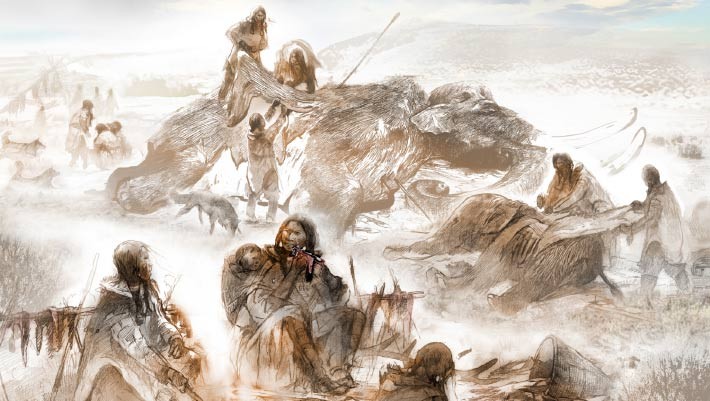
The reality is messier. It involves scavengers. Opportunists. People making do with what the Ice Age left behind.
We have stone tools. We have bones. We do not have the story.
The Journal of Archaeological Science: Reports published this in July. The debate is reopening. Maybe it was never really closed.