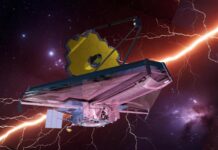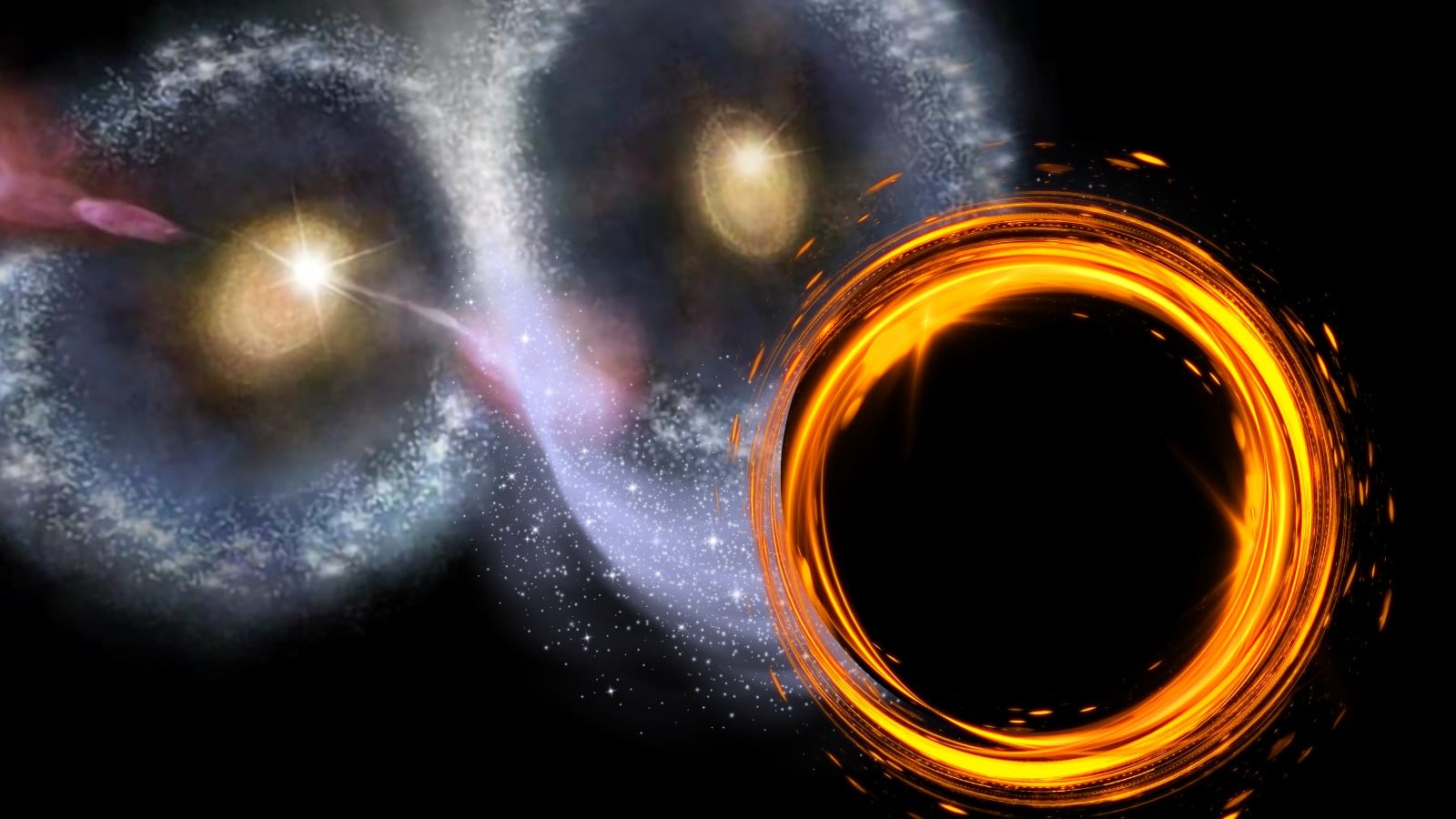
Astronomers have, for the first time, definitively observed a supermassive black hole ejected from its galaxy, traveling at an astonishing 2.2 million miles per hour (1,000 kilometers per second). The discovery, made using the James Webb Space Telescope (JWST), confirms a previously theoretical phenomenon: black holes can be violently expelled from the gravitational clutches of their host galaxies. This ejected black hole, with a mass ten million times that of our Sun, is hurtling through the “Cosmic Owl” pair of galaxies, leaving behind a visible trail of disturbed matter.
The First Confirmed Escape
The runaway black hole was initially identified using the Hubble Space Telescope in 2023. The key was a peculiar streak of light that couldn’t be explained by any known mechanism… until now. JWST observations have verified that this streak is actually a shockwave caused by the black hole’s extreme speed. It is pushing a galaxy-sized “bow-shock” of matter in front of it, while simultaneously dragging a 200,000 light-year-long tail behind it, where gas is accumulating and triggering star formation.
“The forces needed to dislodge such a massive black hole are enormous, yet it was predicted that such escapes should occur,” says Pieter van Dokkum of Yale University, the team leader. This black hole is currently 230,000 light-years from its original home galaxy.
How Do Black Holes Become Runaways?
The most likely explanation is that the black hole was ejected during a galactic collision. When two galaxies merge, their central supermassive black holes will eventually spiral towards each other. There are two main ways this can result in an ejection:
- Black Hole Merger: The two black holes collide, releasing intense gravitational waves that give the resulting combined black hole a massive “kick.” This kick can be strong enough to eject it entirely.
- Three-Body Interaction: If one of the galaxies already contains a binary black hole system, the incoming black hole from the other galaxy destabilizes the system. One of the three black holes is then violently ejected.
The team believes the first scenario – a merger followed by a powerful kick – is the most likely cause for this particular runaway.
The Shockwave and Star Formation
The black hole’s extreme speed compresses the surrounding gas into a shockwave, triggering star formation in its wake. This process creates a trail of new stars, with a combined mass about 100 million times that of our Sun. The discovery reveals an entirely new mechanism for star formation: stars being born in what appears to be empty space, far from any galaxy.
What This Means for the Future
Galactic mergers are common, meaning runaway supermassive black holes may also be widespread. This discovery opens the door to finding more of these rogue objects, which could have significant impacts on other galaxies they encounter. A collision with another galaxy would result in a spectacular shockwave, compressing gas and creating new stars on a massive scale.
Fortunately, at 9 billion light-years away, the Cosmic Owl is too distant to pose any threat to our own galaxy. The team now plans to use future telescopes like the Roman Space Telescope and Euclid to search for additional runaway black holes.
“Everything about this research surprised me… confirming it with JWST was just incredible,” says van Dokkum. The discovery confirms that black hole escapes, once theoretical, are a real phenomenon in the universe, reshaping our understanding of galactic evolution.