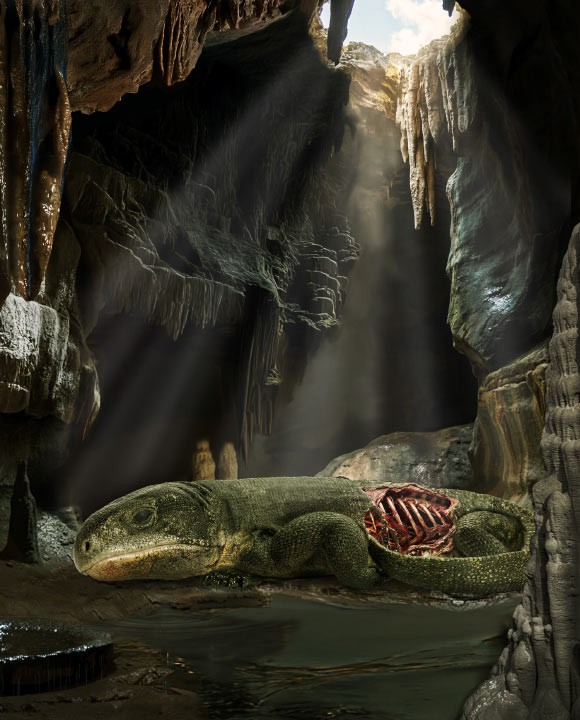
A groundbreaking discovery in Oklahoma has provided paleontologists with a rare glimpse into the evolutionary “engine” that allowed vertebrates to conquer the land. New research published in Nature reveals that a Permian-era reptile, Captorhinus aguti, possessed a sophisticated rib-based breathing system, fundamentally changing our understanding of how early life adapted to dry environments.
The Evolutionary Leap: From Gills to Ribs
For much of early vertebrate history, the transition from water to land presented a massive physiological hurdle: breathing. While aquatic ancestors relied on gills, early land-dwellers (amniotes) initially struggled to extract enough oxygen to support active life on land, often relying on inefficient methods like breathing through their skin or using throat-based pumping.
The discovery of Captorhinus aguti specimens provides the “missing link” in this respiratory evolution. These fossils reveal a complex anatomical structure that includes:
– A segmented cartilaginous sternum (breastbone).
– Sternal and intermediate ribs.
– A complete shoulder girdle connected to the ribcage.
This architecture suggests that Captorhinus aguti was among the first to use its chest muscles and ribcage to expand and contract its lungs. This “rib-powered” breathing was a biological game-changer; it allowed for more efficient oxygen intake, enabling animals to move away from the slow, sedentary lifestyles of their ancestors and adopt much more active, energetic roles in their ecosystems.
Exceptional Preservation in Oklahoma
The quality of these fossils is nothing short of extraordinary. Found in unique cave systems near Richards Spur, Oklahoma, three specimens were encased in fine clay and saturated with oil—conditions that prevented the usual decay of soft tissues.
This preservation allowed researchers to see more than just bone; they could observe the three-dimensional structure of the skin and the cartilaginous connections of the ribcage.
A Record-Breaking Discovery of Proteins
Beyond the skeletal structure, the study utilized synchrotron infrared spectroscopy to uncover something even more rare: remnants of original proteins within the bone, cartilage, and skin.
This finding is exceptional. It dramatically pushes our understanding of what is possible in terms of soft tissue preservation in the fossil record.
These organic molecules are nearly 100 million years older than the previous oldest known protein example (found in a dinosaur), proving that under the right geological conditions, even the most delicate biological signatures can survive from the Paleozoic era.
Why This Matters for Biology
The ability to breathe efficiently via the ribcage did more than just help individual animals survive; it likely triggered an evolutionary explosion. By mastering respiration, early amniotes could inhabit diverse terrestrial niches, leading to the massive diversification of species that eventually paved the way for modern reptiles, birds, and mammals.
The anatomical blueprint found in Captorhinus aguti appears to be the ancestral foundation for the respiratory systems used by almost all modern land vertebrates today.
Conclusion
The discovery of Captorhinus aguti provides definitive evidence of the respiratory innovations that fueled the conquest of land. By revealing both a sophisticated breathing apparatus and ancient protein remnants, this find redefines our understanding of evolutionary mechanics and the limits of fossil preservation.