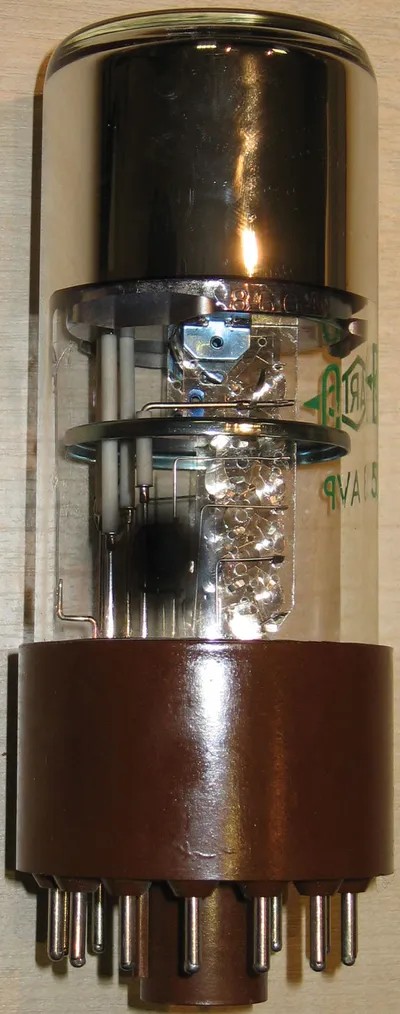
Light seems solid. It hits the retina. It warms your skin. But at the quantum level, light is just a stream of particles called photons. Most of the time they are too faint for us to see. Too dim. Too distant. Enter the photomultiplier tube (PMT). This is more than just a sensor. This is an electron multiplier tube that uses secondary emission to measure low light intensity with terrifying precision.
You might not know the name. You may have already seen the results. PMTs are the silent workhorses behind television camera tubes, helping to convert optical images into electronic signals. They are essential in astronomy, where astronomers measure the intensity of faint stars that would otherwise disappear into the cosmic dark. They are critical in nuclear studies to detect and measure the tiny flashes of light caused by radioactive decay.
Multiplication principle
This device is based on a specific sequence. It starts with a photosensitive cathode. This is the entry point. When light hits this cathode, it emits electrons. This is photoelectric effect in action. But this is just the beginning.
The electrons do not stop there. They move towards a series of additional electrodes. These are called dynodes. Each dynode sits at a successively higher positive potential. This electric field pulls electrons forward. It attracts them from the previous stage.
This is where the magic happens. The first dynode is designed so that one incoming electron releases several new electrons. This is not a 1:1 transfer. It is an amplification. Each new electron strikes the second dynode. This dynode emits more electrons. This process repeats itself.
Why 1,000,000 Matters
This chain reaction creates a cascade. The number of electrons grows exponentially at each step. By the time the electrons reach the last dynode, the signal has been multiplied massively. The total gain can be 1,000,000. Usually nine dynodes are used to achieve this gain.
This level of sensitivity explains why PMTs are used in high-stakes environments. In astronomy, a single photon from a distant galaxy can trigger a measurable current. In nuclear physics, … can be counted accurately tiny flashes of light. Without this multiplication, these signals would be lost in the noise floor.
“Useful in television camera tubes, in astronomy to measure the intensity of faint stars, and in nuclear studies to detect and measure minute flashes of light.”
The design is simple but elegant. No complex digital processing is needed to reconstruct the signal. Just physics. Electrons bounce, multiply and accelerate. The result is a device that can see the invisible. It turns the invisible into data.
However, this technology is decades old. Solid-state sensors are catching up. They are cheaper. They are smaller. Yet PMTs remain unmatched for speed and sensitivity. When you need to count single photons in real time, vacuum tubes still holds the crown. For now.