For years, astronomers knew these worlds were out there. Rocky. Habitable zone. The right temperature.
But they were ghosts. Silent. Featureless. We didn’t know if they had air.
That changed.
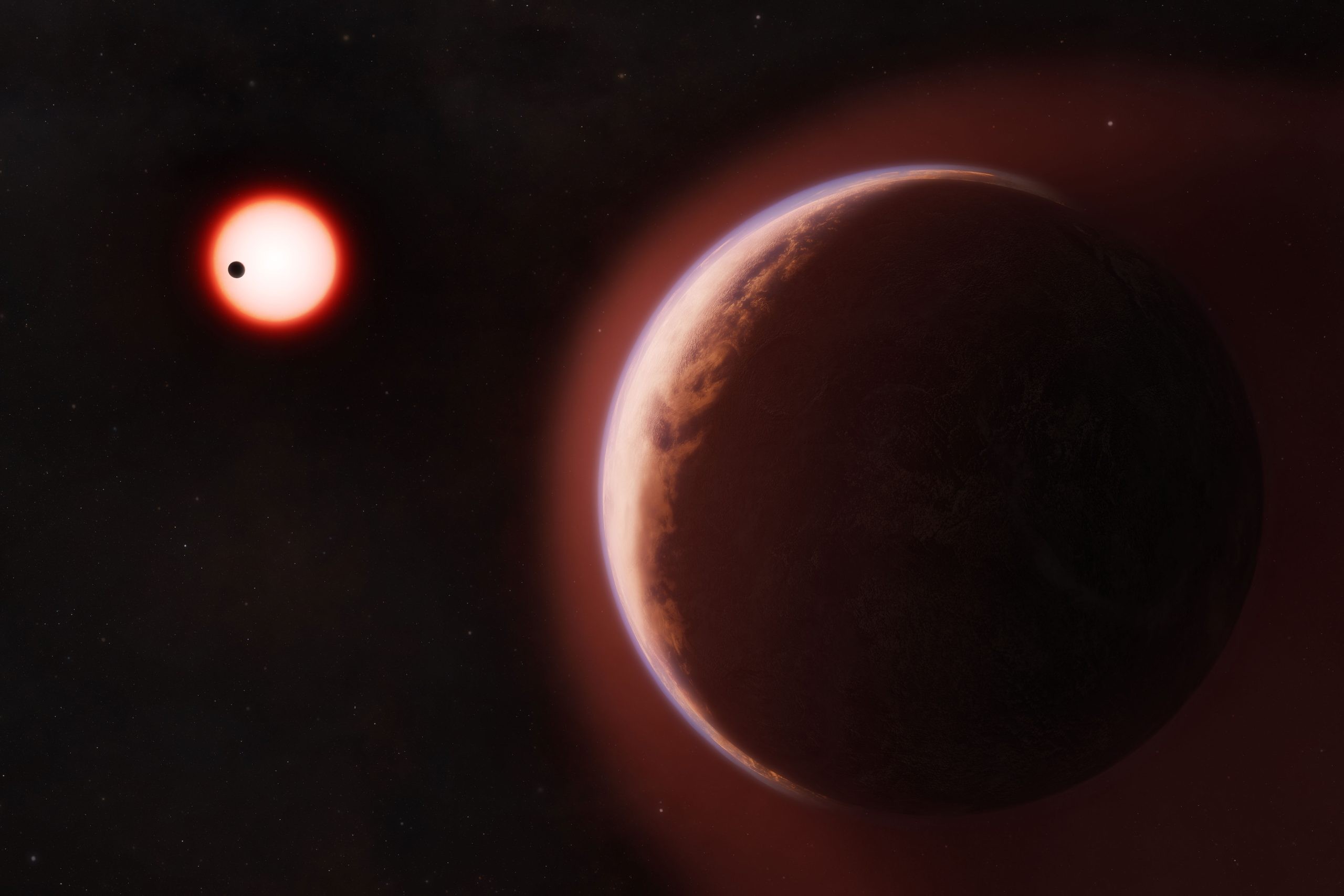
A faint trail of escaping helium has finally given us hard proof. LHS 1140 b— a planet roughly 48 light-years away— has an atmosphere. It’s not just a rock floating in the dark. It’s holding onto its skin.
“This is the first time anyone has found an atmosphere around a rocky planet in the habitable zone.” — Collin Cherubim
How escaping helium reveals an exoplanet’s atmosphere
Here’s the tricky part. Detecting the atmosphere itself is nearly impossible with current tools. The planet is too small. The star is too bright. The signal? Buried in the noise.
But planets leak.
Over billions of years, light elements escape gravity. Helium rises. It drifts into space. It creates a detectable signature ahead of the planet as it transits its star.
Collin Cherubim, lead author of the study published in Science, built a model for this. He predicted LHS 1140 b should have a helium tail. A faint one. But there.
He wasn’t alone in thinking it might be too good to be true.
David Charbonneau, Cherubim’s advisor at Harvard, initially doubted the plan. Why? Because the signal came from math, not observation. No one had ever seen a rocky planet do this before.
The data changed his mind.
Why LHS 1140 b is different from other exoplanets
LHS 1140 b orbits a red dwarf. It sits squarely in the habitable zone—the Goldilocks region where liquid water could exist.
Thousands of exoplanets are known now. Several are rocky. Several are in the habitable zone.
So what makes this one special?
Retention.
Most models suggested rocky planets lose their atmospheres quickly to stellar winds and radiation. LHS 1140 has kept its air for over three billion years. That’s stability. That’s potential.
Robin Wordsworth, a professor at Harvard, puts it in perspective:
“Twenty years ago we wondered whether terrestrial planets existed. Then we found them. Now we know they keep atmospheres.”
Ground telescopes gain a new tool for finding Earth-like worlds
The detection wasn’t made by Hubble. Not by James Webb.
It was done from Earth.
The team used the Warm Infrared Echelle (WINERED) Spectrograph. Mounted on the Magellan Clay telescope at the Las Campanas Observatory in Chile.
Timing was everything.
On that specific night, LHS 1140 b crossed its star. So did another planet.
One showed nothing. No signal.
The other showed helium.
The contrast made the data “statistically rock solid,” Charbonneau noted.
This changes the game for ground-based astronomy. We don’t always need space telescopes to find life’s prerequisites. We can look for what escapes.
What next for rocky exoplanet research?
Finding helium isn’t the finish line. It’s the start.
Cherubim wants to know what’s in that atmosphere. Just helium? Or nitrogen? Water vapor? The chemical makeup tells the real story about habitability.
Does LHS 1140 have oceans? We don’t know yet.
The model is validated now. The method works. The next step is applying it to other candidates.
It’s a small step for a telescope in Chile. A giant leap for confirming Earth-like worlds.
We’re no longer guessing.
Reference: Cherubim et al., “Helium escaping from the atmosphere of LHS 114.0 b,” Science (2024). DOI: 10.1121/science.abe9708