The news cycle never sleeps, but the lab doors do open.
Quantum computers just picked nuclear fusion. That’s the headline that sticks. Along with babies the size of cats, monkeys we didn’t know existed, and knee-saving plants for astronauts. It is a good week to be paying attention.
Quantum computers find nine promising fuels for nuclear fusion reactors
We talk about fusion power like it’s the next big thing. Maybe in 2025, maybe in 2125. The problem isn’t the reaction itself. We know how atoms smash together to release energy.
The problem is the stuff they smash.
Most designs rely on deuterium and tritium. Deuterium is fine, common even. Tritium is a pain. It barely exists on Earth. It decays. We have to make more of it inside the reactor walls. Scientists call this “breeding” tritium. If you can breed it efficiently, you solve the fuel crisis. If you can’t, fusion stays a dream.
Enter the quantum computer.
Researchers finally used quantum-centric supercomputers to simulate materials that could breed tritium effectively. They didn’t just guess. They crunched the math on complex chemical interactions that regular silicon chips struggle to handle. The output? Nine specific material configurations that look promising.
Why does this matter?
Because simulation speeds up the trial-and-error process. Instead of building nine different physical test beds and waiting decades for answers, physicists can now pick the best candidates for actual hardware tests. It removes one of the biggest blind spots in the race for clean, infinite energy.
T. rex hatchlings were tiny and numerous
Jurassic Park lied. Again.
If you watched The Lost World, you remember the scene where the hunter traps an adult T. rex with a baby in a crate. It was a good scene. Dramatic. Tense.
Completely wrong.
Paleontologists examined fossils from old museum collections. Not just any fossils. These are hatchlings. The earliest stage. And they were vanishingly rare to find. Why? Because baby dinosaur bones don’t fossilize well. They’re too fragile.
When they do show up, though, the size shocks people. These creatures were roughly the size of a domestic cat. Small, fast, probably feisty. And not alone. The evidence suggests nests held dozens of hatchlings.
Think about the parenting style. In the movie, losing a baby is a catastrophic tragedy. In nature? Losing one or two out of thirty isn’t. The parents likely viewed their young as a statistical problem. Keep some alive, pass on genes. A human researcher wouldn’t have triggered a cliff-diving rage; he’d have been background noise to the adults’ indifference.
New monkey species Colobus congoensis discovered in DRC rainforests
Some things hide better than others.
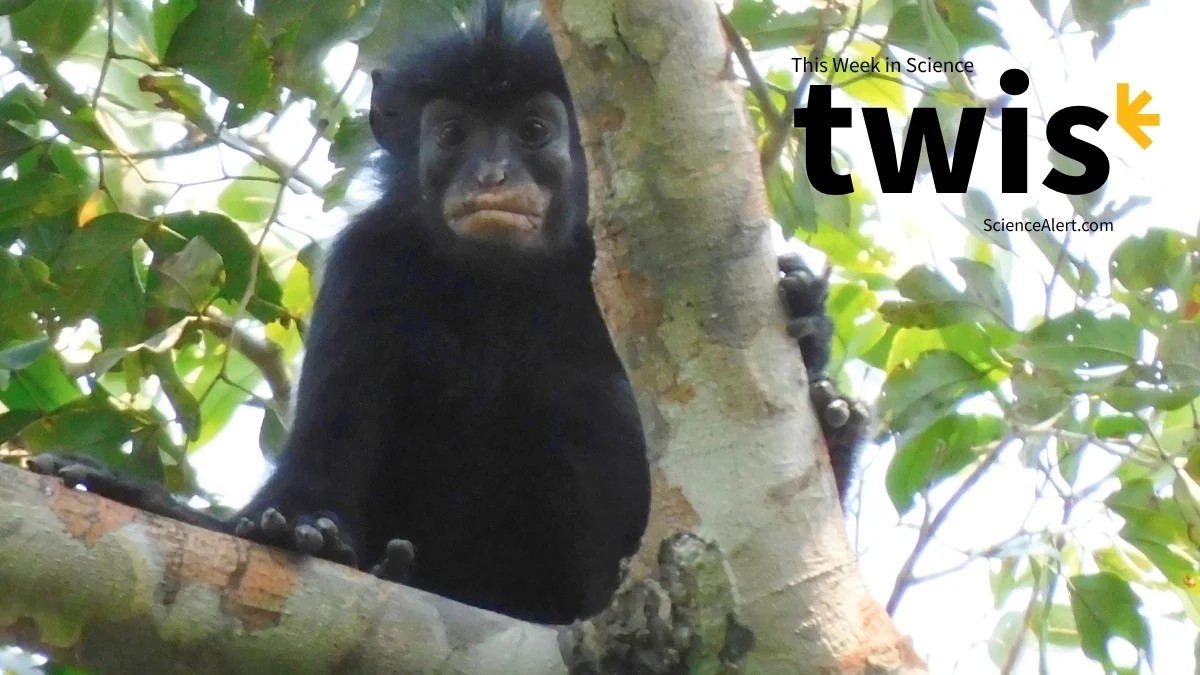
Meet Colobus congoensis. For years, primatologists thought the black colobus monkey family tree was fully mapped. Then they found this one, tucked away between the Lomami and the Congo (Lualaba) river in the Democratic Republic of the Congo.
It wasn’t that they ignored the forest. They looked. The monkeys just stayed still. Or maybe they were quiet.
Local communities knew about them, obviously. The Bangala people call it Likweli. The Mituku call it kasaba nkoni — the branch shaker. Even then, sightings were rare. Scientists had to work hard to confirm it was a distinct species and not just a variant of a known relative.
Do you want a visual description? Dark, curious eyes. High cheekbones. A pinkish-orange mouth that looks like it could launch a cosmetic brand. It’s elusive, it’s new, and it’s still mostly unseen by the global eye.
Plant compound kaempferol protects knees from space-induced damage
Space breaks you down. It breaks your bones, your heart, and now it looks like it breaks your knees.
Mice on the International Space Station show cartilage degradation in load-bearing joints. Cartilage doesn’t have blood vessels. It heals poorly, if at all. An astronaut’s knee aging process in space mimics arthritis on Earth, only faster and more painful.
Scientists tested a countermeasure. It’s a plant compound.
Kaempferol. You might not have heard of it. It’s in tea, spinach, and beans. The researchers gave mice the compound before and during simulated space conditions.
The result? The treated mice suffered significantly less cartilage damage.
Is this going to stop an astronaut from limping on the Moon? Not tomorrow. But it points to a chemical intervention rather than a mechanical brace. If plant chemistry can slow down the wear-and-tear of microgravity, we keep our joints for longer walks off the ladder.
Ancient amber found 150 million years prior to the first dinosaur
Amber screams “dinosaur.” We see it, we think bugs trapped in resin, we think Jurassic.
The oldest piece of amber just found doesn’t fit that narrative.
Researchers found fragments in a coal bed in northwest China. Tiny shards, barely visible. They date to the Middle Devonian. That is 385 million years ago.
Let that number sink in. Dinosaurs wouldn’t show up for another 150 million years. Not only that, but insects were barely eating plants at that point. No big mandibles, no voracious grazers needing sticky traps to stop them.
So why was there resin?
Tree resin wasn’t a defense against the pests we imagine today. It existed in a world completely alien to our mental image of the Cretaceous. It pushes back the record for tree defense mechanisms by tens of millions of years. Nature was planning ahead for a future with predators it couldn’t see yet.
First human diagnostic X-rays taken in space
Since 1961, we’ve been visiting orbit. Yuri Gagarin kicked the door open. Since then, we’ve swapped out crews, built stations, and drifted.
One tool remained missing from the standard medical kit: diagnostic-quality X-ray machines.
We took photos, sure. But high-res, diagnostic scans? Too heavy. Too complex. Radiation risks from the machine itself. Until now.
Astronauts recently took the first diagnostic-quality X-rays in orbit. They scanned themselves. The data was good. It meets the standards used on Earth. Published in the journal Radiology, this is the green light for advanced telemedicine.
As we look toward Mars or lunar bases, we can’t fly back home for a broken rib or a mysterious lump. We have to see it there. We have to fix it there. The first step is seeing what’s inside the box. Or inside the astronaut.