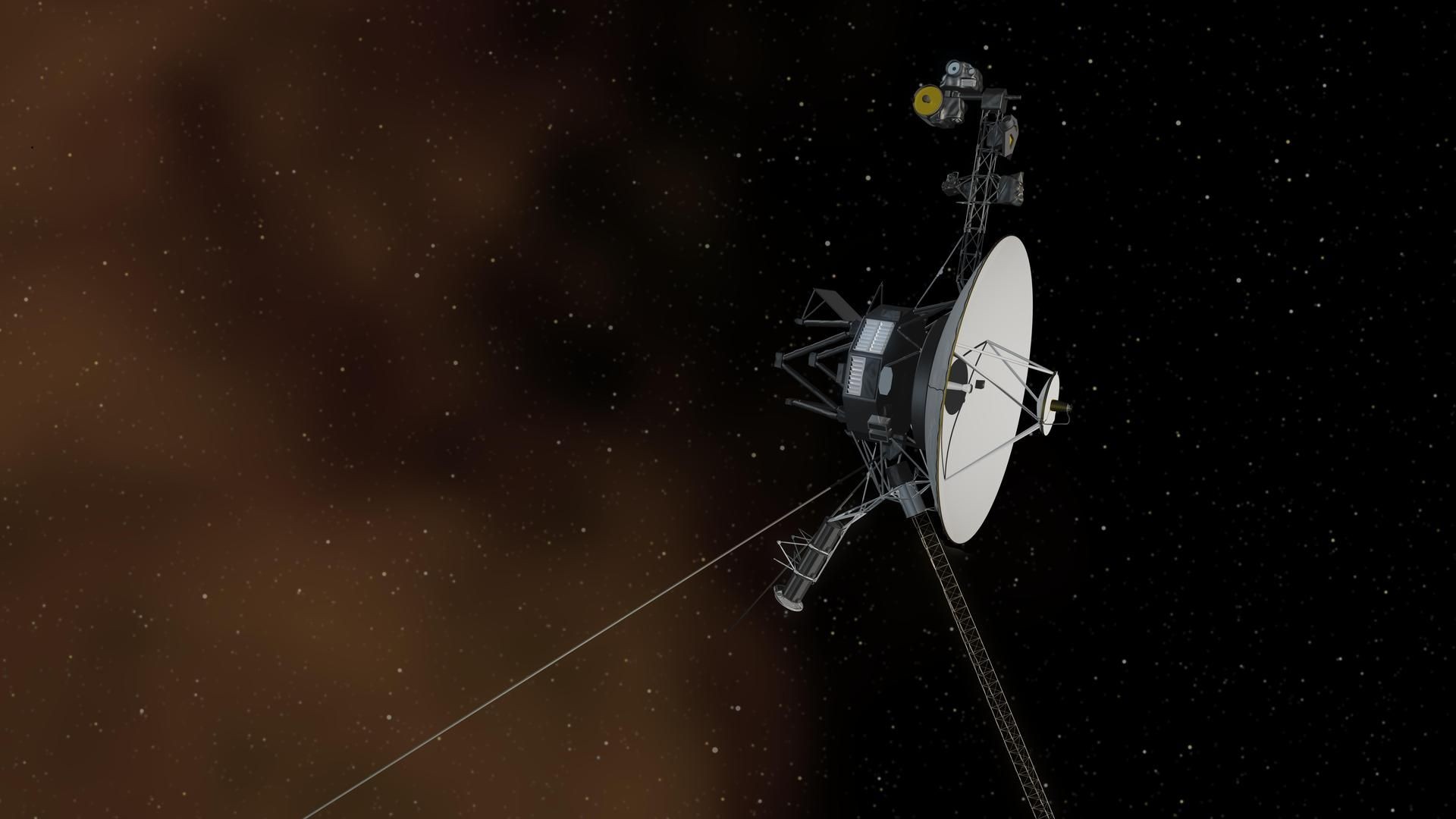
NASA’s twin Voyager spacecraft, the most distant human-made objects in existence, are entering their final operational chapter. After nearly 50 years of exploration, these pioneering probes are running critically low on power. However, a bold engineering maneuver planned for 2026 could buy them extra time, allowing them to continue transmitting data from the edge of our solar system.
The Voyagers were designed to explore the giant planets, not to survive half a century in the harsh vacuum of interstellar space. Yet, through careful management and now a risky recalibration, they continue to defy expectations.
The Power Crisis
When Voyager 1 and Voyager 2 launched in 1977, they generated approximately 470 watts of electrical power using radioisotope thermoelectric generators (RTGs). Today, that output has dwindled significantly due to the natural decay of their nuclear fuel sources.
Both probes lose about four watts of power per year. As energy reserves shrink, NASA’s Jet Propulsion Laboratory (JPL) has been forced to systematically shut down scientific instruments to preserve power for essential housekeeping functions and communications.
- Voyager 1 : Currently operating with only two active instruments: a magnetometer (measuring magnetic fields) and a plasma wave subsystem (analyzing gas and waves).
- Voyager 2 : Slightly more robust, with three instruments still running: the cosmic ray subsystem, the magnetometer, and the plasma wave subsystem.
The remaining power is barely sufficient to keep the spacecraft warm and the transmitters alive. It takes roughly 200 watts just to send signals back to Earth—a distance so vast that a single radio command takes nearly a day to arrive.
The “Big Bang” Engineering Fix
To extend the mission’s lifespan, JPL engineers have devised a clever solution nicknamed the “Big Bang.” This is not an explosion, but a strategic redistribution of power.
Currently, three devices on each spacecraft consume significant energy to prevent thruster fuel lines from freezing. The new plan involves:
1. Turning off these three heating devices.
2. Activating three alternative devices that perform the same function—keeping fuel lines warm—but use almost 10 watts less power.
This modest saving of 10 watts may seem small, but in the context of the Voyagers’ dwindling energy budget, it is significant. If successful, this maneuver could delay the need to shut down another scientific instrument on each probe by at least one year.
The engineering team will test and implement this change on Voyager 2 in May and June 2026. If the results are positive, the same procedure will be applied to Voyager 1 later that summer.
Why This Matters
The Voyagers are not just old machines; they are humanity’s only direct probes in interstellar space. Voyager 1 crossed into this region in 2012, and Voyager 2 followed in 2018. They provide unique data about the heliosphere—the bubble of solar influence that protects our planet—and the conditions of the interstellar medium.
“We don’t know how long the mission will continue, but we can be sure that the spacecraft will provide even more scientific surprises as they travel farther away from the Earth.”
— Suzanne Dodd, Project Manager for Voyager at JPL
The stakes are high because the probes are deteriorating in multiple ways beyond just power:
– Freezing Lines : Thruster fuel lines are nearing freezing points, risking clogs that could prevent course corrections.
– Radiation Damage : Telescopes and sensors were already degraded by Jupiter’s intense radiation in the 1970s and continue to suffer from cosmic particles.
– Aging Electronics : While the computers have backups, those backups are also decaying.
Alan Cummings, a co-investigator on the Voyager mission, notes that the probes are ending their journey in a “graceful” manner, succumbing to multiple simultaneous failures rather than a single catastrophic event. He credits the original mission team for building incredible redundancy into the spacecraft, allowing them to survive far longer than intended.
The Road to 2030 and Beyond
Despite the challenges, mission managers remain cautiously optimistic. Suzanne Dodd has stated that reaching the 2030s is a realistic goal if conditions remain favorable. Her “stretch goal” is for the probes to reach 200 astronomical units (AU) from Earth—approximately 2035.
For context, Voyager 1 is currently about 169.8 AU away, and Voyager 2 is roughly 143.1 AU distant. One AU is the average distance between the Earth and the Sun.
While the power will never technically reach zero (due to the half-life of nuclear decay), it will eventually fall below the threshold needed to operate any instruments. The “Big Bang” maneuver is a critical step in pushing that threshold as far into the future as possible.
Conclusion
The Voyager mission is a testament to human ingenuity and the durability of well-designed engineering. As the probes inch closer to their operational limits, every watt saved and every instrument kept online extends our reach into the unknown. Whether they survive to celebrate their 50th anniversary in 2027 or push into the 2030s, the Voyagers continue to offer profound insights into the cosmos, proving that even in their twilight years, they have much left to teach us.