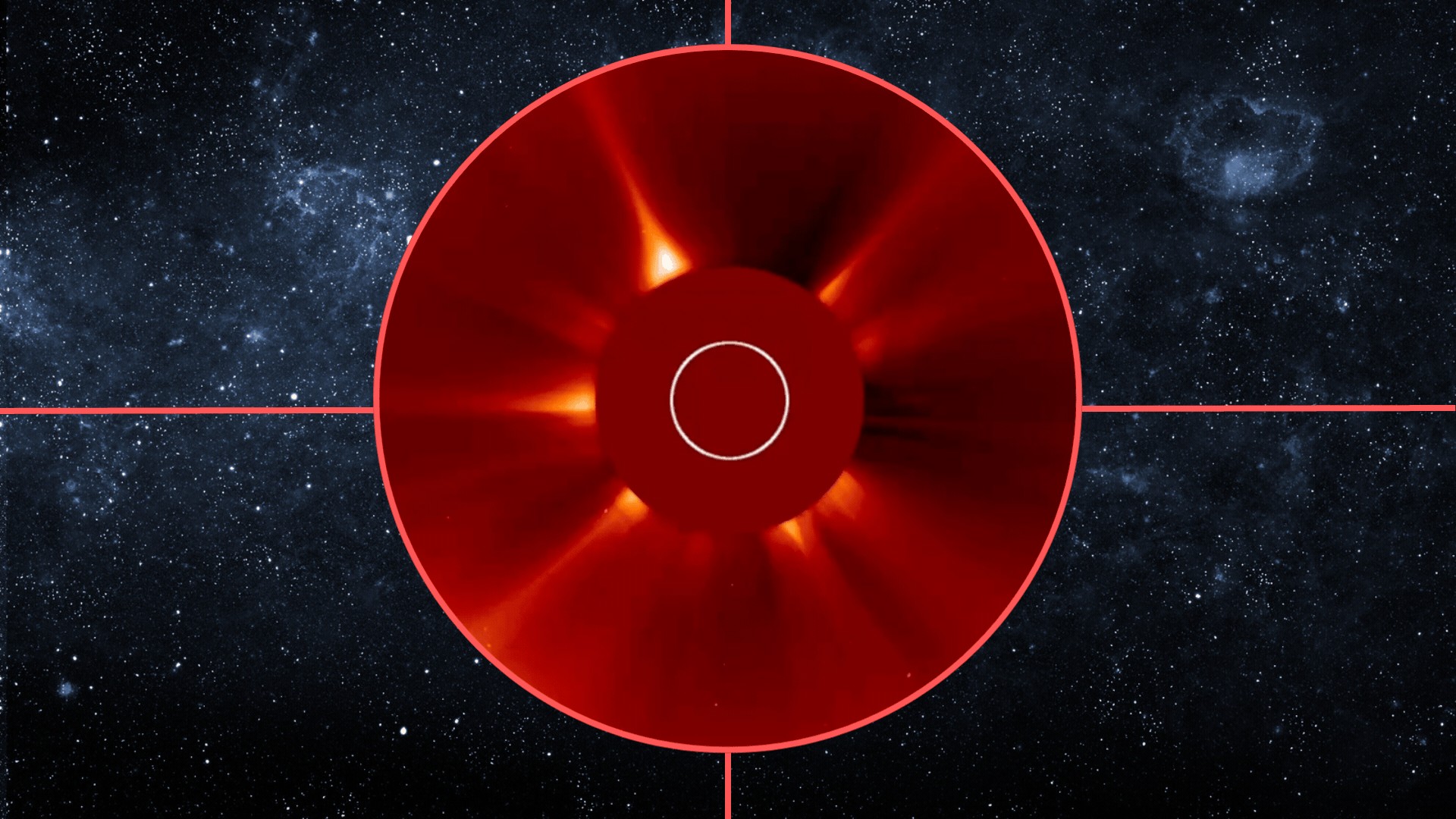
The celestial spectacle many astronomers and stargazers were anticipating has come to a sudden, violent end. Comet MAPS, once hailed by some as “The Great Easter Comet,” met its demise this past Saturday, April 4, as it underwent cataclysmic fragmentation just hours before its closest approach to the Sun.
Instead of a brilliant display in the night sky, observers were left watching the disintegration of a small celestial traveler that simply could not withstand the extreme physics of a solar encounter.
The Fate of a Kreutz Sungrazer
To understand why Comet MAPS vanished, one must look at its classification. MAPS was a Kreutz sungrazer —a type of comet that follows an orbit passing incredibly close to the Sun.
These comets are often fragments of a much larger “progenitor” comet that broke apart centuries or even millennia ago. While some large Kreutz comets (those several miles in diameter) have survived their solar rendezvous to create spectacular light shows—such as the Great Comets of 1843 and 1882—survival is a matter of scale. Larger nuclei have the structural integrity to endure the Sun’s heat; smaller ones often succumb to the stress.
A Matter of Size and Scale
Initial observations in January suggested MAPS might be a large, significant comet. However, modern technology provided a much more sobering reality.
- Early Detection: Unlike most Kreutz comets, which are often detected only days before perihelion, MAPS was spotted nearly four months in advance.
- Technological Clarity: While its early detection was a feat of sensitive telescope technology, data from the James Webb Space Telescope revealed that the comet was much smaller than feared.
- The Nucleus: The nucleus was estimated to be only about 0.2 miles (0.4 kilometers) in diameter.
This small size was its undoing. As the comet raced toward its perihelion—passing just 100,000 miles above the solar surface—it was traveling at a staggering speed of 300 miles (500 km) per second.
The Moment of Disintegration
The destruction of Comet MAPS was captured in real-time by solar observatories, including the SOHO satellite and the GOES 19 satellite. The timeline of its collapse is a textbook example of solar destruction:
- The Brightening: Between 07:00 and 09:00 UTC, the comet suddenly brightened to a magnitude of -1 (comparable to the brightness of the star Sirius). This surge in brightness likely signaled the beginning of a massive structural failure.
- The Streak: By 11:36 UTC, imagery showed the comet no longer as a distinct body, but as an elongated, “headless” streak.
- The Disappearance: During its closest approach, the comet passed behind the Sun’s occulting disk. When it emerged later that day, the nucleus was gone. In its place was merely a “blob” of debris.
By the time the sun set, the comet had transitioned from a solid object into an expanding cloud of dust that is now rapidly dissipating into space.
Why Did It Break?
The physics behind the comet’s death are a result of extreme thermal and gravitational stress.
Having spent nearly 1,800 years in the deep freeze of outer space, the comet’s interior was likely near absolute zero. As it plummeted toward the Sun, its surface temperature spiked to over 5,000°C (3,000°F).
This creates a phenomenon similar to pouring boiling tea into a frozen glass: the extreme temperature differential between the rapidly heating exterior and the frigid interior, combined with intense solar gravity, created enough structural tension to shatter the tiny nucleus completely.
Conclusion
While skywatchers will find nothing to see in the western sky this week, the destruction of Comet MAPS serves as a vivid reminder of the violent, transformative power of our Sun. The comet did not just pass by the Sun; it was consumed by it, leaving behind nothing but a fading trail of cosmic dust.