Science is often perceived as a world of rigid data and somber laboratories, but there is a much more eccentric side to the field—one that manifests in bizarre tourist attractions, humorous academic papers, and even cosmic puns.
The World’s Most Niche Sculpture Park?
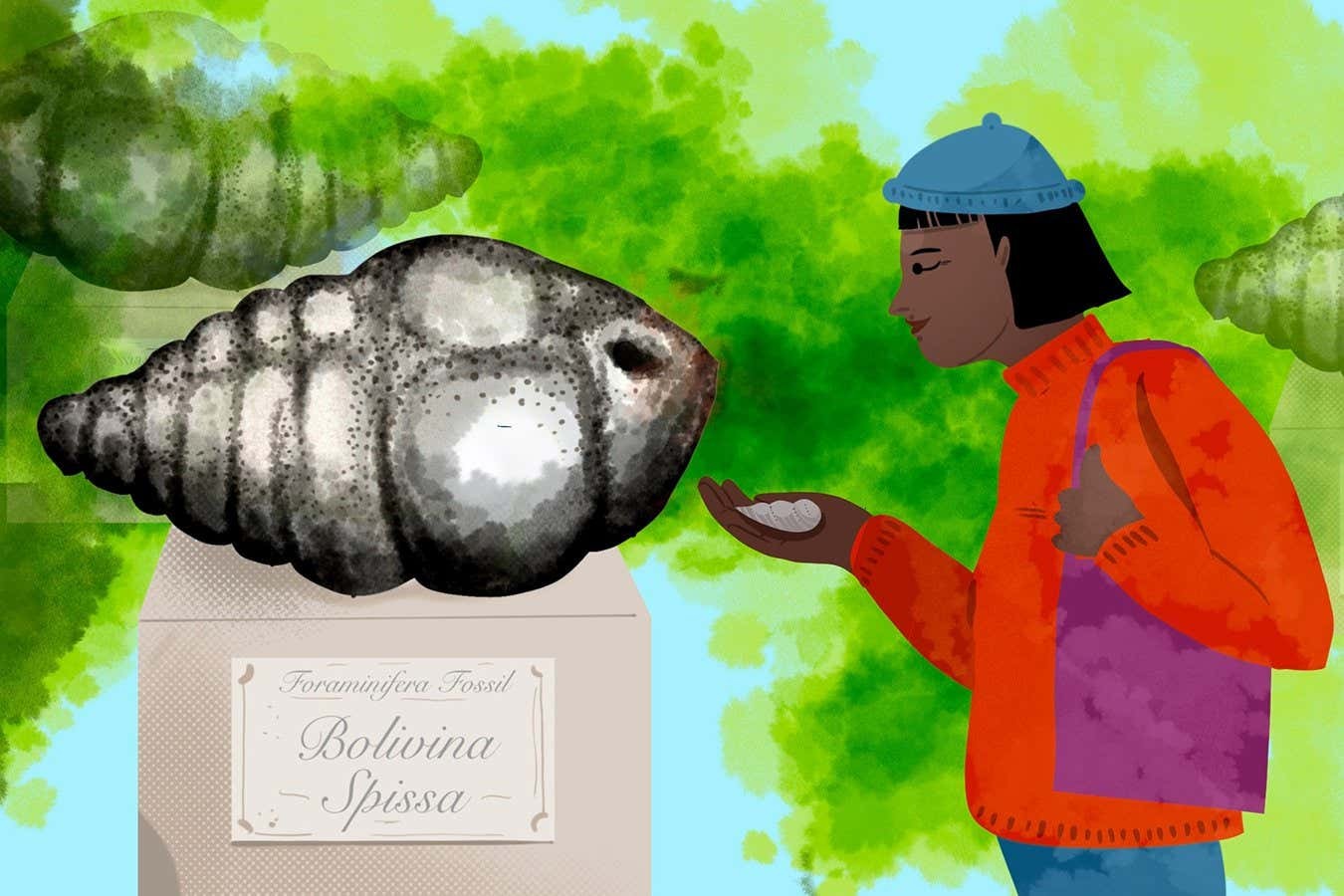
While most travelers seek out grand monuments or famous art galleries, some find beauty in the microscopic. In Zhongshan, China, sits a destination that is likely the most specialized scientific attraction on Earth: the Foraminiferal Sculpture Park.
For those unfamiliar with the subject, foraminifera are single-celled marine organisms. They are famous among scientists for their intricate, hard external shells (known as “tests”), which leave behind an incredibly detailed fossil record due to their vast variety of shapes.
The park, which opened in 2009, features 114 massive sculptures inspired by these tiny organisms. Wandering through the hillside park is akin to walking through an abstract art gallery; the shapes are so complex that they are difficult to describe without specialized terminology, though they share a certain curvaceous aesthetic with the works of modernist sculptor Barbara Hepworth.
Interestingly, the park holds a perfect 5-star rating on TripAdvisor—though this is currently based on a single review from a user named Eudyptes (the scientific name for crested penguins). This raises a humorous question for science enthusiasts: Are there even more niche attractions out there? While famous sites like the Icelandic Phallological Museum exist, the world may still hold hidden gems, such as a museum dedicated solely to moss or a gallery of Western blot images.
When Physicists Break the “Academic Tone”
In the world of formal research, the “abstract”—the brief summary at the start of a paper—is usually a dense, jargon-heavy block of text designed to convey maximum information with minimum flair. However, some scientists are choosing to use this space to inject personality and wit.
The Impatient Physicist
Renowned physicist Leonard Susskind recently broke tradition with a paper regarding time-reversal symmetry in de Sitter space. Rather than sticking to purely technical language, Susskind used his abstract to offer a rare glimpse into the persona of a brilliant mind.
After acknowledging his colleagues, he admitted he wasn’t sure if they even agreed with him. Most notably, he addressed his reputation for being “imprecise,” stating that he had attempted to maintain rigor this time because, at 86 years old, he “can’t wait” for readers to catch up.
The Two-Word Abstract
Susskind isn’t the only one to embrace brevity. In 2011, following a massive scientific controversy regarding neutrinos appearing to travel faster than light (a phenomenon later attributed to faulty wiring), a paper was published with a title asking if the speed could be explained by quantum weak measurement.
The abstract consisted of just two words: “Probably not.”
Such moments remind us that even in the most rigorous disciplines, there is room for human personality and a sense of humor.
A Cosmic Pun
Even the most serious economic forecasts can fall victim to a good pun. As accounting firms like PwC attempt to calculate the future value of a “lunar economy,” the sheer absurdity of monetizing the moon has invited inevitable jokes. In the world of science and commerce, even the moon can be reduced to a simple punchline: it’s really made of cheese.
Conclusion
Whether through specialized sculpture parks or witty academic abstracts, the scientific community frequently reveals a side that is deeply human, humorous, and unexpectedly eccentric.