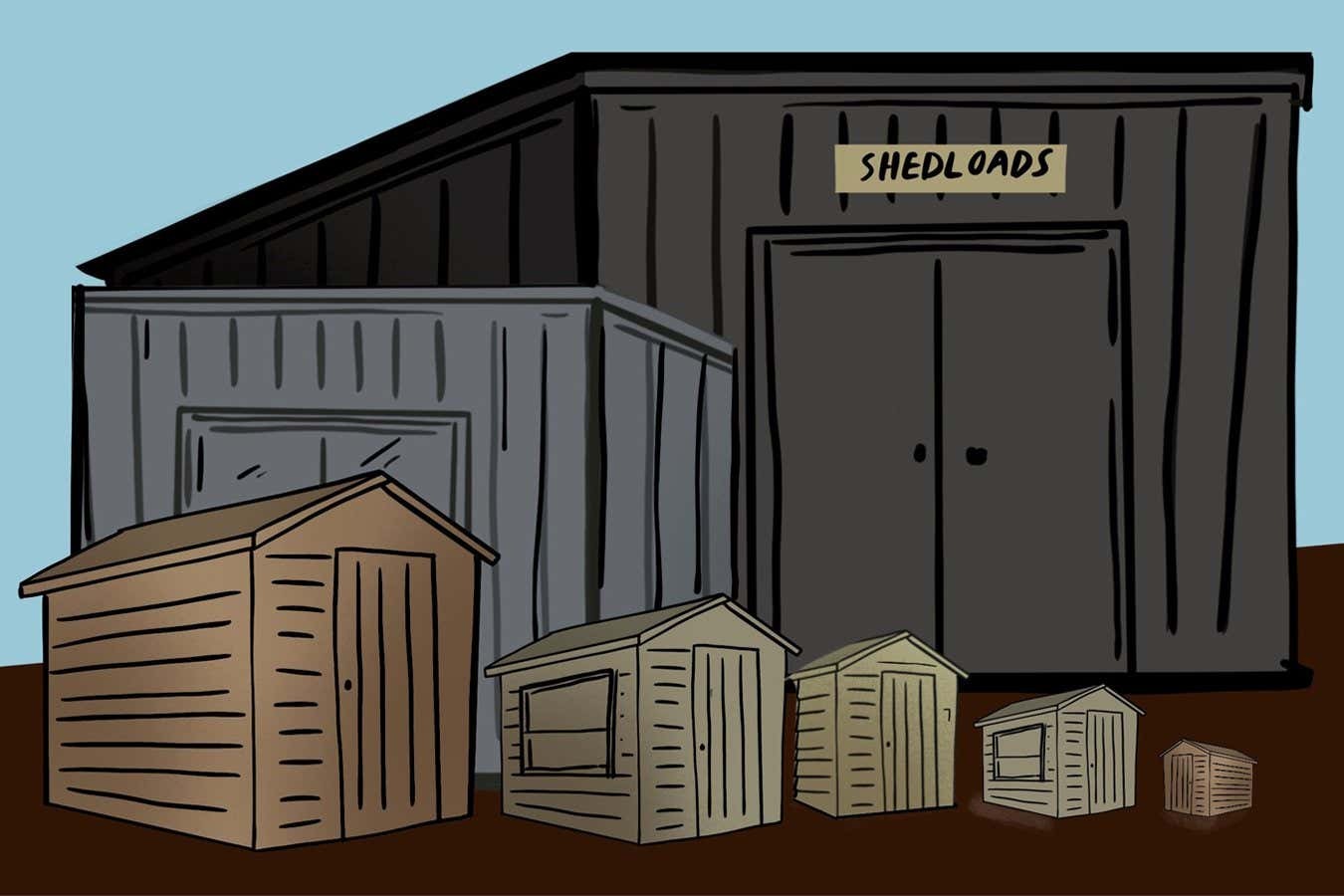
The question of what constitutes a “shedload” of something has ignited a surprisingly heated debate among New Scientist readers. Originally posed as a whimsical query about quantities causing traffic jams, the term has spurred a search for its precise meaning—and led down some unexpectedly scientific rabbit holes.
The Origins of the Term
The discussion began with a reader wondering about the size of the titular “shed” in the phrase “shedload of xxxx.” Responses flooded in, highlighting the inherent ambiguity of such units. One suggestion pointed to lorry accidents: a “shedload” being what’s left after a vehicle sheds its cargo on a motorway. Another proposed an “endogenous relative scaling” (ERS) unit—meaning a shedload is subjective, varying wildly depending on one’s financial situation. For some, £1000 might be a shedload; for others, it’s pocket change.
From Motorways to Particle Physics
Perhaps the most bizarre turn came from a nuclear physicist who revealed that “shed” is actually a real, albeit obscure, unit of measurement in their field. In particle physics, where researchers collide tiny particles, scientists needed a way to describe incredibly small cross-sectional areas. The standard unit is the “barn” (10-28 square meters), roughly the size of a uranium nucleus. However, an even smaller unit exists: the “shed,” defined as 10-24 of a barn.
This is smaller than an “outhouse,” which is 1 millionth of a barn—a baffling hierarchy that raises the question of why physicists would use such counterintuitive terminology. The physicist admitted to being “hazy” on the exact relationship, but confirmed that even a large load of sheds would be far too small to block a motorway.
The Bottom Line
The search for a definitive “shedload” proves that language is often imprecise, especially when dealing with quantities. Whether it refers to cargo on a highway or subatomic particles, the term remains gloriously vague. The core takeaway is that even in science, units can be arbitrary, sometimes hilariously so.