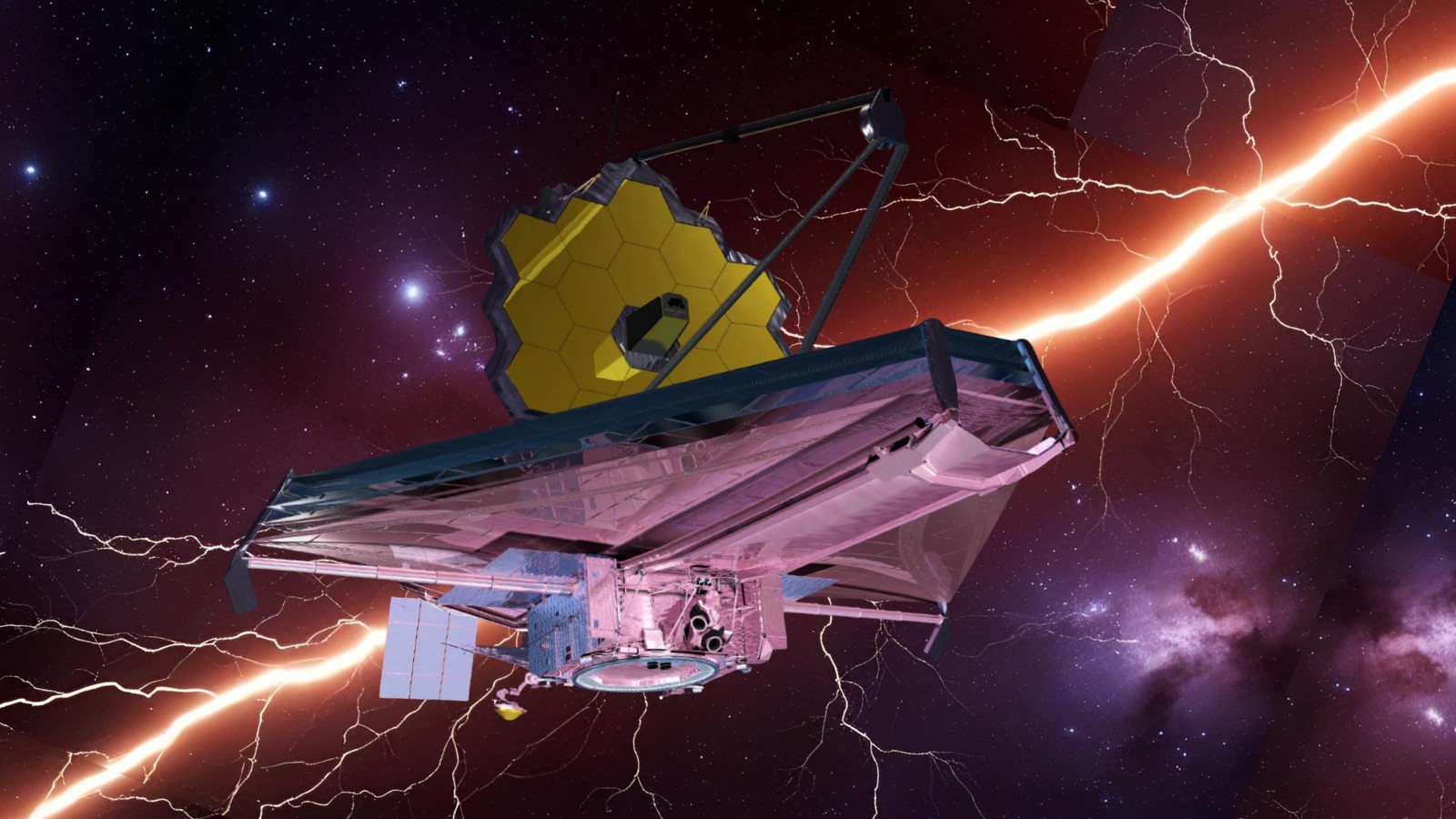
The James Webb Space Telescope (JWST), launched in 2022, has dramatically reshaped our understanding of the early universe. Yet, one of cosmology’s biggest puzzles – the nature of dark matter – has remained elusive. New research suggests the JWST may soon offer a breakthrough, not by directly seeing dark matter (which doesn’t interact with light), but by revealing its gravitational fingerprints on the shapes of ancient galaxies.
Dark matter is estimated to make up 85% of all matter in the universe. The problem is, it doesn’t emit, absorb, or reflect light, making direct detection impossible. Scientists know it exists because of its gravitational effects on visible matter and light. This means dark matter isn’t made of ordinary protons, neutrons, and electrons. Despite decades of searching, hypothetical dark matter particles remain frustratingly unconfirmed.
The new study, published in Nature Astronomy, proposes that the gravitational influence of dark matter could explain the unexpectedly elongated shapes of some young galaxies. Traditionally, simulations assume galaxies form as gas gathers along threads of dark matter, resulting in spherical structures. But the JWST is increasingly observing filamentary, stretched galaxies in the early universe that don’t easily fit this model.
Researchers led by Álvaro Pozo, of the Donostia International Physics Center, tested simulations with different types of dark matter. They found that “fuzzy dark matter” (ultralight particles with wave-like behavior) or “warm dark matter” (faster-moving particles) could explain these odd shapes.
“If ultralight axion particles make up the dark matter, their quantum wave-like behavior would prevent physical scales smaller than a few light-years from forming for a while, contributing to the smooth filamentary behavior that JWST now sees at very large distances,” Pozo explained.
The key is that these alternative dark matter models create smoother filaments than the standard Lambda Cold Dark Matter (LCDM) model. Gas and stars flow along these filaments, resulting in elongated galaxies. The JWST will continue to scan these early galaxies, while researchers refine simulations. Combining these observations with theoretical modeling may finally help solve the mystery of dark matter.
This is a critical step because understanding dark matter isn’t just about completing our cosmological picture; it’s about revealing the fundamental building blocks of the universe. The JWST’s ability to observe the early universe with unprecedented clarity provides the best hope yet for unlocking this decades-old mystery.