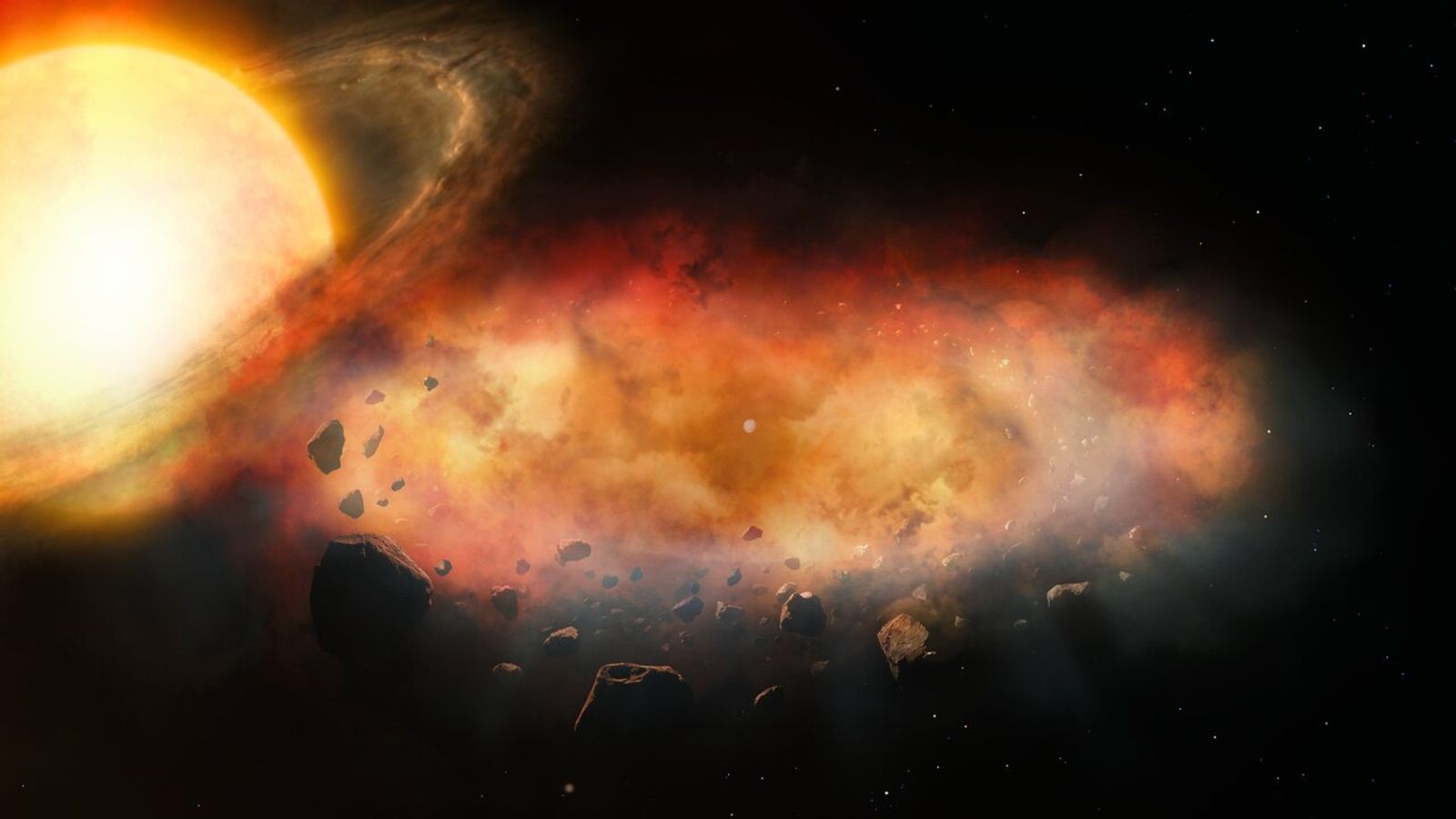
A massive cloud of vaporized metal orbiting a star 3,000 light-years away may conceal a hidden companion – either a giant planet, a low-mass star, or even a brown dwarf. The discovery, detailed in a recent study, raises intriguing questions about the dynamics of planetary systems and the aftermath of catastrophic collisions.
The Unexpected Dimming
In late 2024, astronomers observed J0705+0612, a sun-like star, dimming dramatically. Over nearly nine months, its brightness plummeted to just 3% of its normal level before slowly recovering in May 2025. Such extreme fluctuations are rare, immediately signaling an unusual event. Stars do not simply fade without a reason, making this phenomenon particularly noteworthy.
What the Data Reveals
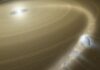
Detailed analysis using the Gemini South and Magellan telescopes revealed a colossal object passing in front of J0705+0612. The object isn’t a typical planet or asteroid belt – it’s a cloud roughly 15,000 times the size of Earth, positioned about halfway between Saturn and Uranus relative to its host star.
The cloud’s composition, probed by the Gemini High-resolution Optical Spectrograph (GHOST), is rich in metals like iron and calcium. This metallic abundance is unusual, and suggests something more than just a natural planetary formation. The cloud’s movements indicate that it’s held together by a substantial central mass.
A Hidden Companion?
The central mass could be one of three possibilities:
– A gas giant significantly larger than Jupiter.
– A low-mass star locked in a binary orbit with J0705+0612.
– A brown dwarf, an object too small to ignite nuclear fusion but too large to be a planet.
The presence of high infrared radiation suggests the central object is more likely a star than a planet. Determining the exact nature of this companion will require further observation. The cloud’s existence challenges existing models of binary systems and circumplanetary disks.
The Origin Story: A Violent Past?
The cloud is estimated to be around 2 billion years old, younger than J0705+0612 (which is approximately 4.6 billion years old). This implies it wasn’t formed alongside the star, but rather afterwards. The leading theory suggests a cataclysmic collision within the system – similar to the event believed to have birthed Earth’s moon. Such an impact would explain both the cloud’s age and its unusual metallic composition.
“This event shows us that even in mature planetary systems, dramatic, large-scale collisions can still occur,” says astrophysicist Nadia Zakamska. “It’s a vivid reminder that the universe is far from static — it’s an ongoing story of creation, destruction, and transformation.”
The next opportunity to observe this system fully will come in 2068, when the cloud is predicted to pass between J0705+0612 and Earth once again. Until then, the mystery of the metal cloud remains a compelling reminder of the violent and dynamic nature of the cosmos.