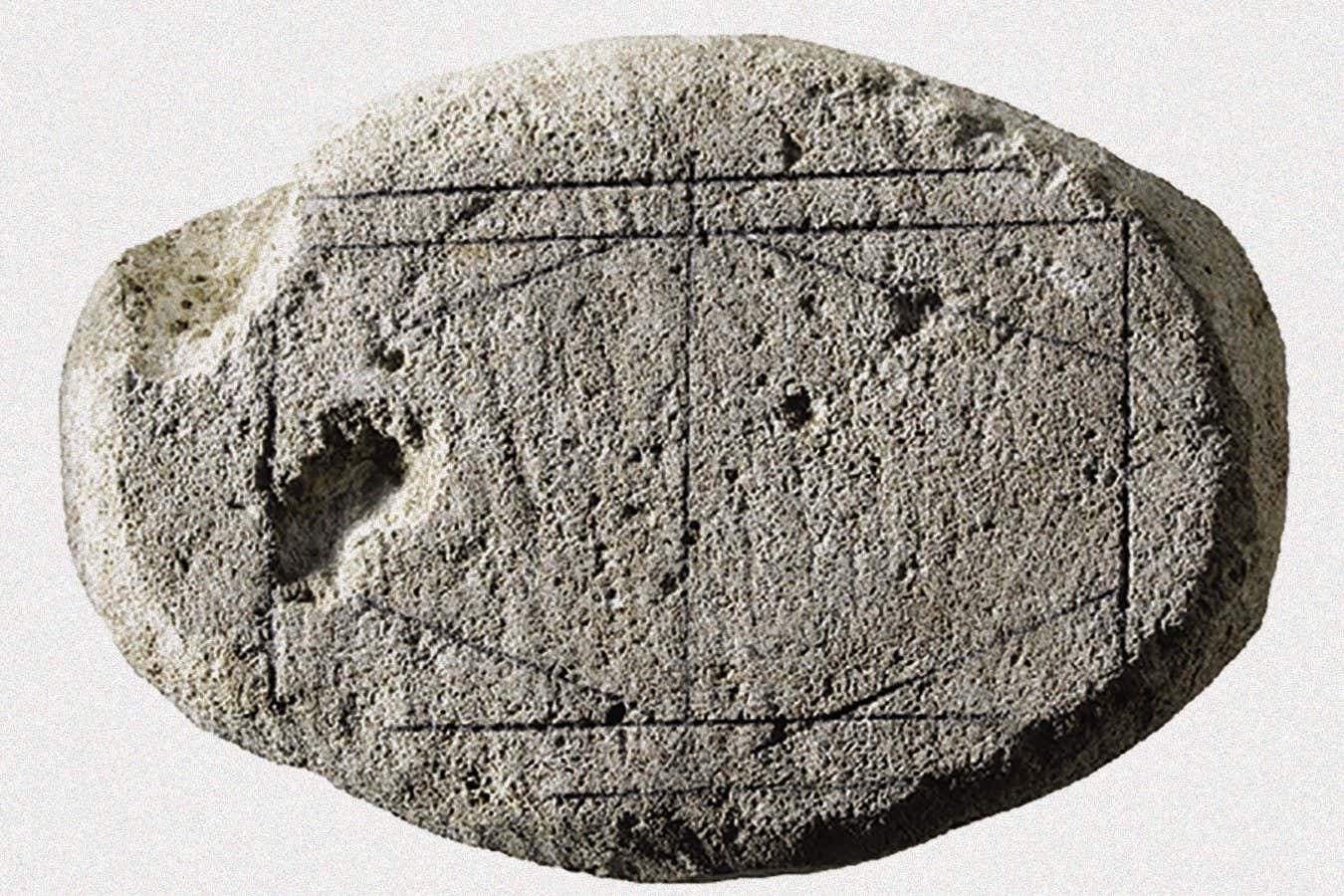
A newly discovered carved stone from the Roman town of Coriovallum (modern-day Heerlen, Netherlands) may represent a previously unknown Roman board game, predating similar games found in Europe by centuries. The finding, made possible through artificial intelligence simulations, suggests the Romans enjoyed complex strategic games beyond the well-documented Ludus latrunculorum or Ludus duodecim scriptorum.
The Discovery
The flat limestone slab, measuring 212 by 145 millimeters, features a unique geometric pattern etched into its surface. Found during excavations at Coriovallum, the stone dates back to AD 250–476, a period when similar limestone was imported from France for architectural decoration. Initial skepticism gave way to curiosity when researcher Walter Crist noticed wear patterns consistent with use as a game board.
AI Reveals Potential Gameplay
To determine if the stone was used for play, Crist’s team employed Ludii, an AI system capable of simulating thousands of game scenarios. The AI tested 130 rule variations from known ancient board games against each other, including Haretavl (Scandinavia) and Gioco dell’orso (Italy). The simulations revealed that nine blocking games — where players compete to trap their opponent — could have caused the distinctive wear pattern observed on the stone.
Implications for Gaming History
The analysis suggests the stone may be a prototype or a game played informally (such as scratched in the dirt), leaving no other traces. If verified, this discovery would push back the documented history of blocking games in Europe by several centuries. Similar games were already known in South and East Asia, but evidence in Europe was limited to later periods.
Debate and Future Research
Not all experts are convinced: some argue the imprecise pattern and lack of similar examples raise doubts. However, researchers like Tim Penn emphasize that combining archaeological finds with AI analysis may unlock further mysteries. Another potential game board from Vindonissa, Switzerland, with an X-shaped grid, could be re-examined using similar techniques.
The discovery highlights how AI can bring new life to historical puzzles. Though conclusive proof may remain elusive, it demonstrates that our understanding of ancient leisure and strategy games is far from complete.