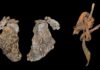
Paleontologists have unearthed a new species of extinct crustacean, Yunnanocyclus fortis, from 251-million-year-old fossils found in Guizhou province, China. This discovery sheds light on a mysterious group of animals known as cyclidans, which thrived for over 200 million years but left behind a sparse fossil record.
A Rare Glimpse into an Ancient Arthropod
Cyclidans first appeared in the Carboniferous period and vanished by the Late Cretaceous. What makes this find significant is the exceptional preservation of the animal’s hard parts, including powerful mandibles – a feature rarely seen in cyclidan fossils. Most previous discoveries consist only of fragmented shells, making this specimen remarkably complete.
What Makes Yunnanocyclus fortis Unique?
The newly identified species is roughly 20mm long and 14mm wide, with a smooth, oval carapace. However, the most striking feature is its robust mandibles, measuring nearly 2mm in length. Micro-X-ray analysis confirms that these jaws were heavily mineralized, suggesting a strong bite force.
This discovery also expands our understanding of cyclidan distribution. Previously, fossils from the Early Triassic period were primarily found in Madagascar and Europe. Yunnanocyclus fortis represents the oldest cyclidan record from the eastern Tethys region, indicating a broader geographical range than previously known.
Evolutionary Insights and the Permian-Triassic Recovery
The analysis of Yunnanocyclus fortis and other cyclidan species reveals a pattern of early diversification followed by a gradual decline in body form variety. This supports the “early burst” model of evolution, where rapid diversification occurs shortly after a group originates, followed by slower changes.
The fossil also contributes to our understanding of ecosystems rebounding after the Permian-Triassic extinction, the largest mass extinction in Earth’s history. The emergence of complex marine life in the Guiyang biota suggests that recovery may have been faster than previously thought. The distribution of cyclidans after the extinction event suggests that decreased environmental gradients across latitudes may have played a role in their spread.
The discovery of Yunnanocyclus fortis provides another glimpse into the recovery and evolution of marine life during one of the most turbulent intervals in Earth’s history.
The research findings are published in Papers in Palaeontology.