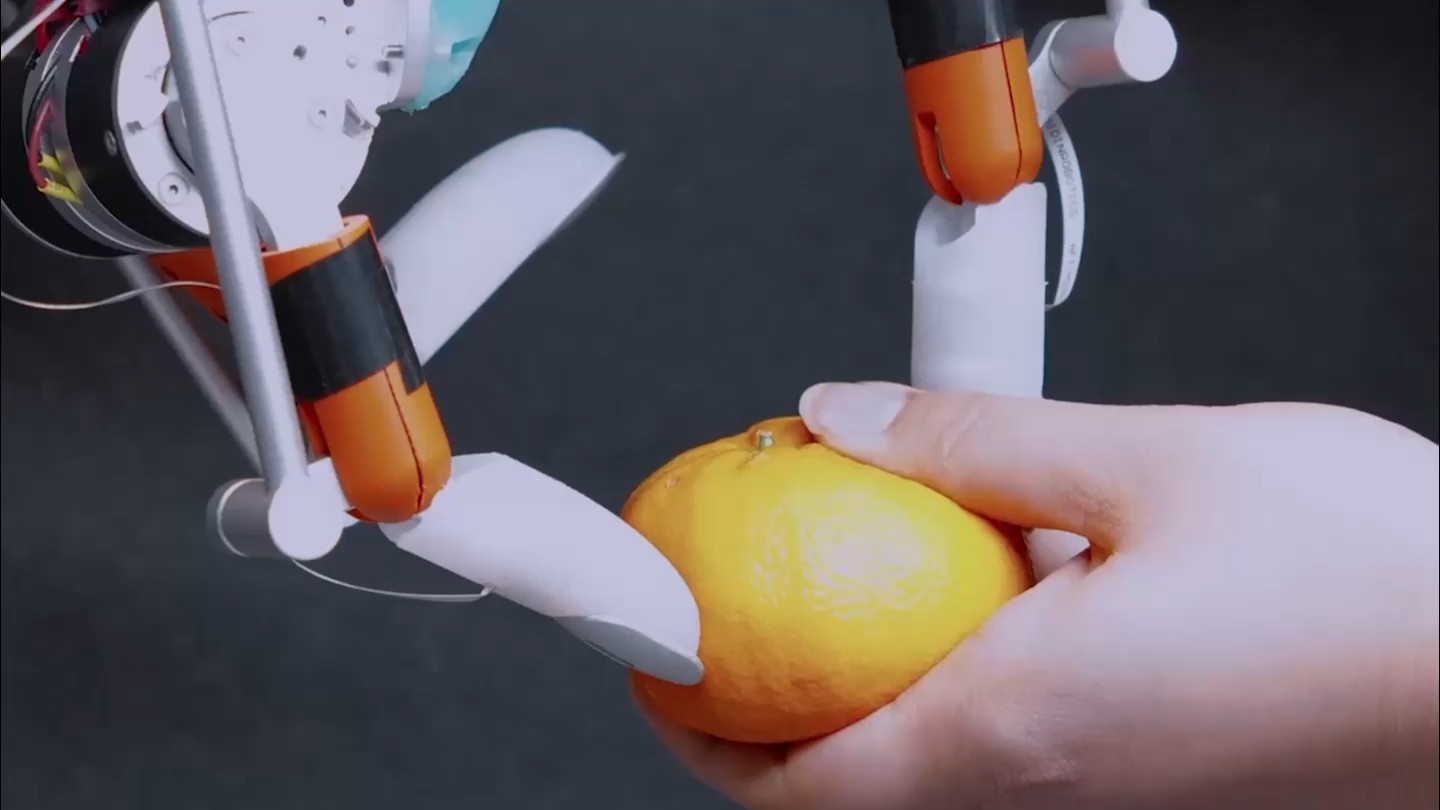
Robotic hands are evolving beyond simple grasping: researchers have developed a new three-fingered design incorporating rigid “fingernails” that significantly improves grip strength and dexterity. This innovation allows robots to handle delicate tasks previously impossible, such as peeling fruit, opening containers, and manipulating thin objects.
The Problem with Soft Grippers
Most robotic grippers rely on soft pads over rigid structures, resulting in a square-shaped fingertip. While effective for direct pressure, this design struggles with twisting or sideways forces, limiting the robot’s ability to adapt to real-world objects. Soft fingertips alone lack the precision needed for many tasks.
The Biomimicry Solution
Inspired by human anatomy, the team at the University of Texas at Austin integrated rigid structures atop soft fingertips, mimicking the function of fingernails. This oval-shaped design stabilizes the grip by focusing pressure and resisting deformation. According to mechanical engineer Dong Ho Kang, “A square shape only adapts well to forces coming straight on, but our design can also respond flexibly to twisting or side forces.”
Testing and Results
Experiments with motorized robotic fingers confirmed the advantages of this design. The fingers with fingernails exhibited a stronger grasping force, particularly when handling curved objects. Without nails, the soft fingertips deformed too easily, resulting in unstable holds. The nail-equipped fingers excelled at tasks that soft fingertips failed entirely: extracting single sheets from stacks, opening sealed containers, and picking up thin items like coins or cards.
What This Means
The development of robotic fingernails represents a critical step towards more versatile and capable robots. The ability to manipulate objects with precision opens doors for applications in manufacturing, logistics, healthcare, and even domestic assistance. Further development to extend this design to full robotic hands will unlock even more possibilities.
These findings suggest that biomimicry – specifically copying the design of human anatomy – remains one of the most effective ways to improve robotic dexterity and adaptability.