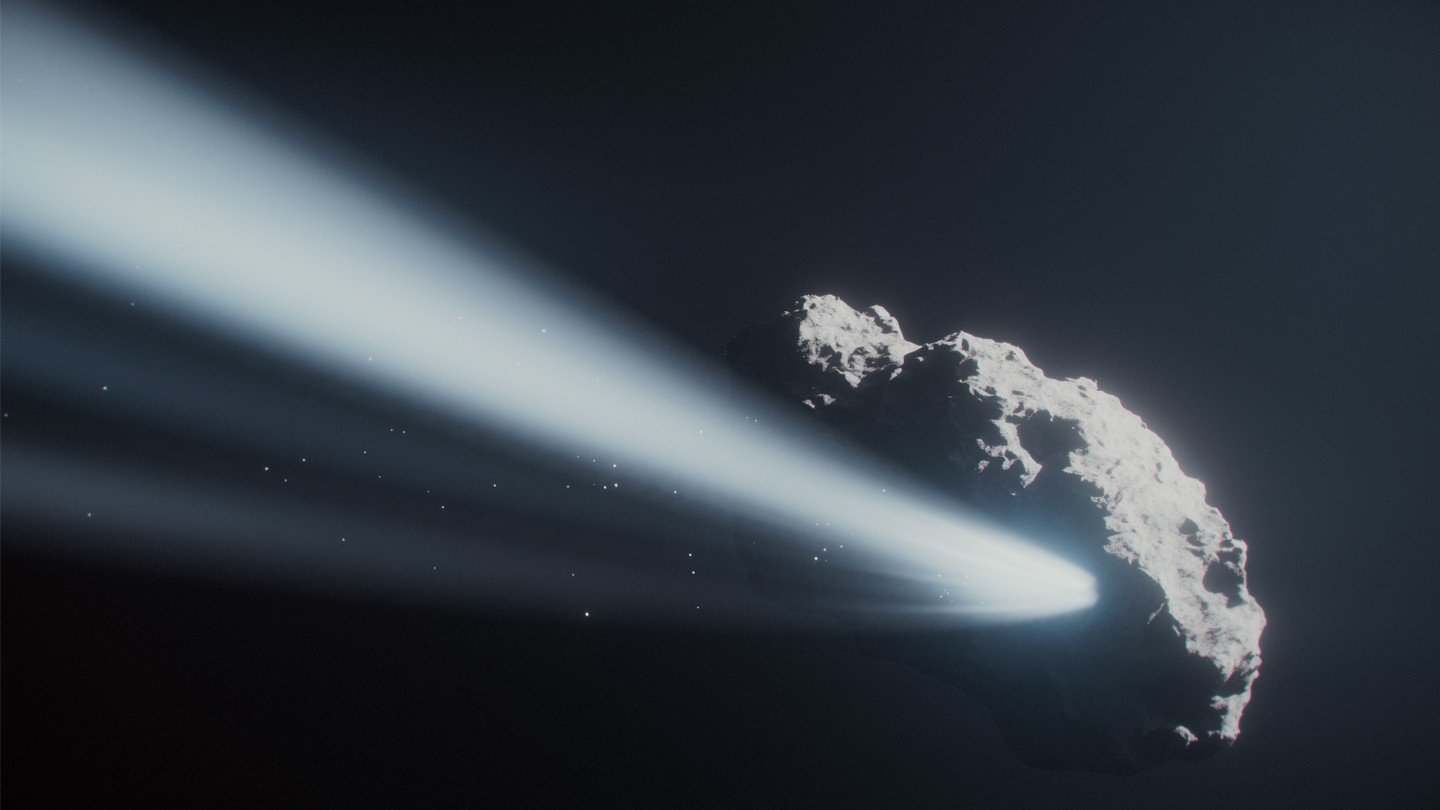
A small comet, 41P/Tuttle-Giacobini-Kresák, has exhibited an unprecedented behavior: it abruptly reversed its spin, a phenomenon that could ultimately tear it apart. This marks the first time such a reversal has been observed, offering insight into why smaller comets are relatively rare in our solar system.
The Unexpected Flip
Between April and December 2017, the comet’s rotation dramatically changed direction, according to astronomer David Jewitt’s research published in the Astronomical Journal. The most likely cause is the release of gases from the comet’s icy surface, which acted as a sort of “thruster,” slowing its spin until it stopped and then reversed.
This isn’t merely a change in speed; it’s a complete flip. Initially rotating every 46 to 60 hours, the comet sped up to complete a rotation in just 14 hours by December, indicating a shift from deceleration to acceleration. This acceleration is the fastest spin change ever recorded for a comet.
Why This Matters: The Fate of Small Comets
The implications are significant. Small comets, those less than a kilometer wide, are inherently unstable. As they lose mass through outgassing (the release of gases from sublimating ice), they spin faster, and faster, until they become centrifugally unstable.
“They spin up so quickly, they’re gone in a relatively short time,” Jewitt explained.
This process explains why we don’t see as many small comets as larger ones: they simply self-destruct before they can persist for long periods.
A History of Instability
Comet 41P assumed its current orbit about 1,500 years ago after a gravitational encounter with Jupiter. It orbits the sun every 5.4 years, bringing it close to Earth and allowing for detailed observation. The recent spin reversal was first detected in May 2017 by NASA’s Neil Gehrels Swift Observatory, where its rotation was observed slowing down. Hubble Space Telescope images in December 2017 confirmed the full reversal.
The heat from the sun sublimates the comet’s ice, releasing gases that act like thrusters, first halting its spin and then pushing it into reverse. This torque-driven process is the most plausible explanation for the observed changes.
In conclusion, comet 41P’s spin reversal is a stark demonstration of the volatile nature of small comets. The process highlights a key reason why these celestial bodies are short-lived, spinning themselves into fragmentation before they can endure in the solar system for extended periods.