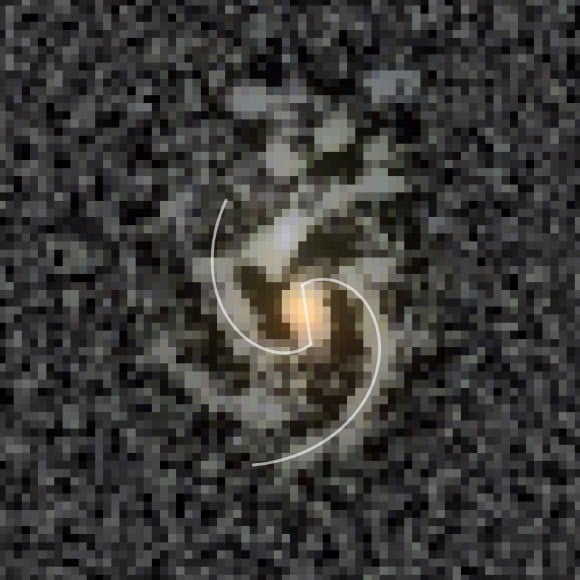
Astronomers have identified one of the earliest barred spiral galaxies ever observed, dating back to just two billion years after the Big Bang. The discovery, made using the James Webb Space Telescope’s Near-InfraRed Camera (NIRCam), challenges existing theories about how quickly galactic structures formed in the early universe.
Discovery of COSMOS-74706
The galaxy, named COSMOS-74706, existed approximately 11.5 billion years ago, making it exceptionally young for a barred spiral. Bars are dense, linear features in the center of galaxies, composed of concentrated stars and gas. They act as conduits, directing material inward toward the galaxy’s central supermassive black hole.
“This galaxy was developing bars two billion years after the birth of the Universe,” said Daniel Ivanov, a graduate student at the University of Pittsburgh, who led the study.
Implications for Galactic Evolution
The presence of a well-defined bar in such an early galaxy is significant. Stellar bars play a crucial role in galactic evolution, funneling gas inward, both fueling black hole growth and suppressing star formation across the galactic disk. Finding one so early suggests these structures might form faster than previously thought.
Previous claims of early barred spirals were less conclusive due to weaker data. Some were based on less precise methods of measuring redshift, while others relied on observations distorted by gravitational lensing – where light bends around massive objects. The COSMOS-74706 galaxy was confirmed using spectroscopy, a more definitive method.
Simulations and Future Research
The discovery aligns with some simulations that predict bars could have formed as early as 12.5 billion years ago (at redshift 5). However, it still remains unusual for this epoch, suggesting the process of bar formation may be more common than previously assumed.
“I wasn’t surprised to find a barred spiral galaxy so early in the Universe’s evolution,” said Ivanov. “But in principle, I think that this is not an epoch in which you expect to find many of these objects.”
The research team presented their findings at the 247th meeting of the American Astronomical Society on January 8. Their study, published under the citation Daniel Ivanov et al. 2026 An Unlensed Barred Spiral at zspec>3, will help constrain timelines for bar formation and refine models of galactic evolution.
The discovery underscores how rapidly structures formed in the early universe, forcing astronomers to rethink assumptions about galactic development.