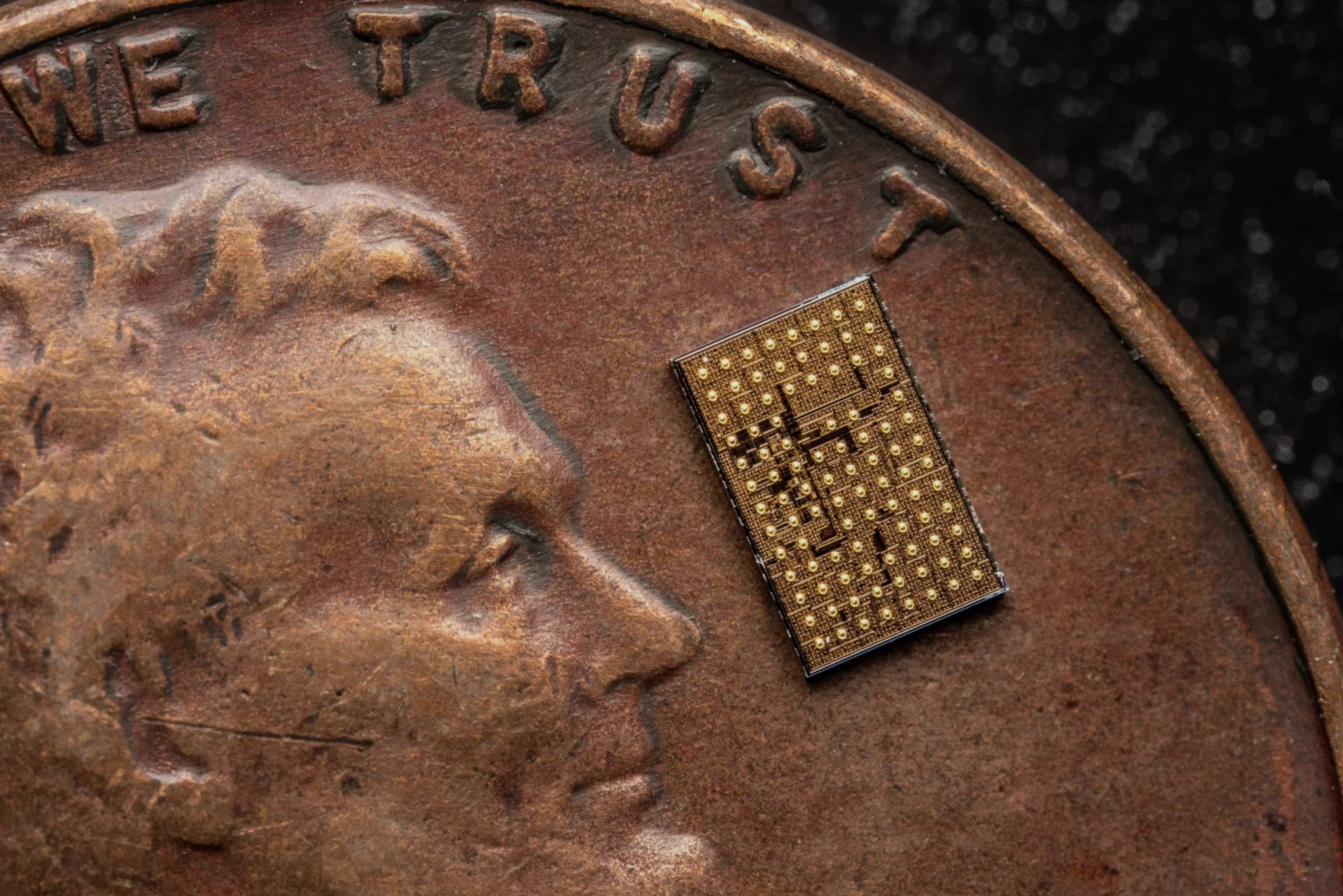
As artificial intelligence and cloud computing explode in popularity, data centers are becoming some of the most energy-intensive facilities on the planet. A significant portion of this energy is lost not in computation, but in power management —specifically, the process of stepping down high-voltage electricity to levels that sensitive chips like GPUs can safely use.
Engineers at the University of California, San Diego (UCSD) have developed a novel chip design that addresses this inefficiency head-on. By replacing traditional magnetic components with piezoelectric resonators, their prototype achieves a peak efficiency of 96.2 percent while delivering significantly more current. This breakthrough could pave the way for smaller, cooler, and more sustainable computing infrastructure.
The Hidden Cost of Power Conversion
Modern data centers typically distribute electricity at 48 volts. However, the graphics processing units (GPUs) and other computing hardware inside these servers require much lower voltages, usually between 1 and 5 volts. Bridging this gap requires a component known as a DC-DC step-down converter.
Think of these converters as the traffic controllers of electricity. They take the high-pressure flow of incoming power and regulate it into a gentle stream suitable for delicate circuits. Without them, hardware would be destroyed by voltage spikes. With them, however, there is a cost: energy loss.
Traditional converters rely on magnetic components, primarily inductors. While effective, these magnetic parts are bulky, generate heat, and are hitting a “performance wall.” As computing systems become denser and more powerful, the physical size of these magnetic components becomes a bottleneck, and their efficiency struggles to keep up with the massive voltage drops required.
“We’ve gotten so good at designing inductive converters that there’s not really much room left to improve them to meet future needs,” said Patrick Mercier, senior author of the study and professor in the Department of Electrical and Computer Engineering at UC San Diego.
A Mechanical Alternative to Magnetic Fields
To break through this limitation, Mercier and his team, including lead author Jae-Young Ko, looked beyond magnetism. They turned to piezoelectric resonators —tiny devices that store and transfer energy through mechanical vibrations rather than magnetic fields.
Piezoelectric materials have long been used in applications like quartz watches and ultrasonic sensors. In the context of power conversion, they offer several theoretical advantages:
* Higher energy density: More power in a smaller package.
* Improved efficiency: Less energy lost as heat.
* Scalability: Easier to manufacture at small scales using existing semiconductor processes.
However, previous attempts to use piezoelectric converters for large voltage drops failed. They struggled to maintain efficiency and could not deliver enough current to power modern high-performance chips.
The Hybrid Solution
The UCSD team’s innovation lies in a hybrid circuit design. Instead of relying solely on piezoelectric resonators, they combined them with small, commercially available capacitors arranged in a specific configuration.
This hybrid approach creates multiple pathways for power to flow through the circuit. The result is a system that:
1. Reduces wasted energy by minimizing resistance.
2. Lowers the load on the piezoelectric resonator, preventing it from being overwhelmed.
3. Delivers higher current output.
In laboratory tests, the prototype successfully converted 48 volts down to 4.8 volts —a standard requirement for data center hardware. The chip achieved a peak efficiency of 96.2 percent and delivered approximately four times more output current than earlier piezoelectric-based designs.
Why This Matters for the Future of Computing
The implications of this technology extend beyond just better chips. As the global demand for AI processing grows, so does the environmental footprint of data centers. Improving power conversion efficiency directly translates to:
* Lower electricity bills for cloud providers.
* Reduced cooling requirements, since less wasted energy means less heat generation.
* Smaller hardware footprints, allowing for denser server racks and more efficient use of space.
Challenges Ahead
Despite the promising results, piezoelectric converters are not yet ready to replace traditional magnetic designs in commercial products. One significant hurdle is integration. Because piezoelectric resonators vibrate during operation, they cannot be attached to circuit boards using standard soldering techniques. Vibration can cause mechanical failure or connection issues over time.
Future research will focus on:
* Developing new packaging methods to secure vibrating components.
* Refining materials to enhance durability and performance.
* Optimizing circuit designs for broader voltage ranges.
“Piezoelectric-based converters aren’t quite ready to replace existing power converter technologies yet,” Mercier noted. “But they offer a trajectory for improvement. We need to continue to improve on multiple areas — materials, circuits, and packaging — to make this technology ready for data center applications.”
Conclusion
The UC San Diego team’s hybrid chip represents a significant step forward in power electronics. By leveraging mechanical vibrations instead of magnetic fields, it offers a path to more efficient, compact, and sustainable computing systems. While engineering challenges remain, this technology could soon help alleviate the energy burden of the world’s growing digital infrastructure.
This research was supported by the Power Management Integration Center (PMIC), an Industry-University Cooperative Research Center funded by the National Science Foundation (award number 2052809). The findings were published in Nature Communications under the title “A hybrid piezoelectric resonator-based DC-DC converter.”